

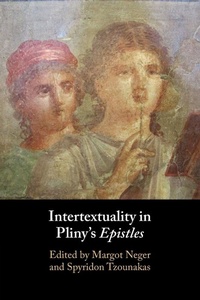
Intertextuality in Pliny's Epistles
Published on 11. September 2025
Book
Paperback/Softback
356 pages
978-1-009-29479-9 (ISBN)
Description
Pliny's Epistles are full of literary artistry. This volume of essays by an impressive international team of scholars showcases this by exploring the intertextual, interdiscursive and also intermedial character of the collection. It provides a contribution to the recent scholarly interest in Latin prose intertextuality and in the literary and cultural interactions of the Imperial period. Focusing on the whole collection as well as on single books and selected letters, it investigates Pliny's strategies of incorporating literary models and genres into his epistolary oeuvre, thus creating a kind of 'super-genre' himself. In addition to displaying Pliny's literary techniques, the volume also serves as an advanced introduction to Latin prose poetics.
Reviews / Votes
'... a set of lucidly written essays that refine our understanding of intertextuality in the Epistles, and indeed of intertextuality more generally.' George Pliotis, Bryn Mawr Classical ReviewMore details
Language
English
Place of publication
Cambridge
United Kingdom
Product notice
Paperback (trade)
Illustrations
Worked examples or Exercises
Dimensions
Height: 228 mm
Width: 153 mm
Thickness: 22 mm
Weight
528 gr
ISBN-13
978-1-009-29479-9 (9781009294799)
Copyright in bibliographic data and cover images is held by Nielsen Book Services Limited or by the publishers or by their respective licensors: all rights reserved.
Schweitzer Classification
Persons
Margot Neger is an Assistant Professor of Latin at the University of Cyprus. She has published monographs on Martial and Pliny the Younger as well as articles and chapters on ancient epigram, epistolography and late antique literature. Spyridon Tzounakas is an Associate Professor of Latin at the University of Cyprus. His main research and publications focus on Roman satire, Roman epistolography, Roman epic, Roman elegy, Cicero's orations, and Roman intertextuality. He is currently working on a monograph on Persius.
Content
Introduction Margot Neger and Spyridon Tzounakas; Part I. Intertextuality and Interdiscursivity in Pliny's Letters: 1. Pliny, Man of Many Parts (Lucretius, Cicero, Valerius Maximus, Tacitus) Christopher Whitton; 2. Intertextuality in Pliny Epistles 6 Roy Gibson; 3. Discourses of Authority in Pliny, Epistles 10 Alice Koenig; Part II. Models and Anti-Models: Pliny's Interaction with Oratory and Natural History; 4. Oratorical Speeches and the Political Elite in the Regulus Cycle Matthew Mordue; 5. Again on Corinthian Bronzes and Vases and on the Use of Cicero's Verrine Orations in Pliny's Works Stefano Rocchi; 6. The Elder Pliny as source of inspiration: Pliny the Younger's reception of the Naturalis Historia and his uncle's writing by the light of a lamp (lucubratio) Judith Hindermann; Part III. Pliny and Seneca: Discourses of Grief and Posthumous Reputation; 7. Pliny's Seneca and the Intertextuality of Grief Michael Hanaghan; 8. Intertextuality and Posthumous Reputation in Pliny's Letter on the Death of Silius Italicus (Plin. Ep. 3.7) Spyridon Tzounakas; Part IV. Pliny's Villas and their Poetic Models: 9. The Villa and the Monument: Horace in Plin. Ep. 1.3 Alberto Canobbio; 10. The Villas of Pliny and Statius Christopher Chinn; Part V. Pliny Turns Nasty: Satire and the Scoptic Tradition; 11. A Busy Day in Rome: Pliny Ep. 1.9 Satirized by Horace Sat. 1.9 Abel Tamas; 12. Putting Pallas out of Context: Pliny on the Roman Senate voting Honours to a Freedman (Ep. 7.29 and 8.6) Jakub Pigon; 13. Risus et indignatio: Scoptic Elements in Pliny's Letters Margot Neger; Part VI. Final Thoughts: Discourses of Representation and Reproduction; 14. Pliny's Calpurnia: Filiation, Imitation, Allusion Ilaria Marchesi.