

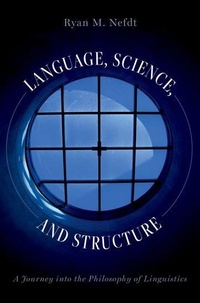
Language, Science, and Structure
A Journey into the Philosophy of Linguistics
Published on 14. June 2023
Book
Hardback
256 pages
978-0-19-765309-8 (ISBN)
Description
What is a language? What do scientific grammars tell us about the structure of individual languages and human language in general? What kind of science is linguistics? These and other questions are the subject of Ryan M. Nefdt's Language, Science, and Structure.
Linguistics presents a unique and challenging subject matter for the philosophy of science. As a special science, its formalisation and naturalisation inspired what many consider to be a scientific revolution in the study of mind and language. Yet radical internal theory change, multiple competing frameworks, and issues of modelling and realism have largely gone unaddressed in the field. Nefdt develops a structural realist perspective on the philosophy of linguistics which aims to confront the aforementioned topics in new ways while expanding the outlook toward new scientific connections and novel philosophical insights. On this view, languages are real patterns which emerge from complex biological systems. Nefdt's exploration of this novel view will be especially valuable to those working in formal and computational linguistics, cognitive science, and the philosophies of science, mathematics, and language.
Linguistics presents a unique and challenging subject matter for the philosophy of science. As a special science, its formalisation and naturalisation inspired what many consider to be a scientific revolution in the study of mind and language. Yet radical internal theory change, multiple competing frameworks, and issues of modelling and realism have largely gone unaddressed in the field. Nefdt develops a structural realist perspective on the philosophy of linguistics which aims to confront the aforementioned topics in new ways while expanding the outlook toward new scientific connections and novel philosophical insights. On this view, languages are real patterns which emerge from complex biological systems. Nefdt's exploration of this novel view will be especially valuable to those working in formal and computational linguistics, cognitive science, and the philosophies of science, mathematics, and language.
Reviews / Votes
A impressive achievement. Integrating work in the philosophy of science with wide-ranging knowledge of linguistic theory and contemporary cognitive science, this book provides both an evaluation of traditional debates within the philosophy of linguistics as well as a proposal for how it ought to be done in the future... This is a highly engaging book, rich with insight and packed with empirical and conceptual detail. Those working in philosophy of linguistics must read it, those in other areas merely should. * Gabriel Dupre, Philosophical Quarterly * Overall, Nefdt's book is an impressive tour de force, which will hopefully stimulate more interest in linguistics from philosophers of science. From a linguistic perspective, the book offers some conciliation against the apparent chaos of competing formalisms, but, more importantly, the reconceptualization of the subject matter could inform novel, and less isolationist, research programs in the field. * Adam James Ross Tallman, Philosophy of Science * Language, Science, and Structure by Ryan Nefdt mounts an impressive and noveldefense of a type of structuralism about both languages and linguistic entities likewords. * David Liebesman, De Gruyter * The book can be recommended to linguists who are striving to obtain an insight into the foundational problems of their discipline as well as to philosophers of science interested in general principles of scientific inquiry. It can provide both groups with an at least partial understanding of why several decades ago linguistics seemed to be one of the driving forces of scientific progress in the human sciences, the social sciences, the cognitive sciences as well as the computer sciences; why this impact eroded over the years; and why the author's approach might be evaluated as an attempt to assign linguistics a substantive role in shaping our knowledge of language, the mind and the formal tools describing them. * Andras Kertesz, Argumentum * ..the book is a great success, introducing a fresh perspective on the study of language that future researchers will be compelled to consider. * Christopher Viger, BJPS Review of Books * Nefdt's aim to marry realism and the spirit of pluralism is exciting, and in a landscape of diversifying approaches in the language sciences promises to be a highly fruitful approach to natural language ontology. This work rightly deserves to be considered a central text in a broader move towards characterizing philosophy of linguistics by the lights of the philosophy of science. It ought to be read by linguists and philosophers alike. * Kate Hazel Stanton, Analysis *More details
Language
English
Place of publication
New York
United States
Product notice
sewn/stitched
Cloth over boards
Dimensions
Height: 237 mm
Width: 157 mm
Thickness: 22 mm
Weight
480 gr
ISBN-13
978-0-19-765309-8 (9780197653098)
Copyright in bibliographic data and cover images is held by Nielsen Book Services Limited or by the publishers or by their respective licensors: all rights reserved.
Schweitzer Classification
Other editions
Additional editions
E-Book
04/2023
OUP eBook
€53.99
Available for download
E-Book
04/2023
OUP eBook
€53.99
Available for download
Person
Ryan M. Nefdt is a philosopher of science who works on issues in linguistics, cognitive science, and AI at the University of Cape Town, South Africa. He holds a PhD in Philosophy from the University of St Andrews, an MSc in Logic from the University of Amsterdam and an MA in Philosophy from the University of Cape Town. He has held research positions at various institutions such as MIT, Pittsburgh, Edinburgh, Minnesota, Yale, and Michigan and is published in numerous journals including Linguistics & Philosophy, Mind & Language, Biology & Philosophy, Synthese, Philosophy Compass, and the Stanford Encyclopedia of Philosophy.
Content
Acknowledgements
Preface Part 1: Introduction
1.1 The Philosophy of Linguistics 1.2 Generative and Non-Generative Frameworks 1.3 Structures and Structuralisms 1.4 A Guide to the Book Part 2: Old Landscapes, New Maps
2.1 What is a Language, Anyway? 2.2 Object-oriented accounts 2.3 State and Network accounts Part 3: The Many and the None
3.1 Anti-realist Accounts 3.2 Why I am not a Pluralist 3.3 No Country for Clear Resolutions Part 4: Language and Structure
4.1 Moderate Naturalism 4.2 Languages as Real Patterns 4.3 Grammars as Compression Algorithms Part 5: Linguistic Patterns and Biological Systems
5.1 Biolinguistics and Biology 5.2 Unbanishing the 'Linguistic Community'
5.3 A Note on Acquisition Part 6: A Case Study: Words and SLEs
6.1 The Naive Picture and Three Naturalistic Desiderata
6.2 Constructions and Constraints 6.3 A Structural Approach to Linguistic Entities Part 7: Structural Realism and the Science of Linguistics
7.1 The Aim and Scope 7.2 Linguistic Theory Change 7.3 Structural Realism in Generative Linguistics 7.4 The Problem of Multiple Grammars Part 8: Language at the Interface
8.1 A Note on Complex Systems 8.2 Levels of Abstraction 8.3 The Proposal 8.4 Semantic Metastructuralism Part 9: Language and Cognitive Science: an arranged marriage 9.1 The Dilemma 9.2 The Study of Mind in Language 9.3 Intersection, Integration, and Architecture 9.4 Unifying Cognitive Structures Conclusion: A Canopy in the Rainforest References
Preface Part 1: Introduction
1.1 The Philosophy of Linguistics 1.2 Generative and Non-Generative Frameworks 1.3 Structures and Structuralisms 1.4 A Guide to the Book Part 2: Old Landscapes, New Maps
2.1 What is a Language, Anyway? 2.2 Object-oriented accounts 2.3 State and Network accounts Part 3: The Many and the None
3.1 Anti-realist Accounts 3.2 Why I am not a Pluralist 3.3 No Country for Clear Resolutions Part 4: Language and Structure
4.1 Moderate Naturalism 4.2 Languages as Real Patterns 4.3 Grammars as Compression Algorithms Part 5: Linguistic Patterns and Biological Systems
5.1 Biolinguistics and Biology 5.2 Unbanishing the 'Linguistic Community'
5.3 A Note on Acquisition Part 6: A Case Study: Words and SLEs
6.1 The Naive Picture and Three Naturalistic Desiderata
6.2 Constructions and Constraints 6.3 A Structural Approach to Linguistic Entities Part 7: Structural Realism and the Science of Linguistics
7.1 The Aim and Scope 7.2 Linguistic Theory Change 7.3 Structural Realism in Generative Linguistics 7.4 The Problem of Multiple Grammars Part 8: Language at the Interface
8.1 A Note on Complex Systems 8.2 Levels of Abstraction 8.3 The Proposal 8.4 Semantic Metastructuralism Part 9: Language and Cognitive Science: an arranged marriage 9.1 The Dilemma 9.2 The Study of Mind in Language 9.3 Intersection, Integration, and Architecture 9.4 Unifying Cognitive Structures Conclusion: A Canopy in the Rainforest References