

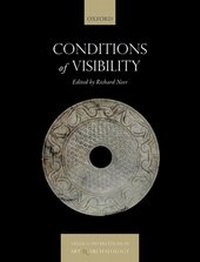
Conditions of Visibility
Published on 5. September 2019
Book
Hardback
168 pages
978-0-19-884556-0 (ISBN)
Description
We often assume that works of visual art are meant to be seen. Yet that assumption may be a modern prejudice. The ancient world - from China to Greece, Rome to Mexico - provides many examples of statues, paintings, and other images that were not intended to be visible. Instead of being displayed, they were hidden, buried, or otherwise obscured. In this third volume in the Visual Conversations in Art & Archaeology series, leading scholars working at the intersection of archaeology and the history of art address the fundamental question of art's visibility. What conditions must be met, what has to be in place, for a work of art to be seen at all? The answer is both historical and methodological; it concerns ancient societies and modern disciplines, and encompasses material circumstances, perceptual capacities, technologies of visualization, protocols of classification, and a great deal more.
The emerging field of archaeological art history is uniquely suited to address such questions. Intrinsically comparative, this approach cuts across traditional ethnic, religious, and chronological categories to confront the academic present with the historical past. The goal is to produce a new art history that is at once cosmopolitan in method and global in scope, and in doing so establish new ways of seeing - new conditions of visibility - for shared objects of study.
The emerging field of archaeological art history is uniquely suited to address such questions. Intrinsically comparative, this approach cuts across traditional ethnic, religious, and chronological categories to confront the academic present with the historical past. The goal is to produce a new art history that is at once cosmopolitan in method and global in scope, and in doing so establish new ways of seeing - new conditions of visibility - for shared objects of study.
Reviews / Votes
A persuasive case for how to go about 'global art history' in the twenty-first century. * Michael Squire, Greece & Rome *More details
Series
Language
English
Place of publication
Oxford
United Kingdom
Target group
Professional and scholarly
Dimensions
Height: 253 mm
Width: 197 mm
Thickness: 17 mm
Weight
592 gr
ISBN-13
978-0-19-884556-0 (9780198845560)
Copyright in bibliographic data and cover images is held by Nielsen Book Services Limited or by the publishers or by their respective licensors: all rights reserved.
Schweitzer Classification
Other editions
Additional editions
Richard Neer
Conditions of Visibility
E-Book
09/2019
1st Edition
OUP eBook
€14.99
Available for download
Richard Neer
Conditions of Visibility
E-Book
09/2019
1st Edition
OUP eBook
€20.99
Available for download
Person
Richard Neer is William B. Ogden Distinguished Service Professor of Art History, Cinema & Media Studies, and the College, at the University of Chicago. He works at the intersection of aesthetics, archaeology, and history, with particular emphasis on theories of style in the fields of Classical Greek sculpture, neo-Classical French painting, and mid-twentieth-century cinema. He has received fellowships and awards from the J. Paul Getty Museum, the Center for Advanced Study in the Visual Arts, the J. Paul Getty Trust, and the American Academy in Rome. His most recent books are The Emergence of the Classical Style in Greek Sculpture (University of Chicago Press, 2010) and Art and Archaeology of the Greek World: A New History, c. 2500-c. 150 BCE (Thames & Hudson, 2012). Since 2010 he has also been the Executive Editor of Critical Inquiry.
Content
Richard Neer: Introduction
1: Richard Neer: Three Types of Invisibility: The Akropolis of Athens
2: Claudia Brittenham: What Lies Beneath: Carving on the Underside of Aztec Sculpture
3: Ja's Elsner: Concealment and Revelation: The Pola Casket and the Visuality of Early Christian Relics
4: Wu Hung: The Archaeology of Passage: Reading Invisibility in Chinese Tombs
1: Richard Neer: Three Types of Invisibility: The Akropolis of Athens
2: Claudia Brittenham: What Lies Beneath: Carving on the Underside of Aztec Sculpture
3: Ja's Elsner: Concealment and Revelation: The Pola Casket and the Visuality of Early Christian Relics
4: Wu Hung: The Archaeology of Passage: Reading Invisibility in Chinese Tombs