

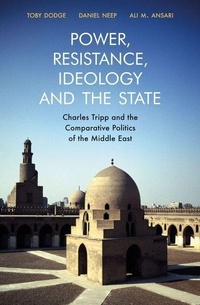
Power, Resistance, Ideology and the State
Charles Tripp and the Comparative Politics of the Middle East
Published on 8. May 2025
Book
Hardback
296 pages
978-1-914983-30-6 (ISBN)
Description
The work of Charles Tripp - professor at the School of Oriental and African Studies (SOAS) for over three decades - has shaped a distinct approach to the study of Middle East politics: an analytical sensibility that is empirically rich, theoretically insightful, and historically sensitive.
Power, Resistance, Ideology and the State brings together contributions from ten political scientists and historians from across Europe, the United States, and the Middle East, each of which takes Tripp's work as an intellectual point of departure for studying politics in the region. The contributions focus on four central themes - power, resistance, ideology and the state - that are central in the field of Middle East politics as a means of examining political trends in cases ranging from Iran and Iraq to Jordan, Lebanon and Syria. Each chapter combines extensive field research and a knowledge of regional politics with methodological and philosophical reflexivity to produce a collection of papers at the cutting edge of contemporary Middle East Studies.
This volume seeks to present a new understanding of a region of unprecedented volatility, where post-colonial projects of state-driven development have now expired, old ruling elites have been delegitimised, and political Islam discredited. Against this background, the contributors explore the contemporary developments that have emerged to fill the intellectual and material shortcomings created by the systemic failures of economics and politics in the region. Examining topics such as the rise of elite-promoted sectarianism in Iraq, thwarted attempts to manage neoliberalism in Lebanon, and new grassroots social movements in Syria, Power, Resistance, Ideology and the State offers an essential addition to the exploration of the politics of today's Middle East.
Power, Resistance, Ideology and the State brings together contributions from ten political scientists and historians from across Europe, the United States, and the Middle East, each of which takes Tripp's work as an intellectual point of departure for studying politics in the region. The contributions focus on four central themes - power, resistance, ideology and the state - that are central in the field of Middle East politics as a means of examining political trends in cases ranging from Iran and Iraq to Jordan, Lebanon and Syria. Each chapter combines extensive field research and a knowledge of regional politics with methodological and philosophical reflexivity to produce a collection of papers at the cutting edge of contemporary Middle East Studies.
This volume seeks to present a new understanding of a region of unprecedented volatility, where post-colonial projects of state-driven development have now expired, old ruling elites have been delegitimised, and political Islam discredited. Against this background, the contributors explore the contemporary developments that have emerged to fill the intellectual and material shortcomings created by the systemic failures of economics and politics in the region. Examining topics such as the rise of elite-promoted sectarianism in Iraq, thwarted attempts to manage neoliberalism in Lebanon, and new grassroots social movements in Syria, Power, Resistance, Ideology and the State offers an essential addition to the exploration of the politics of today's Middle East.
More details
Series
Language
English
Place of publication
London
United Kingdom
Target group
Professional and scholarly
Reading Age: From 18 years
Product notice
With printed dust jacket
Dimensions
Height: 236 mm
Width: 156 mm
Thickness: 30 mm
Weight
499 gr
ISBN-13
978-1-914983-30-6 (9781914983306)
Copyright in bibliographic data and cover images is held by Nielsen Book Services Limited or by the publishers or by their respective licensors: all rights reserved.
Schweitzer Classification
Persons
Charles Tripp is Emeritus Professor of Politics with reference to the Middle East at the School of Oriental and African Studies (SOAS), University of London. In 2012, he was elected a Fellow of the British Academy (FBA), the United Kingdom's national academy for the humanities and social sciences. From 2018 to 2022, he was Vice-President (British International Research Institutes) of the British Academy. From 1995 to 2008 Professor Tripp was also the General Editor of the Cambridge Middle East Studies Series. He is the author of numerous books and articles including 1996: Iran-Saudi Arabia Relations and Regional Order (1996), Islam and the Moral Economy: The Challenge of Capitalism (2006), A Short History of Iraq (2007), and The Power and the People: Paths of Resistance in the Middle East (2013).
Toby Dodge is Professor of International Relations and Kuwait Professor at the London School of Economics and Political Science. His works include Inventing Iraq: The Failure of Nation Building and History Denied and Iraq: from War to a New Authoritarianism.
Daniel Neep is non-resident fellow at the Crown Center for Middle East Studies, Brandeis University. He is the author of Occupying Syria under the French Mandate: Insurgency, Space and State Formation. His research has been published in International Affairs, New Political Economy, and The Journal of Historical Sociology.
Ali M. Ansari is Professor of Modern History with reference to Iran at St Andrews University. He is the author of works including Iran, Islam and Democracy: The Politics of Managing Change and The Politics of Nationalism in Modern Iran.
Contributors:
Hannes Baumann, Lecturer, Department of Politics, University of Liverpool
Louise Fawcett, Professor of International Relations and Fellow of St Catherine's College, University of Oxford.
Toby Matthiesen, Senior Lecturer in Global Religious Studies at the University of Bristol.
Jamil Mouawad, Max Weber Fellow, European University Institute.
Evaleila Pesaran, College Lecturer and Fellow in Politics and International Relations, Murray Edwards College, University of Cambridge.
Aurora Sottimano, Senior Fellow, Centre for Syrian Studies, St Andrews University.
Benjamin Schuetze, Postdoctoral research fellow, University of Freiburg.
Toby Dodge is Professor of International Relations and Kuwait Professor at the London School of Economics and Political Science. His works include Inventing Iraq: The Failure of Nation Building and History Denied and Iraq: from War to a New Authoritarianism.
Daniel Neep is non-resident fellow at the Crown Center for Middle East Studies, Brandeis University. He is the author of Occupying Syria under the French Mandate: Insurgency, Space and State Formation. His research has been published in International Affairs, New Political Economy, and The Journal of Historical Sociology.
Ali M. Ansari is Professor of Modern History with reference to Iran at St Andrews University. He is the author of works including Iran, Islam and Democracy: The Politics of Managing Change and The Politics of Nationalism in Modern Iran.
Contributors:
Hannes Baumann, Lecturer, Department of Politics, University of Liverpool
Louise Fawcett, Professor of International Relations and Fellow of St Catherine's College, University of Oxford.
Toby Matthiesen, Senior Lecturer in Global Religious Studies at the University of Bristol.
Jamil Mouawad, Max Weber Fellow, European University Institute.
Evaleila Pesaran, College Lecturer and Fellow in Politics and International Relations, Murray Edwards College, University of Cambridge.
Aurora Sottimano, Senior Fellow, Centre for Syrian Studies, St Andrews University.
Benjamin Schuetze, Postdoctoral research fellow, University of Freiburg.
Content
1. Symbolic Politics and Secular Logics in the Middle East and
North Africa: Charles Tripp as Social Theorist 1
Daniel Neep
2. States, Elites, and the Management of Change in Beirut's
Post-Civil War Reconstruction 29
Hannes Baumann
3. Digital Entrepreneurs and State Resilience under Sanctions
in Iran 55
Evaleila Pesaran
4. 'My Dream and My Country Walked Away from Each Other':
Youth, Education and Political Agency in Asad's Syria 83
Aurora Sottimano
5. Performing the Jordanian State: Intervention, Aid Dependence
and Eternal Reform 123
Benjamin Schuetze
6. Producing the 'Weak' State in Lebanon: The Shadow State
at Play 147
Jamil Mouawad
7. Charles Tripp, Pierre Bourdieu and Writing a Modern
History of Iraq 177
Toby Dodge
8. The British Empire, the Modern State and the Institutionalisation
of Sectarian Difference 207
Toby Matthiesen
9. Myths of the Iran-Iraq War and the Development of the
Praetorian State in Iran 241
Ali M. Ansari10. The Middle East and International Relations: History Lessons
Not Learned 265
Louise Fawcett
Acknowledgements 287
North Africa: Charles Tripp as Social Theorist 1
Daniel Neep
2. States, Elites, and the Management of Change in Beirut's
Post-Civil War Reconstruction 29
Hannes Baumann
3. Digital Entrepreneurs and State Resilience under Sanctions
in Iran 55
Evaleila Pesaran
4. 'My Dream and My Country Walked Away from Each Other':
Youth, Education and Political Agency in Asad's Syria 83
Aurora Sottimano
5. Performing the Jordanian State: Intervention, Aid Dependence
and Eternal Reform 123
Benjamin Schuetze
6. Producing the 'Weak' State in Lebanon: The Shadow State
at Play 147
Jamil Mouawad
7. Charles Tripp, Pierre Bourdieu and Writing a Modern
History of Iraq 177
Toby Dodge
8. The British Empire, the Modern State and the Institutionalisation
of Sectarian Difference 207
Toby Matthiesen
9. Myths of the Iran-Iraq War and the Development of the
Praetorian State in Iran 241
Ali M. Ansari10. The Middle East and International Relations: History Lessons
Not Learned 265
Louise Fawcett
Acknowledgements 287