

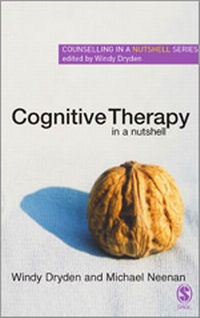
Cognitive Therapy in a Nutshell
1st Edition
Published on 22. November 2005
Book
Paperback/Softback
120 pages
978-1-4129-0769-9 (ISBN)
Description
Seminars by Professor Windy Dryden. See the man live and in action. To find out more and to book your place go to www.cityminds.com
________________________________________
`Size-wise, these books span an open palm and have a very handy flap on the back and front as an integral feature of the cover which can be used as a bookmark. They are concise, yet thorough, providing introductions to the key elements of the theory and practice underpinning major therapeutic approaches... [An] ideal 'intro'... I would recommend these books because, 'in a nutshell', they work' - Therapy Today
Cognitive therapy is one of the most widely used approaches within counselling and psychotherapy today. As such, there is a wealth of literature on offer to the newcomer, which can sometimes be overwhelming for those seeking an initial understanding of the approach. Cognitive Therapy in a Nutshell solves this problem by providing the key elements of cognitive therapy theory and practice in a very concise and accessible way.
Cognitive therapy teaches clients that there is always more than one way of seeing events, and therefore that their viewpoint is largely a matter of choice. Helping clients to develop and maintain more helpful viewpoints in tackling their problems is the focus of the therapy. Cognitive Therapy in a Nutshell offers clear explanations of the fundamental models used to treat clients including the information-processing model, and the three cognitive levels examined during therapy - automatic thoughts, underlying assumptions/rules, and core beliefs (schemas). The authors also provide a valuable case study of a client with a social phobia to demonstrate how cognitive therapy works in action.
Cognitive Therapy in a Nutshell also explores the techniques involved in:
o eliciting and examining negative automatic thoughts;
o uncovering and examining underlying assumptions, rules and core beliefs;
o maintaining gains from therapy.
This book will be invaluable to those coming to cognitive therapy for the first time, and who want to gain a full understanding of the basics of the approach.
Windy Dryden currently works at Goldsmiths College where he is Professor of Psychotherapeutic Studies as well as being the Programme Co-ordinator of the MSc in Rational Emotive Behaviour Therapy and the Diploma in Cognitive Approaches to Counselling and Psychotherapy. Michael Neenan works for the Centre for Stress Management, Blackheath.
________________________________________
`Size-wise, these books span an open palm and have a very handy flap on the back and front as an integral feature of the cover which can be used as a bookmark. They are concise, yet thorough, providing introductions to the key elements of the theory and practice underpinning major therapeutic approaches... [An] ideal 'intro'... I would recommend these books because, 'in a nutshell', they work' - Therapy Today
Cognitive therapy is one of the most widely used approaches within counselling and psychotherapy today. As such, there is a wealth of literature on offer to the newcomer, which can sometimes be overwhelming for those seeking an initial understanding of the approach. Cognitive Therapy in a Nutshell solves this problem by providing the key elements of cognitive therapy theory and practice in a very concise and accessible way.
Cognitive therapy teaches clients that there is always more than one way of seeing events, and therefore that their viewpoint is largely a matter of choice. Helping clients to develop and maintain more helpful viewpoints in tackling their problems is the focus of the therapy. Cognitive Therapy in a Nutshell offers clear explanations of the fundamental models used to treat clients including the information-processing model, and the three cognitive levels examined during therapy - automatic thoughts, underlying assumptions/rules, and core beliefs (schemas). The authors also provide a valuable case study of a client with a social phobia to demonstrate how cognitive therapy works in action.
Cognitive Therapy in a Nutshell also explores the techniques involved in:
o eliciting and examining negative automatic thoughts;
o uncovering and examining underlying assumptions, rules and core beliefs;
o maintaining gains from therapy.
This book will be invaluable to those coming to cognitive therapy for the first time, and who want to gain a full understanding of the basics of the approach.
Windy Dryden currently works at Goldsmiths College where he is Professor of Psychotherapeutic Studies as well as being the Programme Co-ordinator of the MSc in Rational Emotive Behaviour Therapy and the Diploma in Cognitive Approaches to Counselling and Psychotherapy. Michael Neenan works for the Centre for Stress Management, Blackheath.
Reviews / Votes
`Size-wise, these books span an open palm and have a very handy flap on the back and front as an integral feature of the cover which can be used as a bookmark. They are concise, yet thorough, providing introductions to the key elements of the theory and practice underpinning major therapeutic approaches... [An] ideal 'intro'... I would recommend these books because, 'in a nutshell', they work' - Therapy TodayMore details
Series
Edition
First Edition
Language
English
Place of publication
Thousand Oaks
United States
Target group
College/higher education
Dimensions
Height: 174 mm
Width: 110 mm
Weight
134 gr
ISBN-13
978-1-4129-0769-9 (9781412907699)
Copyright in bibliographic data and cover images is held by Nielsen Book Services Limited or by the publishers or by their respective licensors: all rights reserved.
Schweitzer Classification
Other editions
New editions
Michael Neenan | Windy Dryden
Cognitive Therapy in a Nutshell
Book
11/2010
2nd Edition
SAGE Publications Ltd
€59.70
Shipment within 15-20 days
Mark Merlis
American Studies
Book
11/1995
1st Edition
Fourth Estate Ltd
€31.13
Article is exhausted; no reprint
Persons
Windy Dryden is one of the leading practitioners and trainers in the UK in the Cognitive Behaviour Therapy (CBT) tradition of psychotherapy. He is best known for his work in Rational-Emotive Cognitive Behaviour Therapy (RECBT), a leading CBT approach. He has been working in the field of counselling and psychotherapy since 1975 and was one of the first people in Britain to be trained in CBT.
He has published over 200 books and has trained therapists all over the world, in as diverse places as the UK, the USA, South Africa, Turkey and Israel.
He is Emeritus Professor of Psychotherapeutic Studies at Goldsmiths, University of London.
He has published over 200 books and has trained therapists all over the world, in as diverse places as the UK, the USA, South Africa, Turkey and Israel.
He is Emeritus Professor of Psychotherapeutic Studies at Goldsmiths, University of London.
Content
An Overview of Cognitive Therapy
Assessment
Eliciting and Examining Negative Automatic Thoughts
Homework
Uncovering and Examining Underlying Assumptions, Rules, and Core Beliefs
Maintaining Gains from Therapy
Assessment
Eliciting and Examining Negative Automatic Thoughts
Homework
Uncovering and Examining Underlying Assumptions, Rules, and Core Beliefs
Maintaining Gains from Therapy