

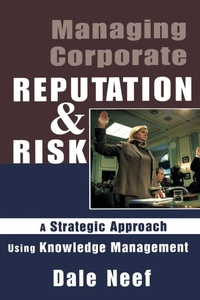
Managing Corporate Reputation and Risk
Developing a Strategic Approach to Corporate Integrity Using Knowledge Management
1st Edition
Published on 3. September 2003
Book
Paperback/Softback
268 pages
978-0-7506-7715-8 (ISBN)
Description
This book is an executive briefing for business people explaining how a corporation can combine leading practices in risk and knowledge management with emerging international integrity guidelines in order to manage corporate reputation and risk. Through a mixture of leading practice case studies and a clear framework, it shows how existing knowledge management tools and systems can be re-engineered to manage corporate risk and integrity policies.
Reviews / Votes
"...even the most sophisticated organizations will learn much by studying the phases in The Evolution of the Ethical Corporation outlined in the book."- David Stangis, Director of Corporate Responsibility, Intel Corporation
More details
Language
English
Place of publication
Oxford
United Kingdom
Publishing group
Taylor & Francis Ltd
Target group
College/higher education
Professional Practice & Development
Dimensions
Height: 234 mm
Width: 156 mm
Thickness: 15 mm
Weight
412 gr
ISBN-13
978-0-7506-7715-8 (9780750677158)
Copyright in bibliographic data and cover images is held by Nielsen Book Services Limited or by the publishers or by their respective licensors: all rights reserved.
Schweitzer Classification
Other editions
Additional editions
Dale Neef
Managing Corporate Reputation and Risk
Developing a Strategic Approach to Corporate Integrity Using Knowledge Management
Book
08/2017
1st Edition
Routledge
€282.26
Shipment within 10-20 days
Dale Neef
Managing Corporate Reputation and Risk
E-Book
06/2012
1st Edition
Routledge
€67.49
Available for download
Dale Neef
Managing Corporate Reputation and Risk
E-Book
06/2012
1st Edition
Routledge
€67.49
Available for download
Person
Dale Neef is an author and management consultant specializing in strategic corporate policy and knowledge management, and is currently researching the subject of corporate integrity as a Visiting Fellow at The Center for Global Change and Governance at Rutgers University. He has worked for IBM and CSC, and was a fellow at Ernst & Young's Center for Business Innovation, where he helped the firm to develop their knowledge management service line and wrote or edited several books on knowledge management and globalization. Over the past fifteen years he has worked with executives from more than forty companies on strategy development, corporate assessments, and strategic change initiatives. He earned his doctorate from Cambridge University, was a research fellow at Harvard, and along with radio commentary, speaker tours, and frequent contributions to journals, has written or edited numerous books on business, globalization and the changing economy, including: * E-Procurement: From Strategy to Implementation, (New York: Prentice Hall, May, 2001) - the Financial Times/Prentice Hall's 3rd best-selling business book in 2001; * A Little Knowledge Is a Dangerous Thing: Understanding the Global, Knowledge-based Economy, (Boston: Butterworth-Heinemann, 1999); * The Economic Impact of Knowledge, Co-editor, (Boston: Butterworth-Heinemann, 1998); * The Knowledge-Based Economy, Editor, (Boston: Butterworth-Heinemann, 1997); * Enterprise Value in the Knowledge Economy: Measuring Performance in the Age of Intangibles, Co-editor, (OECD/Ernst & Young, 1997) These books have been recommended by the Harvard Business School and have been used as texts for courses at MIT, Birbeck/University of London, the University of Northern Texas, the University of Tennessee and George Mason University.
Content
Part 1 The Case for Greater Integrity; Chapter 1 New Ethical Concerns for the Modern Corporation; Chapter 2 Making the Business Case for an Integrated Program of Ethics and Knowledge Management; Chapter 3 Key Areas of Risk; Chapter 4 How Have Corporations Responded?; Part 2 A Program for Corporate Integrity; Chapter 5 Moving Beyond Stage Two; Chapter 6 Establishing and Managing an Ethical Framework; Chapter 7 Understanding the Value of Knowledge and Risk Management; Chapter 8 Integrating Ethics, Risk, Standards, and Knowledge Management into an Ethical Framework; Chapter 9 Creating a Culture of Integrity and Knowledge Sharing; Chapter 10 Systems That Support Integrated Knowledge and Risk Management; Chapter 11 Choosing and Implementing Standards;