

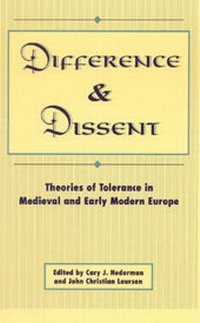
Difference and Dissent
Theories of Toleration in Medieval and Early Modern Europe
Published on 30. December 1996
Book
Hardback
272 pages
978-0-8476-8375-8 (ISBN)
Description
This innovative collection points to the need for a reevaluation of the origins of toleration theory. Philosophers, intellectual historians, and political theorists have assumed that the development of the theory of toleration has been a product of the modern world, and John Locke is usually regarded as the first theorist of toleration. The contributors to Difference and Dissent, however, discuss a range of conceptual positions that were employed by medieval and early modern thinkers to support a theory of toleration, and question the claim that Locke's theory of toleration was as original or philosophically adequate as his adherents have asserted.
Reviews / Votes
...this book offers important reformulations of tolerance. ...by demonstrating the broad array of theories of tolerance, this book opens promising paths of inquiry for political philosophy... -- Pascal Massie, Vanderbilt University Albert E. Gunn and Staff Nederman shows that there is a wide 'diversity of intellectual frameworks that have generated viable defenses of toleration'. Theolody Digest, Vol.45 N0. 3 Fall 1998 The overall contribution of Difference and Dissent is to recognize communitarian and natural law foundations of toleration theory and to encourage us to ask percislely whom a theorist is tolerating, whethers/he intends temporary concordance or permanent toleration and to whom the theorist is not extending toleration. -- Maryanne Cline Horowitz, Occidental College & UC of Los Angeles American Political Science Review All the essays inDifference and Dissentare informative and intellectually stimulating. -- Hilmar M. Pabel, Simon Frasher University H-Net: Humanities and Social Science Reviews Online The editors of this collection of lively, interesting, and accessible essays are said to be congratulated on the coherence created by the common focus uniting the contributions... This is clearly a quite different defence of toleration from that which makes free speech an inalienable individual right... [offers] some alternatives to the conventional way of thinking about tolerance and [gives] us some practice in thinking about it in ways and contexts different fom the dominant modern narrative. -- Ruth Abbey, University of Notre Dame Journal Of Religious History This volume is a happy antidote to those who think that the discussion of toleration in the modern world starts with John Locke. This collection brings together eleven essays that discuss kinds of toleration theories from the middle ages through the seventeenth century in different cultures, indicating that the idea of toleration has a much richer and interesting history than we are usually told about. -- Richard H. Popkin, editor of the Columbia History of Western Philosophy ...this book offers important reformulations of tolerance. ...by demonstrating the broad array of theories of tolerance, this book opens promising paths of inquiry for political philosophy. -- Pascal Massie, Vanderbilt University Albert E. Gunn and Staff These essays force us to acknowledge tha essential artificiality of all theories of tolerance, while at the same time encouraging us to choose whatever ideological matter and tools we need to promote tolerance as well as a sense of reponsibilty in our dealings with others. -- Charles F. Briggs, Georgia Southern University Journal of Church & State, Vol. 40, No.3, Summer 1998 These 11 essays show that there is a wide 'diversity of intellectual frameworks that have generated viable defenses of toleration.' Heiser These essays address the political issue of the millennium: how to ground a pluralist society. -- Antony Black, University of Dundee Political Studies Review, Vol.44, No. 4, September 1998 ...eleven essays which form a worthwhile addition to the now extensive literature on toleration before the Enlightenment. ...Glen Burgess in an excellent analysis of Hobbes's perspective on toleration... ...Lauren's own thought-provoking essay on Spinoza and his possible influence on Locke. -- Diarmaid Macculloch, St. Cross College, Oxford Ehr, Apr. 1999More details
Language
English
Place of publication
Lanham, MD
United States
Target group
College/higher education
Professional and scholarly
Illustrations
index
Dimensions
Height: 229 mm
Width: 152 mm
Thickness: 25 mm
Weight
454 gr
ISBN-13
978-0-8476-8375-8 (9780847683758)
Copyright in bibliographic data and cover images is held by Nielsen Book Services Limited or by the publishers or by their respective licensors: all rights reserved.
Schweitzer Classification
Persons
Cary J. Nederman is associate professor of political science at the University of Arizona and the author of numerous books, including Community and Consent: The Secular Political Theory of Marsiglio of Paduas Defensor Pacis and Medieval Political Theory-A Reader: The Quest for the Body Politic, 1100-1400. John Christian Laursen is associate professor of political science at the University of California, Riverdale. He is author of The Politics of Skepticism: in the Ancients, Montaigne, Hume, and Kant.
Content
Chapter 1 Acknowledgments Chapter 2 Difference and Dissent: Introduction Chapter 3 Liberty, Community, and Toleration: Freedom and Function in Medieval Political Thought Chapter 4 Toleration in the Theology and Social Thought of John Wyclif Chapter 5 Respect, Interdependence, Virtue: A Medieval Theory of Toleration in the Works of Christine de Pizan Chapter 6 "Turks and Heathen Are Our Kin": The Notion of Tolerance in the Works of Hans Denck and Sebastian Franck Chapter 7 Spanish Thomism and the American Indians: Vitoria and Las Casas on the Toleration of Cultural Difference Chapter 8 Bodin's Pluralistic Theory of Toleration Chapter 9 Thomas Hobbes: Religious Toleration or Religious Indifference? Chapter 10 Samuel Pufendorf's Concept of Toleration Chapter 11 Spinoza on Toleration: Arming the State and Reining in the Magistrate Chapter 12 Force, Metaphor, and Persuasion in Locke's A Letter Concerning Toleration Chapter 13 Index