

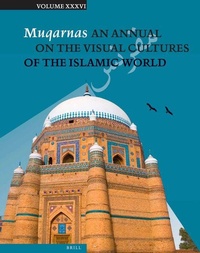
Muqarnas 36
Published on 26. November 2019
Book
Hardback
256 pages
978-90-04-41945-2 (ISBN)
Description
Muqarnas 36 features a stunning variety of Islamic art genres, ranging from monumental architecture, manuscripts, textiles, and tiles, to inscriptions, material objects, and forgery. It sweeps across India, Iran, and Turkey, and concludes in Britain, with the discovery of an Ashmolean Museum objet d'art that is not exactly what it is advertised to be.
The volume begins with an overview by Finbarr Barry Flood of the architecture, calligraphy, epigraphy, painting, and portable arts of pre-Mughal Islamicate South Asia. Pre-Mughal court culture has always played second fiddle to the overwhelming hegemony and brilliance of the Mughal dynasty but in its regional heterogeneity it is more than worthy of study. This is followed by two essays examining manuscript illumination: Cailah Jackson, 2017 winner of the Margaret B. Sevcenko Prize in Islamic Art and Culture, discusses two manuscripts illuminated by Mukhlis ibn ?Abdallah al-Hindi in thirteenth-century Konya; and Denise-Marie Teece treats the early sixteenth-century Safina manuscript (Biblioteca Reale Ms. Or. 101), its illuminator Ruzbehan al-Modhahheb, and its unique six-page preface. A Byzantine stole with embroidered Arabic inscriptions in the collection of Vatopediou Monastery on Mount Athos is the subject of the fourth essay by Nikolaos Vryzidis. The volume's seven essays conclude with three investigations into Ottoman art history: the blue-and-white tiles of the Baba Naqqas style of the late fifteenth and early sixteenth centuries, as prominently displayed in the Muradiye Mosque in Edirne (Patricia Blessing), the architectural book Risa?le-i Mi?ma?riyye of the seventeenth-century Ca?fer Efendi and in particular his notes on surveying and the architect's cubit (Guel Kale), and the evolution of the late sixteenth-century Ottoman custom of requiring the sultan to be victorious over the non-Muslim enemy and to only use spoils from the holy war in the construction of a sultanic mosque (Samet Budak).
The Notes and Sources section continues with Bill Hickman's analysis of the tantalizing calligraphed tiles of the now destroyed mosque built for the Sufi shaykh and poet Esrefoglu Rumi (d. 1469?), and two communications about artifacts on British soil: a wooden box, believed to have contained the heart of Abbot Roger de Norton (d. 1291), with an Arabic inscription that is now deciphered by Barry Knight, 147 years after its discovery; and a gorgeous Persian luster bowl in Oxford's Ashmolean Museum, which when subjected to UV examination, revealed that it was a product of extensive repair, or "restoration," over the centuries. A systematic examination of the bowl and its remarkable history by Francesca Leoni and her colleagues uncovers a level of fakery of antiques that, it is suggested, might be prevalent in museum ceramic collections.
The volume begins with an overview by Finbarr Barry Flood of the architecture, calligraphy, epigraphy, painting, and portable arts of pre-Mughal Islamicate South Asia. Pre-Mughal court culture has always played second fiddle to the overwhelming hegemony and brilliance of the Mughal dynasty but in its regional heterogeneity it is more than worthy of study. This is followed by two essays examining manuscript illumination: Cailah Jackson, 2017 winner of the Margaret B. Sevcenko Prize in Islamic Art and Culture, discusses two manuscripts illuminated by Mukhlis ibn ?Abdallah al-Hindi in thirteenth-century Konya; and Denise-Marie Teece treats the early sixteenth-century Safina manuscript (Biblioteca Reale Ms. Or. 101), its illuminator Ruzbehan al-Modhahheb, and its unique six-page preface. A Byzantine stole with embroidered Arabic inscriptions in the collection of Vatopediou Monastery on Mount Athos is the subject of the fourth essay by Nikolaos Vryzidis. The volume's seven essays conclude with three investigations into Ottoman art history: the blue-and-white tiles of the Baba Naqqas style of the late fifteenth and early sixteenth centuries, as prominently displayed in the Muradiye Mosque in Edirne (Patricia Blessing), the architectural book Risa?le-i Mi?ma?riyye of the seventeenth-century Ca?fer Efendi and in particular his notes on surveying and the architect's cubit (Guel Kale), and the evolution of the late sixteenth-century Ottoman custom of requiring the sultan to be victorious over the non-Muslim enemy and to only use spoils from the holy war in the construction of a sultanic mosque (Samet Budak).
The Notes and Sources section continues with Bill Hickman's analysis of the tantalizing calligraphed tiles of the now destroyed mosque built for the Sufi shaykh and poet Esrefoglu Rumi (d. 1469?), and two communications about artifacts on British soil: a wooden box, believed to have contained the heart of Abbot Roger de Norton (d. 1291), with an Arabic inscription that is now deciphered by Barry Knight, 147 years after its discovery; and a gorgeous Persian luster bowl in Oxford's Ashmolean Museum, which when subjected to UV examination, revealed that it was a product of extensive repair, or "restoration," over the centuries. A systematic examination of the bowl and its remarkable history by Francesca Leoni and her colleagues uncovers a level of fakery of antiques that, it is suggested, might be prevalent in museum ceramic collections.
More details
Series
Language
English
Place of publication
Leiden
Netherlands
Target group
Professional and scholarly
Product notice
sewn/stitched
Cloth over boards
Dimensions
Height: 277 mm
Width: 218 mm
Thickness: 20 mm
Weight
1111 gr
ISBN-13
978-90-04-41945-2 (9789004419452)
Copyright in bibliographic data and cover images is held by Nielsen Book Services Limited or by the publishers or by their respective licensors: all rights reserved.
Schweitzer Classification
Persons
Guelru Necipoglu, (Ph.D., Harvard University, 1986) is the Aga Khan Professor of Islamic Art and Architecture at Harvard University. She has been the editor of Muqarnas since 1993.
Content
CONTENTS
Finbarr Barry Flood, Before the Mughals: Material Culture of Sultanate North India
Cailah Jackson, The Illuminations of Mukhlis ibn ?Abdullah al-Hindi: Identifying Manuscripts from Late Medieval Konya
Denise-Marie Teece, "Compassionate Companion, Familiar Friend": The Turin Safina (Biblioteca Reale Ms. Or. 101) and Its Significance
Nikolaos Vryzidis, The "Arabic Stole" of Vatopediou Monastery: Traces of Islamic Material Culture in Late Byzantium
Patricia Blessing, The Blue-and-White Tiles of the Muradiye in Edirne: Architectural Decoration between Tabriz, Damascus, and Cairo
Guel Kale, Intersections between the Architect's Cubit, the Science of Surveying, and Social Practices in Ca?fer Efendi's Seventeenth-Century Book on Ottoman Architecture
Samet Budak, "The Temple of the Incredulous": Ottoman Sultanic Mosques and the Principle of Legality
NOTES AND SOURCES
Bill Hickman, A Forgotten Fifteenth-Century Ottoman Mosque and Its Inscriptions
Barry Knight, The Heart Case of Abbot Roger de Norton from St. Albans Abbey: An Islamic Object in a Medieval English Context
Francesca Leoni, Dana Norris, Kelly Domoney, Moujan Matin, and Andrew Shortland, "The Illusion of an Authentic Experience": A Luster Bowl in the Ashmolean Museum
Finbarr Barry Flood, Before the Mughals: Material Culture of Sultanate North India
Cailah Jackson, The Illuminations of Mukhlis ibn ?Abdullah al-Hindi: Identifying Manuscripts from Late Medieval Konya
Denise-Marie Teece, "Compassionate Companion, Familiar Friend": The Turin Safina (Biblioteca Reale Ms. Or. 101) and Its Significance
Nikolaos Vryzidis, The "Arabic Stole" of Vatopediou Monastery: Traces of Islamic Material Culture in Late Byzantium
Patricia Blessing, The Blue-and-White Tiles of the Muradiye in Edirne: Architectural Decoration between Tabriz, Damascus, and Cairo
Guel Kale, Intersections between the Architect's Cubit, the Science of Surveying, and Social Practices in Ca?fer Efendi's Seventeenth-Century Book on Ottoman Architecture
Samet Budak, "The Temple of the Incredulous": Ottoman Sultanic Mosques and the Principle of Legality
NOTES AND SOURCES
Bill Hickman, A Forgotten Fifteenth-Century Ottoman Mosque and Its Inscriptions
Barry Knight, The Heart Case of Abbot Roger de Norton from St. Albans Abbey: An Islamic Object in a Medieval English Context
Francesca Leoni, Dana Norris, Kelly Domoney, Moujan Matin, and Andrew Shortland, "The Illusion of an Authentic Experience": A Luster Bowl in the Ashmolean Museum