

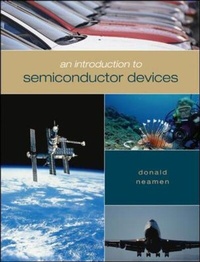
An Introduction to Semiconductor Devices
Published on 16. February 2005
Book
Hardback
704 pages
978-0-07-298756-0 (ISBN)
Description
An Introduction to Semiconductor Devices by Donald Neamen provides an understanding of the characteristics, operations and limitations of semiconductor devices. In order to provide this understanding, the book brings together the fundamental physics of the semiconductor material and the semiconductor device physics.This new text provides an accessible and modern presentation of material. Quantum mechanic material is minimal, and the most advanced material is designated with an icon. This modern approach meands that coverage of the MOS transistor preceeds the material on the bipolar transitor, which reflects the dominance of MOS technology in today's world. Excellent pedagogy is present throughout the book in the form of interesting chapters openers, worked examples, a variety of exercises, key terms, and end of chapter problems.
More details
Language
English
Place of publication
United States
Publishing group
McGraw-Hill Education - Europe
Target group
College/higher education
Illustrations
458 Illustrations
Dimensions
Height: 234 mm
Width: 213 mm
Thickness: 33 mm
Weight
1211 gr
ISBN-13
978-0-07-298756-0 (9780072987560)
Copyright in bibliographic data and cover images is held by Nielsen Book Services Limited or by the publishers or by their respective licensors: all rights reserved.
Schweitzer Classification
Content
Chapter 1 The Crystal Structure of Solids Chapter 2 Theory of Solids Chapter 3 The Semiconductor in Equilibrium Chapter 4 Carrier Transport Phenomena Chapter 5 The pn Junction Chapter 6 Fundamentals of the MOS Transistor Chapter 7 The MOSFET: Additional Concepts Chapter 8 Nonequilibrium Excess Carriers in Semiconductors Chapter 9 The pn Junction Diode Chapter 10 The Bipolar Transistor Chapter 11 Additional Semiconductor Devices and Device Concepts Chapter 12 Optical Devices Appendix A Selected List of Symbols Appendix B System of Units, Conversion FActors, and General Constants Appendix C The Periodic Table Appendix D "Derivation" of Schrodinger's Wave Equation Appendix E Units of Energy-The Electron-Volt Appendix F Derivation of Density of States Function Appendix G Derivation of Shockley-Read-Hall Recombination Rates Appendix H Answers to Selected Problems