

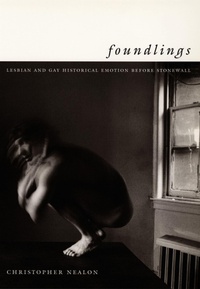
Foundlings
Lesbian and Gay Historical Emotion Before Stonewall
Will be published approx. on 8. October 2001
Book
Hardback
224 pages
978-0-8223-2688-5 (ISBN)
Description
What is it like to "feel historical"? In Foundlings Christopher Nealon analyzes texts produced by American gay men and lesbians in the first half of the twentieth century-poems by Hart Crane, novels by Willa Cather, gay male physique magazines, and lesbian pulp fiction. Nealon brings these diverse works together by highlighting a coming-of-age narrative he calls "foundling"-a term for queer disaffiliation from and desire for family, nation, and history.
The young runaways in Cather's novels, the way critics conflated Crane's homosexual body with his verse, the suggestive poses and utopian captions of muscle magazines, and Beebo Brinker, the aging butch heroine from Ann Bannon's pulp novels-all embody for Nealon the uncertain space between two models of lesbian and gay sexuality. The "inversion" model dominant in the first half of the century held that homosexuals are souls of one gender trapped in the body of another, while the more contemporary "ethnic" model refers to the existence of a distinct and collective culture among gay men and lesbians. Nealon's unique readings, however, reveal a constant movement between these two discursive poles, and not, as is widely theorized, a linear progress from one to the other.
This startlingly original study will interest those working on gay and lesbian studies, American literature and culture, and twentieth-century history.
The young runaways in Cather's novels, the way critics conflated Crane's homosexual body with his verse, the suggestive poses and utopian captions of muscle magazines, and Beebo Brinker, the aging butch heroine from Ann Bannon's pulp novels-all embody for Nealon the uncertain space between two models of lesbian and gay sexuality. The "inversion" model dominant in the first half of the century held that homosexuals are souls of one gender trapped in the body of another, while the more contemporary "ethnic" model refers to the existence of a distinct and collective culture among gay men and lesbians. Nealon's unique readings, however, reveal a constant movement between these two discursive poles, and not, as is widely theorized, a linear progress from one to the other.
This startlingly original study will interest those working on gay and lesbian studies, American literature and culture, and twentieth-century history.
Reviews / Votes
"Foundlings is a first-rate, innovative, and unprecedented work that will take the literary world by storm. Christopher Nealon proves himself here to be the very best of a new generation of queer theorists."-Judith Butler "Foundlings provides a new paradigm for thinking historically and theoretically about the longing for history within gay and lesbian texts. This is not just a stunning addition to queer historiography but also a challenge to the historicist turn in literary and cultural criticism."-Bill Brown, author of The Material Unconscious: American Amusement, Stephen Crane, and the Economies of PlayMore details
Series
Language
English
Place of publication
North Carolina
United States
Target group
Professional and scholarly
Product notice
Cloth over boards
Illustrations
2 photos
Dimensions
Height: 226 mm
Width: 163 mm
Thickness: 23 mm
Weight
485 gr
ISBN-13
978-0-8223-2688-5 (9780822326885)
Copyright in bibliographic data and cover images is held by Nielsen Book Services Limited or by the publishers or by their respective licensors: all rights reserved.
Schweitzer Classification
Other editions
Additional editions
Christopher Nealon | Michèle Aina Barale | Jonathan Goldberg
Foundlings
Lesbian and Gay Historical Emotion before Stonewall
E-Book
10/2001
1st Edition
De Gruyter
€198.99
Available for download
Person
Christopher Nealon is Associate Professor of English at the University of California, Berkeley.
Content
Acknowledgments
Introduction: The Invert, the Foundling, and the "Member of the Tribe"
1. Hart Crane's History
2. Feeling and Affiliation in Willa Cather
3. The Secret Public of Physique Culture
4. The Ambivalence of Lesbian Pulp Fiction
Conclusion: Contexts and Afterlives
Notes
References
Index
Introduction: The Invert, the Foundling, and the "Member of the Tribe"
1. Hart Crane's History
2. Feeling and Affiliation in Willa Cather
3. The Secret Public of Physique Culture
4. The Ambivalence of Lesbian Pulp Fiction
Conclusion: Contexts and Afterlives
Notes
References
Index