

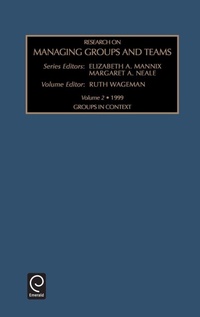
Groups in Context
Will be published approx. on 23. September 1999
Book
Hardback
264 pages
978-0-7623-0511-7 (ISBN)
Description
This book comprises the work of scholars who gathered in May, 1998, at a conference held at Stanford University's Graduate School of Business Administration. The conference was part of an ongoing series presenting cutting edge research on teams. Presented first, are those articles that address particular macro aspects of team context and their influences on team process and effectiveness and ultimately their effectiveness as performing units. The following chapters address: how the organizational context shapes the timing of behavior in teams; process outcome and the effects of organizational performance on top management teams; group process and the nature of contextual features; and, conditions under which working teams actively manage their external environments and consequences of those actions. The work concludes with an overview of the multiple ways that contexts affect and are affected by group behavior, helping the reader to organize and to extend their understanding of contextual phenomena.
More details
Series
Language
English
Place of publication
United States
Publishing group
Emerald Publishing Limited
Target group
Professional and scholarly
Dimensions
Height: 240 mm
Width: 161 mm
Thickness: 19 mm
Weight
564 gr
ISBN-13
978-0-7623-0511-7 (9780762305117)
Copyright in bibliographic data and cover images is held by Nielsen Book Services Limited or by the publishers or by their respective licensors: all rights reserved.
Schweitzer Classification
Content
List of contributors. Preface (R. Wageman). We can't get there unless we know where we are going: direction setting for knowledge work teams (S.G. Cohen et al.). Cycles and synchrony: the temporal role of context in team behavior (D. Ancona, Chee-Leong Chong). Cause or effect? An investigation of the relationship between top management team group dynamics and organizational performance (R.S. Peterson et al.). Predicting process improvement team performance in an automotive firm: explicating the roles of trust and empowerment (G.M. Spreitzer et al.). Fairness norms and the potential for mutual agreements involving majority and minority groups (J.T. Jost, L. Ross). Groupthink and preparedness for the Loma Prieta earthquake: a social identity maintenance analysis of causes and preventions (A.R. Pratkanis, M.E. Turner). Group cognition and creativity in organizations (A.B. Hargadon). Unwrapping the work group: how extra-organizational context affects group behavior (R. Lacey, D. Gruenfeld). A safe harbor: social psychological conditions enabling boundary spanning in work teams (A. Edmondson). The antecedents of team competence: toward a fine-grained model of self-managing team effectiveness (V.U. Druskat, D.C. Kayes). Thinking differently about context (J.R. Hackman).