

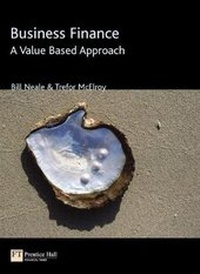
Business Finance:
A Value Based Approach
Published on 12. February 2004
Book
Paperback/Softback
512 pages
978-0-201-61904-1 (ISBN)
Description
This new book offers an introduction to financial decision-making, covering key areas of financial management ranging from objectives through to investment financing and dividend policy. The emphasis is on "managing for value" which reflects a growing concern in the focus of modern business management. The book examines business finance from a managerial angle, integrating strategy in a way that has not been achieved yet in most other core finance texts. The material will be relevant to all types of business organisations, and examples are taken from Europe and around the world. Using up-to-date, topical case material, based upon real-life companies familiar to many students, the text analyses value-adding strategies and how practice compares with theory.
More details
Language
English
Place of publication
New Jersey
United States
Publishing group
Pearson Education (US)
Target group
Professional and scholarly
Dimensions
Height: 234 mm
Width: 174 mm
Thickness: 27 mm
Weight
842 gr
ISBN-13
978-0-201-61904-1 (9780201619041)
Copyright in bibliographic data and cover images is held by Nielsen Book Services Limited or by the publishers or by their respective licensors: all rights reserved.
Schweitzer Classification
Content
CHAPTER ONE
SETTING THE SCENE
1.1 Introduction
1.2 Value and Wealth
1.3 Owners, Managers and Other Stakeholders
1.4 Business Objectives
1.5 Shareholder Wealth Maximisation
1.6 The Stakeholder Approach
1.7 A Little Historical Background
1.8 The Vodaphone/Mannesman Case - a Seminal Event?
1.9 2000-2 Stock Market Slump and Corporate Scandals
1.10 The Focus of Finance - the Big Three Issues
1.11 Outline of the Book and How to Use It
CASE STUDY: CADBURY-SCHWEPPES PLC
CHAPTER 2
THE MEANING OF SHAREHOLDER VALUE
2.1 Introduction
2.2 The Touchstone of Success - The Pursuit of Shareholder Value
2.3 The Meaning of the NPV
2.4 The Twin Determinants of Value
2.5 The Efficient Markets Hypothesis (EMH)
2.6 Internal Constraints on Value Maximisation - Agency Issues
2.7 Words of warning
2.8 Summary
CHAPTER 3
STRATEGIC MANAGEMENT FOR VALUE CREATION
3.1 Introduction
3.2 Levels of Strategy
3.3 Core Competences
3.4 How Core competences Add Value
3.5 Core Competences as a Basis or Strategy
3.6 Divestment - a return to Core Competence?
3.7 Selecting the markets in which to exploit core competences
3.8 Protecting Core Competence
3.9 Overview of the Key Ideas in Strategic Management
3.10 Summary
CASE STUDY: THE QUAKER STORY
CHAPTER 4
PROJECT APPRAISAL I: THE BASICS
4.1 Introduction
4.2 The role of strategy
4.3 The ingredients of an investment appraisal
4.4. Non-discounting methods
4.5 Discounting methods/discounted cash flow (DCF)
4.6 Worked example
4.7 Problems with DCF methods
4.8 Assessment of the methods
4.9 Summary
CHAPTER 5
PROJECT APPRAISAL II: THE TRICKY BITS
5.1 Introduction
5.2 Allowing for inflation in project appraisal
5.3 Allowing for taxation in DCF
5.4 Risk and uncertainty in project appraisal
5.5 Expected NPVs and probabilities
5.6 Sensitivity analysis
5.7 Worked Example; Bowman plc
5.8 Guarding against Project Risk
5.9 Summary
CASE STUDY: VIRGIN'S WEST COAST RAILWAY PROJECT
CHAPTER 6
THE RATE OF RETURN REQUIRED BY OWNERS
6.1 Introduction
6.2 The Dividend Valuation Model (DVM)
6.3 The Capital Asset Pricing Model (CAPM)
6.4 International Diversification
6.5 The Risk of Individual Securities
6.6 The Core of the CAPM: Security Market Line (SML)
6.7 Application - Finding the Required Return
6.8 Tailoring the Beta Value for New Projects of Varying Risks
6.9 Worked Example
6.10 The Equity Premium in Practice
6.11 Summary
CHAPTER 7
Working capital management
7.1 Introduction
7.2 What is Working capital?
7.3 Investment in cash
7.4 Investment in Stock
7.5 Investment in debtors
7.6 "Investment" in creditors
7.7 The cash conversion cycle
7.8 Putting it together - strategic working capital management
7.9 Overtrading
7.10 Worked example: Ewden plc
7.11 Summary
CASE STUDY: SODEXHO PLC
CHAPTER 8
RAISING LONG TERM FINANCE
8.1 Introduction
8.2 The Strategic issues
8.3 Equity Financing
8.4 Borrowing
8.5 Borrowing and the Gearing Phenomenon
8.6 Types of Long-Term Debt
8.7 Hybrids
8.8 Worked Example: Bardsey plc
8.9 Summary
CHAPTER 9
THE REQUIRED RETURN ON INVESTMENT
9.1 Introduction
9.2 The cost of debt
9.3 The required rate of return when equity and debt are combined
9.4 Worked example
9.5 Gearing and company value
9.6 Is there an optimal gearing ratio?
9.7 Summary
CHAPTER 10
HOW TO VALUE COMPANIES
10.1 Introduction
10.2 T
SETTING THE SCENE
1.1 Introduction
1.2 Value and Wealth
1.3 Owners, Managers and Other Stakeholders
1.4 Business Objectives
1.5 Shareholder Wealth Maximisation
1.6 The Stakeholder Approach
1.7 A Little Historical Background
1.8 The Vodaphone/Mannesman Case - a Seminal Event?
1.9 2000-2 Stock Market Slump and Corporate Scandals
1.10 The Focus of Finance - the Big Three Issues
1.11 Outline of the Book and How to Use It
CASE STUDY: CADBURY-SCHWEPPES PLC
CHAPTER 2
THE MEANING OF SHAREHOLDER VALUE
2.1 Introduction
2.2 The Touchstone of Success - The Pursuit of Shareholder Value
2.3 The Meaning of the NPV
2.4 The Twin Determinants of Value
2.5 The Efficient Markets Hypothesis (EMH)
2.6 Internal Constraints on Value Maximisation - Agency Issues
2.7 Words of warning
2.8 Summary
CHAPTER 3
STRATEGIC MANAGEMENT FOR VALUE CREATION
3.1 Introduction
3.2 Levels of Strategy
3.3 Core Competences
3.4 How Core competences Add Value
3.5 Core Competences as a Basis or Strategy
3.6 Divestment - a return to Core Competence?
3.7 Selecting the markets in which to exploit core competences
3.8 Protecting Core Competence
3.9 Overview of the Key Ideas in Strategic Management
3.10 Summary
CASE STUDY: THE QUAKER STORY
CHAPTER 4
PROJECT APPRAISAL I: THE BASICS
4.1 Introduction
4.2 The role of strategy
4.3 The ingredients of an investment appraisal
4.4. Non-discounting methods
4.5 Discounting methods/discounted cash flow (DCF)
4.6 Worked example
4.7 Problems with DCF methods
4.8 Assessment of the methods
4.9 Summary
CHAPTER 5
PROJECT APPRAISAL II: THE TRICKY BITS
5.1 Introduction
5.2 Allowing for inflation in project appraisal
5.3 Allowing for taxation in DCF
5.4 Risk and uncertainty in project appraisal
5.5 Expected NPVs and probabilities
5.6 Sensitivity analysis
5.7 Worked Example; Bowman plc
5.8 Guarding against Project Risk
5.9 Summary
CASE STUDY: VIRGIN'S WEST COAST RAILWAY PROJECT
CHAPTER 6
THE RATE OF RETURN REQUIRED BY OWNERS
6.1 Introduction
6.2 The Dividend Valuation Model (DVM)
6.3 The Capital Asset Pricing Model (CAPM)
6.4 International Diversification
6.5 The Risk of Individual Securities
6.6 The Core of the CAPM: Security Market Line (SML)
6.7 Application - Finding the Required Return
6.8 Tailoring the Beta Value for New Projects of Varying Risks
6.9 Worked Example
6.10 The Equity Premium in Practice
6.11 Summary
CHAPTER 7
Working capital management
7.1 Introduction
7.2 What is Working capital?
7.3 Investment in cash
7.4 Investment in Stock
7.5 Investment in debtors
7.6 "Investment" in creditors
7.7 The cash conversion cycle
7.8 Putting it together - strategic working capital management
7.9 Overtrading
7.10 Worked example: Ewden plc
7.11 Summary
CASE STUDY: SODEXHO PLC
CHAPTER 8
RAISING LONG TERM FINANCE
8.1 Introduction
8.2 The Strategic issues
8.3 Equity Financing
8.4 Borrowing
8.5 Borrowing and the Gearing Phenomenon
8.6 Types of Long-Term Debt
8.7 Hybrids
8.8 Worked Example: Bardsey plc
8.9 Summary
CHAPTER 9
THE REQUIRED RETURN ON INVESTMENT
9.1 Introduction
9.2 The cost of debt
9.3 The required rate of return when equity and debt are combined
9.4 Worked example
9.5 Gearing and company value
9.6 Is there an optimal gearing ratio?
9.7 Summary
CHAPTER 10
HOW TO VALUE COMPANIES
10.1 Introduction
10.2 T