

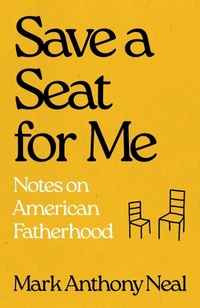
Save a Seat for Me
Notes on American Fatherhood
Will be published approx. on 4. August 2026
Book
Hardback
240 pages
978-1-6680-5424-6 (ISBN)
Description
From the preeminent scholar on Black masculinity in America, Save a Seat for Me is Mark Anthony Neal's attempt to bring his scholarship on fatherhood to a broader audience.
Save a Seat for Me embraces the nuances of how contemporary frameworks of masculinity informed by unprecedented advances in women and LGBTQ communities have necessitated a reimagining of the societal expectations a father plays in the public and private sectors of their homes.
The soul of this book centers on Neal's confrontation of the various political, cultural, historical narratives and messages that inform the role of Black fatherhood, and fatherhood at large, which has put him at odds with the way he fathers his own children.
Raised by a working class father, during a time when American society conceived of the role of father as protector, provider, and disciplinarian, Neal struggles with these expectations as his education (a doctorate's degree), profession (tenured professor at one of the best colleges in the country), and financial position (making more money than his father ever did) are drastically different than that of his father. Linking his father to his own fathering of his two daughters, Neal grounds his intellectual arguments about Black fatherhood in experience and emotion makes for a vulnerable read, as well as a transformative one.
In our culture, the public performance of fatherhood keeps us from wondering what the practice of being a father looks like in private. Neal is opening a long overdue door to the interiority that Black men particularly-and men living in a patriarchal society generally-have only learned existed in the last twenty years.
Save a Seat for Me embraces the nuances of how contemporary frameworks of masculinity informed by unprecedented advances in women and LGBTQ communities have necessitated a reimagining of the societal expectations a father plays in the public and private sectors of their homes.
The soul of this book centers on Neal's confrontation of the various political, cultural, historical narratives and messages that inform the role of Black fatherhood, and fatherhood at large, which has put him at odds with the way he fathers his own children.
Raised by a working class father, during a time when American society conceived of the role of father as protector, provider, and disciplinarian, Neal struggles with these expectations as his education (a doctorate's degree), profession (tenured professor at one of the best colleges in the country), and financial position (making more money than his father ever did) are drastically different than that of his father. Linking his father to his own fathering of his two daughters, Neal grounds his intellectual arguments about Black fatherhood in experience and emotion makes for a vulnerable read, as well as a transformative one.
In our culture, the public performance of fatherhood keeps us from wondering what the practice of being a father looks like in private. Neal is opening a long overdue door to the interiority that Black men particularly-and men living in a patriarchal society generally-have only learned existed in the last twenty years.
More details
Language
English
Place of publication
New York
United States
Product notice
sewn/stitched
Cloth over boards
Dimensions
Height: 213 mm
Width: 140 mm
Thickness: 17 mm
Weight
376 gr
ISBN-13
978-1-6680-5424-6 (9781668054246)
Copyright in bibliographic data and cover images is held by Nielsen Book Services Limited or by the publishers or by their respective licensors: all rights reserved.
Schweitzer Classification
Other editions
Additional editions
E-Book
approx. 08/2026
Simon + Schuster LLC
€14.83
Not yet available
Person
Mark Anthony Neal is the James B. Duke Distinguished Professor of African and African American Studies at Duke University. He is one of the preeminent scholars in the United States studying black masculinity, misogyny, and pop culture, exploring how these issues affect Black communities in America and the broader effects these cultural messages contribute to US society.