

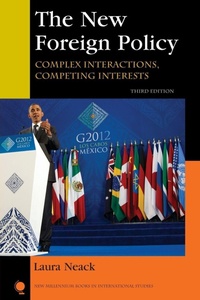
The New Foreign Policy
Complex Interactions, Competing Interests
3rd Edition
Published on 8. August 2013
Book
Paperback/Softback
260 pages
978-1-4422-2007-2 (ISBN)
Description
Integrating theory and case studies, this cogent text explores the processes and factors that shape foreign policy. In her thoroughly revised and updated edition, Laura Neack considers both old and new lessons, drawing on a rich array of real foreign policy choices and outcomes. In new cases, Neack explores decision making in the Eurozone crisis, increasing nationalism in Germany and Japan and what seems to be growing bellicosity among Canadians, Obama's grand strategy and the responses of rising powers Brazil and India, and the Egyptian youth revolution. Following a levels-of-analysis organization, the author considers all elements that influence foreign policy, including the role of leaders, bargaining, national image, political culture, public opinion, the media, and nonstate actors.
Reviews / Votes
This dense yet apprehensible volume is made more accessible via the use of extensive cases to clarify the practical application of scholarly tools. Brief outlines of the content of each chapter's main subject areas significantly enhance the book's utility. Recommended. * Choice Reviews * Students find Neack's writing, with her use of many real-world examples, very interesting and accessible. The book's coverage of foreign policy scholarship is comprehensive and up-to-date and nicely introduces key theoretical ideas from foreign policy analysis. -- Juliet Kaarbo, University of Edinburgh Very readable and interesting. Various vignettes are used to good advantage to illustrate multiple perspectives on foreign policy analysis. A nice flagship publication. -- Ole R. Holsti, Duke University A clear, balanced, and accessible text with no gratuitous jargon. A solid work. -- Robert J. Beck, University of Wisconsin-Milwaukee The New Foreign Policy is a well-written, well-organized undergraduate text which integrates theory and examples well and is congruent with the way in which many professors want to introduce foreign policy to their students. I recommend it. -- Donald A. Sylvan, The Ohio State University Given my location in an English-speaking university in the Middle East, I work very hard to find texts in English that do not alienate my students. Neack does a great job of teaching the theory behind foreign policy analysis and gives numerous and diverse examples in the process. -- Jennifer Skulte-Ouaiss, Lebanese American University in BeirutMore details
Series
Edition
3rd edition
Language
English
Place of publication
United States
Publishing group
Bloomsbury Publishing Plc
Target group
College/higher education
US School Grade: From College Freshman to College Graduate Student
Illustrations
1 b/w illustration
Dimensions
Height: 229 mm
Width: 152 mm
Thickness: 15 mm
Weight
382 gr
ISBN-13
978-1-4422-2007-2 (9781442220072)
Copyright in bibliographic data and cover images is held by Nielsen Book Services Limited or by the publishers or by their respective licensors: all rights reserved.
Schweitzer Classification
Other editions
Additional editions
E-Book
08/2013
3rd Edition
Rowman & Littlefield Publishers
€43.49
Available for download
E-Book
08/2013
3rd Edition
Bloomsbury eBooks US
€43.49
Available for download
Person
Laura Neack is professor of political science at Miami University, Oxford, Ohio.
Content
Chapter 1: Introduction: The New Foreign Policy
Chapter 2: Rational Actors and National Interests
Chapter 3: Cognitive Misers and Distrusting Leaders
Chapter 4: Decision Units, Small Groups, and Autonomous Groups
Chapter 5: National Self-Image, Culture, and Domestic Institutions
Chapter 6: Domestic Politics
Chapter 7: Public Opinion and Media
Chapter 8: Great Powers in General, the United States Specifically
Chapter 9: Competitors, Rising Powers, and Allies
Chapter 10: Conclusion: A Nested Game with Many Players
Chapter 2: Rational Actors and National Interests
Chapter 3: Cognitive Misers and Distrusting Leaders
Chapter 4: Decision Units, Small Groups, and Autonomous Groups
Chapter 5: National Self-Image, Culture, and Domestic Institutions
Chapter 6: Domestic Politics
Chapter 7: Public Opinion and Media
Chapter 8: Great Powers in General, the United States Specifically
Chapter 9: Competitors, Rising Powers, and Allies
Chapter 10: Conclusion: A Nested Game with Many Players