

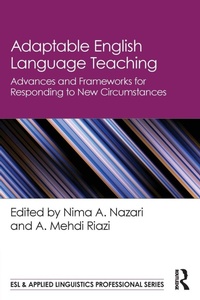
Adaptable English Language Teaching
Advances and Frameworks for Responding to New Circumstances
1st Edition
Published on 6. September 2024
Book
Paperback/Softback
276 pages
978-1-032-41429-4 (ISBN)
Description
In an age of rapid technological transformation and evolving teaching settings, the ELT community must adapt to the needs of emerging situations and a diverse range of learners. Adaptable English Language Teaching addresses this need by bringing together contributions from renowned scholars around the world with insights on all major areas of English language teaching with an emphasis on adaptability-of teaching method, context, skills, and priorities.
Organized around an innovative past-present-future structure, chapters offer methods, strategies, and perspectives that are adaptable to any difficult or under-resourced context. It delves into engaging through online applications, understanding emerging trends in computer-assisted language learning and teaching, and the implementation of virtual classroom and multimodality in ELT.
Given its multifaceted focus, this book will provide ELT practitioners, trainers, trainees, and researchers with invaluable insights and research findings to effectively navigate and adapt to emerging circumstances.
Organized around an innovative past-present-future structure, chapters offer methods, strategies, and perspectives that are adaptable to any difficult or under-resourced context. It delves into engaging through online applications, understanding emerging trends in computer-assisted language learning and teaching, and the implementation of virtual classroom and multimodality in ELT.
Given its multifaceted focus, this book will provide ELT practitioners, trainers, trainees, and researchers with invaluable insights and research findings to effectively navigate and adapt to emerging circumstances.
More details
Series
Language
English
Place of publication
London
United Kingdom
Publishing group
Taylor & Francis Ltd
Target group
Professional and scholarly
College/higher education
Postgraduate
Illustrations
4 s/w Zeichnungen, 1 farbige Zeichnung, 1 s/w Tabelle, 9 s/w Abbildungen, 2 farbige Abbildungen, 5 s/w Photographien bzw. Rasterbilder, 1 Farbfoto bzw. farbiges Rasterbild
1 Tables, black and white; 1 Line drawings, color; 4 Line drawings, black and white; 1 Halftones, color; 5 Halftones, black and white; 2 Illustrations, color; 9 Illustrations, black and white
Dimensions
Height: 229 mm
Width: 152 mm
Thickness: 16 mm
Weight
429 gr
ISBN-13
978-1-032-41429-4 (9781032414294)
Copyright in bibliographic data and cover images is held by Nielsen Book Services Limited or by the publishers or by their respective licensors: all rights reserved.
Schweitzer Classification
Other editions
Additional editions
Nima A. Nazari | A. Mehdi Riazi
Adaptable English Language Teaching
Advances and Frameworks for Responding to New Circumstances
E-Book
09/2024
1st Edition
Routledge
€59.49
Available for download
Nima A. Nazari | A. Mehdi Riazi
Adaptable English Language Teaching
Advances and Frameworks for Responding to New Circumstances
Book
09/2024
1st Edition
Routledge
€228.50
Shipment within 10-20 days
Nima A. Nazari | A. Mehdi Riazi
Adaptable English Language Teaching
Advances and Frameworks for Responding to New Circumstances
E-Book
09/2024
1st Edition
Routledge
€59.49
Available for download
Persons
Nima A. Nazari is Professor of Applied Linguistics and works as Centre Director at OnCampus London South Bank University, UK.
A. Mehdi Riazi is Professor of Applied Linguistics at the College of Humanities and Social Sciences of Hamad Bin Khalifa University (HBKU), Qatar.
A. Mehdi Riazi is Professor of Applied Linguistics at the College of Humanities and Social Sciences of Hamad Bin Khalifa University (HBKU), Qatar.
Content
Introduction
Section 1: ELT responses to new circumstances
Chapter 1: English language curriculum development in new circumstances
Chapter 2: Sustainability in English language teacher education: Preparing teachers for an unknown future
Chapter 3: Understanding the needs of international EAP students: Adaptive progress
Chapter 4: Silence as autonomy: Case studies of Australian and international students
Section 2: ELT assessment, feedback, and managing classrooms in new circumstances
Chapter 5: New approaches to the assessment of English as an additional language
Chapter 6: Feedback to students in ELT
Chapter 7: ELT classroom management in times of change
Section 3: Teaching English language skills and components in new circumstances
Chapter 8: Teaching listening in new circumstances
Chapter 9: Teaching reading
Chapter 10: Challenges and opportunities in teaching speaking
Chapter 11: L2 Writing Pedagogy: Responding to emerging needs and emergencies
Chapter 12: Adaptable teaching of grammar, vocabulary, and pronunciation: Enhancing fluency and engagement through online apps
Section 4: The contribution of technology to ELT in new circumstances
Chapter 13: Language teachers and teaching technologies: Valuing the teacher and teacher values in online learning
Chapter 14: Computer-assisted language learning and teaching: Emerging trends, challenges, and solutions in ELT
Chapter 15: A Multimodal analysis of roleplays between Upper Intermediate level learners: lessons for teaching oral language competency in online contexts
Conclusion
Section 1: ELT responses to new circumstances
Chapter 1: English language curriculum development in new circumstances
Chapter 2: Sustainability in English language teacher education: Preparing teachers for an unknown future
Chapter 3: Understanding the needs of international EAP students: Adaptive progress
Chapter 4: Silence as autonomy: Case studies of Australian and international students
Section 2: ELT assessment, feedback, and managing classrooms in new circumstances
Chapter 5: New approaches to the assessment of English as an additional language
Chapter 6: Feedback to students in ELT
Chapter 7: ELT classroom management in times of change
Section 3: Teaching English language skills and components in new circumstances
Chapter 8: Teaching listening in new circumstances
Chapter 9: Teaching reading
Chapter 10: Challenges and opportunities in teaching speaking
Chapter 11: L2 Writing Pedagogy: Responding to emerging needs and emergencies
Chapter 12: Adaptable teaching of grammar, vocabulary, and pronunciation: Enhancing fluency and engagement through online apps
Section 4: The contribution of technology to ELT in new circumstances
Chapter 13: Language teachers and teaching technologies: Valuing the teacher and teacher values in online learning
Chapter 14: Computer-assisted language learning and teaching: Emerging trends, challenges, and solutions in ELT
Chapter 15: A Multimodal analysis of roleplays between Upper Intermediate level learners: lessons for teaching oral language competency in online contexts
Conclusion