

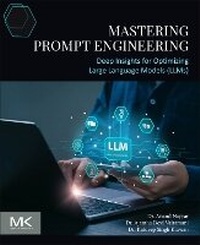
Mastering Prompt Engineering
Deep Insights for Optimizing Large Language Models (LLMs)
Published on 7. August 2025
Book
Paperback/Softback
364 pages
978-0-443-33904-2 (ISBN)
Description
Mastering Prompt Engineering: Deep Insights for Optimizing Large Language Models (LLMs) is a comprehensive guide that takes readers on a journey through the world of Large Language Models (LLMs) and prompt engineering. Covering foundational concepts, advanced techniques, ethical considerations, and real-world case studies, this book equips both novices and experts to navigate the complex LLM landscape. It provides insights into LLM architecture, training, and prompt engineering methods, while addressing ethical concerns such as bias and privacy. Real-world case studies showcase the practical application of prompt engineering in a wide range of settings. This resource is not just for specialists but is a practical and ethically conscious guide for AI practitioners, students, scientific researchers, and anyone interested in harnessing the potential of LLMs in natural language processing and generation. Mastering Prompt Engineering serves as a gateway to a deeper understanding of LLMs and their responsible and effective utilization through its comprehensive, ethical, and practical approach.
More details
Language
English
Place of publication
San Francisco
United States
Publishing group
Elsevier Science & Technology
Target group
Professional and scholarly
Dimensions
Height: 235 mm
Width: 191 mm
Weight
770 gr
ISBN-13
978-0-443-33904-2 (9780443339042)
Copyright in bibliographic data and cover images is held by Nielsen Book Services Limited or by the publishers or by their respective licensors: all rights reserved.
Schweitzer Classification
Other editions
Additional editions
Anand Nayyar | Ajantha Devi Vairamani | Kuldeep Kaswan
Mastering Prompt Engineering
Deep Insights for Optimizing Large Language Models (LLMs)
E-Book
07/2025
Elsevier
€167.99
Available for download
Persons
Dr. Anand Nayyar received his Ph.D (Computer Science) from Desh Bhagat University in 2017 in Wireless Sensor Networks and Swarm Intelligence. He is currently working in School of Computer Science and Artificial Intelligence (SCA), Duy Tan University, Vietnam. He has published numerous research papers in various high-impact journals and holds 100 Patents to his credit in the area of Wireless Communications, Artificial Intelligence, IoT and Image Processing.
Dr. Ajantha Devi Vairamani is a distinguished Research Head at AP3 Solutions in Chennai, India and is a prominent figure in computer science and artificial intelligence. With a PhD from the University of Madras in 2015, she has played pivotal roles in UGC Major Research Projects and holds prestigious certifications from Microsoft Corp. Her academic prowess is evident in over 50 published papers and numerous books in computer science. Actively participating in international conferences, she contributes to research collaboration in various roles. Dr. Ajantha Devi's groundbreaking work in artificial intelligence, machine learning, and deep learning has led to Australian Patents. Her research spans Image Processing, Signal Processing, Pattern Matching, and Natural Language Processing, addressing real-world challenges. Her dedication has earned her Best Paper Presentation Awards and international honors, solidifying her position as a leading figure in the field, influencing both academia and industry.
Dr. Kuldeep Singh Kaswan is a distinguished academic figure, currently affiliated with the School of Computing Science & Engineering at Galgotias University in Uttar Pradesh, India. His extensive contributions are centered around the fields of Brain-Computer Interface (BCI), Cyborg technology, and Data Science. With a remarkable academic journey spanning thirteen years and experience garnered from esteemed global institutions such as Amity University, Noida, Gautam Buddha University in Greater Noida, and PDM University in Bahadurgarh, he has solidified his position as a leading expert in his domain. Dr. Kaswan holds a Doctorate in Computer Science from Banasthali Vidyapith in Rajasthan, a testament to his dedication to advancing knowledge in his field. He has also been awarded the prestigious Doctor of Engineering (D. Engg.) degree from the Dana Brain Health Institute in Iran, further enhancing his international recognition and expertise. His academic journey includes a Master's Degree in Computer Science and Engineering from Choudhary Devi Lal University in Sirsa, Haryana. A true mentor and guide, Dr. Kaswan has played a pivotal role in supervising numerous undergraduate and postgraduate projects for engineering students. He has authored nine books and contributed more than 50 book chapters, both at the national and international levels. His extensive body of work also includes numerous publications in esteemed international and national journals, as well as presentations at conferences.
Dr. Ajantha Devi Vairamani is a distinguished Research Head at AP3 Solutions in Chennai, India and is a prominent figure in computer science and artificial intelligence. With a PhD from the University of Madras in 2015, she has played pivotal roles in UGC Major Research Projects and holds prestigious certifications from Microsoft Corp. Her academic prowess is evident in over 50 published papers and numerous books in computer science. Actively participating in international conferences, she contributes to research collaboration in various roles. Dr. Ajantha Devi's groundbreaking work in artificial intelligence, machine learning, and deep learning has led to Australian Patents. Her research spans Image Processing, Signal Processing, Pattern Matching, and Natural Language Processing, addressing real-world challenges. Her dedication has earned her Best Paper Presentation Awards and international honors, solidifying her position as a leading figure in the field, influencing both academia and industry.
Dr. Kuldeep Singh Kaswan is a distinguished academic figure, currently affiliated with the School of Computing Science & Engineering at Galgotias University in Uttar Pradesh, India. His extensive contributions are centered around the fields of Brain-Computer Interface (BCI), Cyborg technology, and Data Science. With a remarkable academic journey spanning thirteen years and experience garnered from esteemed global institutions such as Amity University, Noida, Gautam Buddha University in Greater Noida, and PDM University in Bahadurgarh, he has solidified his position as a leading expert in his domain. Dr. Kaswan holds a Doctorate in Computer Science from Banasthali Vidyapith in Rajasthan, a testament to his dedication to advancing knowledge in his field. He has also been awarded the prestigious Doctor of Engineering (D. Engg.) degree from the Dana Brain Health Institute in Iran, further enhancing his international recognition and expertise. His academic journey includes a Master's Degree in Computer Science and Engineering from Choudhary Devi Lal University in Sirsa, Haryana. A true mentor and guide, Dr. Kaswan has played a pivotal role in supervising numerous undergraduate and postgraduate projects for engineering students. He has authored nine books and contributed more than 50 book chapters, both at the national and international levels. His extensive body of work also includes numerous publications in esteemed international and national journals, as well as presentations at conferences.
Content
1. Basic Insights into Large Language Models
2. Foundations of LLM-based Prompt Engineering
3. Familiarity with Prompt Design
4. Pre-processing and Tokenization in Prompt Engineering
5. State-of-the-Art Techniques in Prompt Engineering
6. Diverse Prompt Engineering Models and their Implementations
7. Evaluation and Refinement of Prompt Engineering
8. Prompt Engineering: Ethical Considerations and Challenges
9. Case Studies in Prompt Engineering
10. Future Trends in Large Language Models and Prompt Engineering cum Concluding Remarks
2. Foundations of LLM-based Prompt Engineering
3. Familiarity with Prompt Design
4. Pre-processing and Tokenization in Prompt Engineering
5. State-of-the-Art Techniques in Prompt Engineering
6. Diverse Prompt Engineering Models and their Implementations
7. Evaluation and Refinement of Prompt Engineering
8. Prompt Engineering: Ethical Considerations and Challenges
9. Case Studies in Prompt Engineering
10. Future Trends in Large Language Models and Prompt Engineering cum Concluding Remarks