

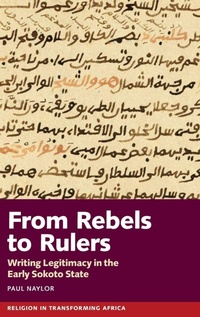
From Rebels to Rulers
Writing Legitimacy in the Early Sokoto State
Published on 2. August 2021
Book
Hardback
228 pages
978-1-84701-270-8 (ISBN)
Description
A reinterpretation of the history of Sokoto that provides a new assessment of its leaders and their visions for the Muslim state.
Sokoto was the largest and longest lasting of West Africa's nineteenth-century Muslim empires. Its intellectual and political elite left behind a vast written record, including over 300 Arabic texts authored by the jihad's leaders: Usman dan Fodio, his brother Abdullahi and his son, Muhammad Bello (known collectively as the Fodiawa). Sokoto's early years are one of the most documented periods of pre-colonial African history, yet current narratives pay little attention to the formative role these texts played in the creation of Sokoto, and the complex scholarly world from which they originated. Far from being unified around a single concept of Muslim statecraft, this book demonstrates how divided the Fodiawa were about what Sokoto could and should be, and the various discursive strategies they used to enrol local societies into their vision. Based on a close analysis of the sources (some appearing in English translation for the first time) and an effort to date their intellectual production, the book restores agency to Sokoto's leaders as individuals with different goals, characters and methods. More generally, it shows how revolutionary religious movements gain legitimacy, and how the kind of legitimacy they claim changes as they move from rebels to rulers.
Sokoto was the largest and longest lasting of West Africa's nineteenth-century Muslim empires. Its intellectual and political elite left behind a vast written record, including over 300 Arabic texts authored by the jihad's leaders: Usman dan Fodio, his brother Abdullahi and his son, Muhammad Bello (known collectively as the Fodiawa). Sokoto's early years are one of the most documented periods of pre-colonial African history, yet current narratives pay little attention to the formative role these texts played in the creation of Sokoto, and the complex scholarly world from which they originated. Far from being unified around a single concept of Muslim statecraft, this book demonstrates how divided the Fodiawa were about what Sokoto could and should be, and the various discursive strategies they used to enrol local societies into their vision. Based on a close analysis of the sources (some appearing in English translation for the first time) and an effort to date their intellectual production, the book restores agency to Sokoto's leaders as individuals with different goals, characters and methods. More generally, it shows how revolutionary religious movements gain legitimacy, and how the kind of legitimacy they claim changes as they move from rebels to rulers.
Reviews / Votes
Naylor's study has bought some new dimensions to understanding the Sokoto empire through the texts written by its founders. The study not only allows one to understand the Sahelian territory but also helps to better map out the geographical, linguistic, cultural, and socio-political make-up of greater Africa. Naylor's study has reasonably succeeded in making accessible to the public a very specific part of Africa's history, which otherwise would have remained inaccessible. ... Paul Naylor must be congratulated for his contribution and bringing to light this much-needed volume. * Islamic Literary Society * This is the most important new book on northern Nigeria's precolonial past that has come out for some years. -- Journal of African HistoryMore details
Series
Language
English
Place of publication
Oxford
United Kingdom
Target group
Professional and scholarly
Product notice
Cloth over boards
Illustrations
4 Karten
4 Maps
Dimensions
Height: 240 mm
Width: 161 mm
Thickness: 17 mm
Weight
505 gr
ISBN-13
978-1-84701-270-8 (9781847012708)
Copyright in bibliographic data and cover images is held by Nielsen Book Services Limited or by the publishers or by their respective licensors: all rights reserved.
Schweitzer Classification
Other editions
Additional editions
Book
01/2024
James Currey
€30.90
Shipment within 3-4 weeks
E-Book
08/2021
1st Edition
De Gruyter
€48.99
Available for download
Person
PAUL NAYLOR is a Cataloguer of West African Manuscripts at the Hill Museum and Manuscript Library, Minnesota. He has held teaching positions at Loyola University Chicago and Tulane University's Africana Studies Program.
Content
Introduction
The Arabic Writings of the Fodiawa in their Context
A History of the Historiography
Approaching Legitimacy
1. Sources of Legitimacy in the Nineteenth-Century Sahel
Fiqh
Kashf
Nasab
Conclusion
2. Discourses of Dissent and Moderation
Laying Claims to Legitimacy: Usman's Writings in the 1790s
A Discourse of Dissent (c.1804-1810)
A Discourse of Moderation (1810-1812)
The Intellectual Challenge of Abdullahi dan Fodio (c.1812-1817)
Conclusion: from Ijtihad to Taqlid
3. 'Lesser of two evils': The Succession of Muhammad Bello
Defending the Succession (1817)
A Second Jihad (1817-1821)
'Fear them not, but fear me': Enforcing Obedience to Bello's Rule
Creating a Caliphate: Bello's Exchanges with Ahmad Lobbo
Conclusion
4. 'God has subjugated this land for me': Bello's Rule of Sokoto 1821-1837
Policies of Integration: The Hausa
Policies of Enslavement
Policies of Exclusion: The Tuareg
Policies of Sedentarisation: The Fulani
Meanwhile, in Gwandu...
Conclusion
Appendix: Sokoto Chronology
Bibliography
The Arabic Writings of the Fodiawa in their Context
A History of the Historiography
Approaching Legitimacy
1. Sources of Legitimacy in the Nineteenth-Century Sahel
Fiqh
Kashf
Nasab
Conclusion
2. Discourses of Dissent and Moderation
Laying Claims to Legitimacy: Usman's Writings in the 1790s
A Discourse of Dissent (c.1804-1810)
A Discourse of Moderation (1810-1812)
The Intellectual Challenge of Abdullahi dan Fodio (c.1812-1817)
Conclusion: from Ijtihad to Taqlid
3. 'Lesser of two evils': The Succession of Muhammad Bello
Defending the Succession (1817)
A Second Jihad (1817-1821)
'Fear them not, but fear me': Enforcing Obedience to Bello's Rule
Creating a Caliphate: Bello's Exchanges with Ahmad Lobbo
Conclusion
4. 'God has subjugated this land for me': Bello's Rule of Sokoto 1821-1837
Policies of Integration: The Hausa
Policies of Enslavement
Policies of Exclusion: The Tuareg
Policies of Sedentarisation: The Fulani
Meanwhile, in Gwandu...
Conclusion
Appendix: Sokoto Chronology
Bibliography