

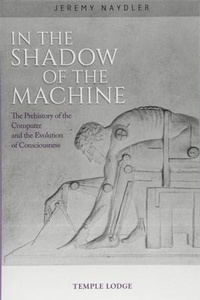
In The Shadow of the Machine
The Prehistory of the Computer and the Evolution of Consciousness
Will be published approx. on 29. May 2018
Book
Paperback/Softback
392 pages
978-1-912230-14-3 (ISBN)
Description
Contemporary life is so deeply reliant upon digital technology that the computer has come to dominate almost every aspect of our culture. What is the philosophical and spiritual significance of this dependence on electronic technology, both for our relationship to nature and for the future of humanity? And, what processes in human perception and awareness have produced the situation we find ourselves in?
As Jeremy Naydler elucidates in this penetrating study, we cannot understand the emergence of the computer without seeing it within the wider context of the evolution of human consciousness, which has taken place over millennia. Modern consciousness, he shows, has evolved in conjunction with the development of machines and under their intensifying shadow.
The computer was the product of a long historical development, culminating in the scientific revolution of the 17th century. It was during this period that the first mechanical calculators were invented and the project to create more complex `thinking machines' began in earnest. But the seeds were sown many hundreds of years earlier, deep in antiquity. Naydler paints a vast panorama depicting human development and the emergence of electronic technology. His painstaking research illuminates an urgent question that concerns every living person today: What does it mean to be human and what, if anything, distinguishes us from machines?
As Jeremy Naydler elucidates in this penetrating study, we cannot understand the emergence of the computer without seeing it within the wider context of the evolution of human consciousness, which has taken place over millennia. Modern consciousness, he shows, has evolved in conjunction with the development of machines and under their intensifying shadow.
The computer was the product of a long historical development, culminating in the scientific revolution of the 17th century. It was during this period that the first mechanical calculators were invented and the project to create more complex `thinking machines' began in earnest. But the seeds were sown many hundreds of years earlier, deep in antiquity. Naydler paints a vast panorama depicting human development and the emergence of electronic technology. His painstaking research illuminates an urgent question that concerns every living person today: What does it mean to be human and what, if anything, distinguishes us from machines?
More details
Language
English
Place of publication
East Sussex
United Kingdom
Target group
Professional and scholarly
Illustrations
black & white illustrations and line drawings
Dimensions
Height: 233 mm
Width: 154 mm
Thickness: 32 mm
Weight
627 gr
ISBN-13
978-1-912230-14-3 (9781912230143)
Copyright in bibliographic data and cover images is held by Nielsen Book Services Limited or by the publishers or by their respective licensors: all rights reserved.
Schweitzer Classification
Person
JEREMY NAYDLER, PH.D., holds a doctorate in theology and religious studies, and is a philosopher, cultural historian and gardener who lives and works in Oxford, England. He has long been interested in the history of consciousness and sees the study of past cultures - which were more open to the world of spirit than our own, predominantly secular, culture - as relevant both to understanding our situation today and to finding pathways into the future. His longstanding concern about the impact of electronic technologies on our inner life and on our relationship to nature has found expression in numerous articles contributed to magazines such as New View, Self and Society and Resurgence.
Content
Preface and Acknowledgements
PART ONE: THE ANCIENT WORLD - CHAPTER ONE Participative Consciousness in Deep Antiquity; CHAPTER TWO
The Gods and Technological Consciousness in the Ancient Near East; CHAPTER THREE Poets, Visionaries and the Rise of the Clever Man; CHAPTER FOUR Harnessing Logic to the Pursuit of Wisdom; CHAPTER FIVE Technology in the Greco-Roman Age; CHAPTER SIX The Eclipse of the Mystery Knowledge of Electricity; PART TWO: THE MIDDLE AGES - CHAPTER SEVEN Grammar and Logic in the Middle Ages; CHAPTER EIGHT The Logic Machine and the Cam Logical Devices; CHAPTER NINE The Mechanical Clock and Human Consciousness; CHAPTER TEN The Quantification of the World
The Denial of Ideas in Nature; CHAPTER ELEVEN The Renunciation of the Upper Border; Notes, Index
PART ONE: THE ANCIENT WORLD - CHAPTER ONE Participative Consciousness in Deep Antiquity; CHAPTER TWO
The Gods and Technological Consciousness in the Ancient Near East; CHAPTER THREE Poets, Visionaries and the Rise of the Clever Man; CHAPTER FOUR Harnessing Logic to the Pursuit of Wisdom; CHAPTER FIVE Technology in the Greco-Roman Age; CHAPTER SIX The Eclipse of the Mystery Knowledge of Electricity; PART TWO: THE MIDDLE AGES - CHAPTER SEVEN Grammar and Logic in the Middle Ages; CHAPTER EIGHT The Logic Machine and the Cam Logical Devices; CHAPTER NINE The Mechanical Clock and Human Consciousness; CHAPTER TEN The Quantification of the World
The Denial of Ideas in Nature; CHAPTER ELEVEN The Renunciation of the Upper Border; Notes, Index