

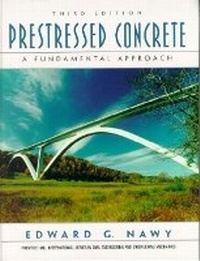
Prestressed Concrete
A Fundamental Approach
3rd Edition
Published on 13. January 2000
Book
Hardback
939 pages
978-0-13-020593-3 (ISBN)
Description
Created for senior-level undergraduate and graduate Civil Engineering courses.
Completely revised to reflect the new ACI 318 Building Code, this popular text offers a unique approach to examining the design of prestressed concrete members in a logical, step-by- step trial and adjustment procedure. Encouraging clear, systematic thinking, it integrates handy flow charts to better understand the steps needed for design and analysis. Extensive discussions on material properties and concrete performance are provided, as well as an in-depth analysis of prestressing of circular tanks for liquid and gas containment and their prestressed shell roofs.
Completely revised to reflect the new ACI 318 Building Code, this popular text offers a unique approach to examining the design of prestressed concrete members in a logical, step-by- step trial and adjustment procedure. Encouraging clear, systematic thinking, it integrates handy flow charts to better understand the steps needed for design and analysis. Extensive discussions on material properties and concrete performance are provided, as well as an in-depth analysis of prestressing of circular tanks for liquid and gas containment and their prestressed shell roofs.
More details
Edition
3rd edition
Language
English
Place of publication
United States
Publishing group
Pearson Education (US)
Target group
College/higher education
Dimensions
Height: 260 mm
Width: 210 mm
Thickness: 38 mm
Weight
1844 gr
ISBN-13
978-0-13-020593-3 (9780130205933)
Copyright in bibliographic data and cover images is held by Nielsen Book Services Limited or by the publishers or by their respective licensors: all rights reserved.
Schweitzer Classification
Other editions
New editions
Book
07/2002
4th Edition
Pearson
€53.31
Article exhausted; check for reprint
Person
DR. EDWARD G. NAWY is a distinguished profession in the Department of Civil and Environmental Engineering at Rutgers, The State University of New Jersey. He has been active in the ACI and PCI since 1949 and is internationally recognized for his extensive work in the fields of reinforced and prestressed concrete, particularly in the areas of crack and deflection control. Dr. Nawy has published in excess of 160 papers in numerous technical journals worldwide and is the author of Reinforced Concrete: A Fundamental Approach, 4th Edition, (c)2000, published by Prentice Hall, Fundamentals of High Performance Concrete, 2nd Edition, (c)2000, published by John Wiley and Sons, and Concrete Construction Engineering Handbook, (c)1998, published by CRC Press. He is the recipient of several major awards, including the Henry L. Kennedy Award of the ACI, honorary professorship, Nanjing Institute of Technology, and is Evaluator for the Accreditation Board for Engineering and Technology (ABET). He is licensed Professional Engineer in the States of New York, New Jersey, Pennsylvania, California and Florida, and has been a consultant in structural engineering to agencies throughout the United States.
Content
1. Basic Concepts.
2. Materials and Systems for Prestressing.
3. Partial Loss of Prestress.
4. Flexural Design of Prestressed Concrete Elements.
5. Shear and Torsion Strength Design.
6. Indeterminate Prestressed Concrete Structures.
7. Camber, Deflection, and Crack Control.
8. Prestressed Compression and Tension Members.
9. Two-Way Prestressed Concrete Floor Systems.
10. Connections for Prestressed Concrete Elements.
11. Prestressed Concrete Circular Storage Tanks and Steel Roofs.
12. LRFD and Standard AASHTO Design of Concrete Bridges.
13. Seismic Design of Prestressed Concrete Structures.
Appendix A. Computer Programs in Q-Basic.
Appendix B. Unit Conversions, Design Information, Properties of Reinforcement.
Appendix C. Selected Typical Standard Precast Double Tees, Inverted Tees, Hollow Core Sections, and AASHTO Bridge Sections.
Index.
2. Materials and Systems for Prestressing.
3. Partial Loss of Prestress.
4. Flexural Design of Prestressed Concrete Elements.
5. Shear and Torsion Strength Design.
6. Indeterminate Prestressed Concrete Structures.
7. Camber, Deflection, and Crack Control.
8. Prestressed Compression and Tension Members.
9. Two-Way Prestressed Concrete Floor Systems.
10. Connections for Prestressed Concrete Elements.
11. Prestressed Concrete Circular Storage Tanks and Steel Roofs.
12. LRFD and Standard AASHTO Design of Concrete Bridges.
13. Seismic Design of Prestressed Concrete Structures.
Appendix A. Computer Programs in Q-Basic.
Appendix B. Unit Conversions, Design Information, Properties of Reinforcement.
Appendix C. Selected Typical Standard Precast Double Tees, Inverted Tees, Hollow Core Sections, and AASHTO Bridge Sections.
Index.