

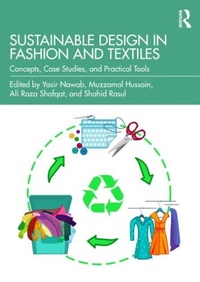
Sustainable Design in Fashion and Textiles
Concepts, Case Studies, and Practical Tools
1st Edition
Will be published approx. on 20. October 2026
Book
Hardback
280 pages
978-1-041-06964-5 (ISBN)
Description
Addressing the urgent environmental issues resulting from conventional textile production, this book delivers essential knowledge and tools that will enable policymakers, industry professionals, and students to implement sustainable practices and reduce the environmental impact of these sectors globally.
Providing a comprehensive guide to how to apply sustainable design principles, the book covers a broad range of topics and opens with an introduction to sustainable design concepts and the pressing need for change in the textile industry. It examines environmentally-friendly processing techniques, sustainable fibres and materials, life cycle analysis (LCA) and the environmental impacts of current practices through case studies from Asia, Europe, and North America. It promotes discussions on traceability and the integration of circular economy principles, including upcycling, closed-loop systems, and disassembly-friendly design, and showcases practical applications of these ideas. Each chapter concludes with summaries of the key concepts and practical takeaways. The book provides readers with an in depth understanding of the commercial implications of sustainable design, including market trends, regulatory compliance, benefits of eco-labelling and certification, and the promotion of openness and accountability in the supply chain.
Designed as both a professional reference and an academic resource, this book catalyzes systemic transformation by equipping stakeholders with the knowledge and tools necessary to reduce environmental impact, enhance transparency, and build resilient circular business models. In doing so, it supports industry professionals, such as fashion designers, textile engineers, sustainability consultants, businesses, and policymakers, with everything they need to stay ahead in a rapidly developing sector.
Providing a comprehensive guide to how to apply sustainable design principles, the book covers a broad range of topics and opens with an introduction to sustainable design concepts and the pressing need for change in the textile industry. It examines environmentally-friendly processing techniques, sustainable fibres and materials, life cycle analysis (LCA) and the environmental impacts of current practices through case studies from Asia, Europe, and North America. It promotes discussions on traceability and the integration of circular economy principles, including upcycling, closed-loop systems, and disassembly-friendly design, and showcases practical applications of these ideas. Each chapter concludes with summaries of the key concepts and practical takeaways. The book provides readers with an in depth understanding of the commercial implications of sustainable design, including market trends, regulatory compliance, benefits of eco-labelling and certification, and the promotion of openness and accountability in the supply chain.
Designed as both a professional reference and an academic resource, this book catalyzes systemic transformation by equipping stakeholders with the knowledge and tools necessary to reduce environmental impact, enhance transparency, and build resilient circular business models. In doing so, it supports industry professionals, such as fashion designers, textile engineers, sustainability consultants, businesses, and policymakers, with everything they need to stay ahead in a rapidly developing sector.
More details
Language
English
Place of publication
London
United Kingdom
Publishing group
Taylor & Francis Ltd
Target group
College/higher education
Professional and scholarly
Postgraduate, Professional Practice & Development, and Undergraduate Advanced
Illustrations
50 farbige Zeichnungen, 17 s/w Tabellen, 63 farbige Abbildungen, 13 Farbfotos bzw. farbige Rasterbilder
17 Tables, black and white; 50 Line drawings, color; 13 Halftones, color; 63 Illustrations, color
Dimensions
Height: 246 mm
Width: 174 mm
ISBN-13
978-1-041-06964-5 (9781041069645)
Copyright in bibliographic data and cover images is held by Nielsen Book Services Limited or by the publishers or by their respective licensors: all rights reserved.
Schweitzer Classification
Other editions
Additional editions

Yasir Nawab | Muzzamal Hussain | Ali Raza Shafqat
Sustainable Design in Fashion and Textiles
Concepts, Case Studies, and Practical Tools
E-Book
approx. 10/2026
Routledge
€49.99
Not yet available
Yasir Nawab | Muzzamal Hussain | Ali Raza Shafqat
Sustainable Design in Fashion and Textiles
Concepts, Case Studies, and Practical Tools
Book
approx. 10/2026
1st Edition
Routledge
€47.50
Not yet published
Yasir Nawab | Muzzamal Hussain | Ali Raza Shafqat
Sustainable Design in Fashion and Textiles
Concepts, Case Studies, and Practical Tools
E-Book
approx. 10/2026
Routledge
€49.99
Not yet available
Persons
Yasir Nawab is Vice Chancellor of the University of Kamalia, Pakistan, and a Tenured Professor at the National Textile University, Faisalabad, with an adjunct affiliation at North Carolina State University, USA. He has authored over 170 journal publications and edited more than 10 books. His research focuses on sustainable textiles, the circular economy, and advanced materials. He serves as Co-Chairman of the Pakistan Circular Textile Platform and contributes to global sustainability initiatives, including collaborations with WWF-Pakistan. Dr. Nawab is a member of leading professional bodies such as the Materials Research Society and the Textile Institute (UK).
Muzzamal Hussain is CEO of KnowTex, Pakistan, and Assistant Professor at the National Textile University, Faisalabad. He also serves as Director of the National Centre for Composite Materials. His research focuses on sustainable textile engineering, composite materials, and alternative fibers. He has authored over 22 journal publications and several book chapters, and has contributed to technology commercialization, including licensed innovations using agricultural waste fibers. Dr. Hussain is a member of professional bodies including the Society of Plastics Engineers (USA), the Institution of Engineers Pakistan, and the Pakistan Engineering Council.
Ali Raza Shafqat is CEO of ReComp Solutions, Pakistan, and a Lecturer in the Department of Textile Engineering & Design at BUITEMS, Quetta. He is also a PhD scholar at the National Textile University, Faisalabad. His research focuses on sustainable textile composites, the circular economy, and the valorization of textile and agricultural waste into innovative materials. He has contributed to multiple research projects, publications, and international conferences. His work integrates academia and industry to develop scalable, sustainable solutions for the fashion and textile sector.
Shahid Rasul is an Associate Professor of Mechanical Engineering at Northumbria University, UK. His research focuses on sustainable materials, the circular economy, and energy systems. He leads innovative initiatives such as the Texonomy project, aimed at transforming the textile sector through circular and low-carbon solutions. With international academic experience spanning Japan, Saudi Arabia, and the UK, he actively collaborates with industry and academia to address global sustainability challenges and promote clean energy and materials innovation.
Muzzamal Hussain is CEO of KnowTex, Pakistan, and Assistant Professor at the National Textile University, Faisalabad. He also serves as Director of the National Centre for Composite Materials. His research focuses on sustainable textile engineering, composite materials, and alternative fibers. He has authored over 22 journal publications and several book chapters, and has contributed to technology commercialization, including licensed innovations using agricultural waste fibers. Dr. Hussain is a member of professional bodies including the Society of Plastics Engineers (USA), the Institution of Engineers Pakistan, and the Pakistan Engineering Council.
Ali Raza Shafqat is CEO of ReComp Solutions, Pakistan, and a Lecturer in the Department of Textile Engineering & Design at BUITEMS, Quetta. He is also a PhD scholar at the National Textile University, Faisalabad. His research focuses on sustainable textile composites, the circular economy, and the valorization of textile and agricultural waste into innovative materials. He has contributed to multiple research projects, publications, and international conferences. His work integrates academia and industry to develop scalable, sustainable solutions for the fashion and textile sector.
Shahid Rasul is an Associate Professor of Mechanical Engineering at Northumbria University, UK. His research focuses on sustainable materials, the circular economy, and energy systems. He leads innovative initiatives such as the Texonomy project, aimed at transforming the textile sector through circular and low-carbon solutions. With international academic experience spanning Japan, Saudi Arabia, and the UK, he actively collaborates with industry and academia to address global sustainability challenges and promote clean energy and materials innovation.
Content
Section 1: Foundations of Sustainable Design in Textiles and Fashion 1. Introduction to Sustainable Design in Fashion and Textiles 2. Environmental Impact of Conventional Textile Production 3. Principles of Sustainable Design and Circular Design 4. Science-Led Design for Sustainable Fashion Futures Section 2: Materials, Processes, and Innovations 5. Innovation in Sustainable Fibers and Materials 6. Responsible Textile Production Techniques 7. Tools and Methods for Sustainable Design in Fashion and Textiles 8. Circular Design and Upcycling Practices Section 3: Business Strategies, Policy, and Industry Applications 9. Sustainable Design for Small and Medium Enterprises (SMEs) 10. Corporate Responsibility, Environmental and Social Governance (ESG), and Sustainable Business Models 11. Life Cycle Assessment (LCA) and Product Environmental Footprint (PEF) in Textiles 12. Eco-Labelling, Certifications, and Traceability in Textiles Section 4: Future Trends in Sustainable Design for Textiles and Fashion 13. Future Trends in Sustainable Design for Textiles and Fashion 14. Conclusion