

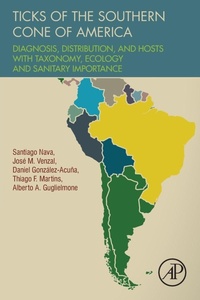
Ticks of the Southern Cone of America
Diagnosis, Distribution, and Hosts with Taxonomy, Ecology and Sanitary Importance
Published on 15. February 2017
Book
Paperback/Softback
372 pages
978-0-12-811075-1 (ISBN)
Description
Ticks of the Southern Cone of America: Diagnosis, Distribution and Hosts with Taxonomy, Ecology and Sanitary Importance focuses on the tick species prevalent in The Southern Cone of America, including their distribution, biology, associated pathogens, their effects on the host, and control methods.
Based on review of the literature from more than five decades, 62 species of both hard and soft tick have been discovered on the Southern Cone of America. Tick genera observed and recorded include Amblyomma, Dermacentor, Haemaphysalis, Ixodes, and Rhipicephalus.
Based on review of the literature from more than five decades, 62 species of both hard and soft tick have been discovered on the Southern Cone of America. Tick genera observed and recorded include Amblyomma, Dermacentor, Haemaphysalis, Ixodes, and Rhipicephalus.
More details
Language
English
Place of publication
San Diego
United States
Publishing group
Elsevier Science Publishing Co Inc
Target group
Professional and scholarly
This book can be used by the researchers, scientists, undergraduate / graduate students in parasitology, entomology, biology and veterinary/medical practitioners.
Product notice
Paperback (trade)
Dimensions
Height: 229 mm
Width: 152 mm
Thickness: 20 mm
Weight
501 gr
ISBN-13
978-0-12-811075-1 (9780128110751)
Copyright in bibliographic data and cover images is held by Nielsen Book Services Limited or by the publishers or by their respective licensors: all rights reserved.
Schweitzer Classification
Other editions
Additional editions
Santiago Nava | Jose M. Venzal | Daniel González Acuña
Ticks of the Southern Cone of America
Diagnosis, Distribution, and Hosts with Taxonomy, Ecology and Sanitary Importance
E-Book
02/2017
Academic Press
€71.95
Available for download
Persons
Dr Nava is a young Argentinean researcher whose interest is focused on systematics, ecology and control of ticks, and epidemiology of tick-borne pathogens. Within this subject area he coordinates different projects on ticks with medical and veterinary importance. The principal contribution of Dr. Nava has been in the study of Neotropical ticks, and he also has an active collaboration with scientists from more than 20 countries from America, Europe and Africa. Jose M. VENZAL is a young Uruguayan researcher on ticks and tick-borne diseases with a great expertise in systematic and phylogeny of Argasidae, a field mastered for few persons worldwide. The contribution of Prof. Venzal has been fundamental to describe several new Neotropical species of ticks (argasids and ixodids) but also for tick ecology and epidemiology of ticks-transmitted diseases. He received the Scopus Award Uruguay 2011 in the area of Agricultural Sciences. Editorial Elsevier and the National Academy of Veterinary Medicine of Uruguay Award 2008. Daniel Gonzalez Acuna is a doctor in Veterinary Medicine at the Institute of Wildlife of the Veterinary Medicine Superior School of Hannover, Germany. Full Professor of the Faculty of Veterinary at the Universidad de Concepcion, where he teaches General Zoology for students of Veterinary Medicine and Agriculture Zoology for students of Agronomy. Prof. Gonzalez-Acuna is specialized in parasites of Chile?s wild fauna; within this endevour he coordinated several research projects about ticks from the wild fauna in Chile. His contribution resulted in the description of several new species of ticks found in Chile and neighbor countries, and relevant biogeography information. Dr. Martins is a Brazilian posdoc student with a prolific contribution on tick taxonomy and ecology. Dr. Martins made a very important contribution for the diagnoses of Argentinian and Brazilian nymphs from the genus Amblyomma, the most numerically important tick genus in South America. He is an active collaborator with many tick-research groups in Brazil and elsewhere providing his expertise for tick identification. Dr. Guglielmone is a senior Argentinean scientist with a long career on ticks and cattle tick-borne diseases started in 1975 but currently dealing with biogeography of Ixodidae. Dr. Guglielmone contributed with more than 300 scientific articles and several books, and collaborated with scientists from more than 30 countries. He also received several awards and is a member of the Academia Nacional de Agronomia y Veterinaria (Argentina).
Author
Instituto Nacional de Tecnologica, Agropecuaria Buenos Aires, Estacion Experimental Agropecuaria, Santa Fe, Argentina
Professor, Laboratorio de Vectores y Enfermedades transmitidas, Facultad de Veterinaria, CENUR Litoral Norte, Universidad de la Republica, Uruguay
Profesor, Facultad de Ciencias Veterinarias, Universidad de Concepcion, Chillan, Chile
Department of Preventive Veterinary Medicine and Animal Health, Faculty of Veterinary Medicine, University of Sao Paulo, Brazil
Senior Scientist, Estacion Experimental Agropecuaria Rafaela, Instituto Nacional de Tecnologia Agropecuaria, and Superior Scientist, Consejo Nacional de Investigaciones Cientifica y Tecnicas, Argentina
Content
1. Tick Classification, External Tick Anatomy with a Glossary, and Biological Cycles2. Genera and Species of Ixodidae3. Genera and Species of Argasidae4. Morphological Keys for Genera and Species of Ixodidae and Argasidae