

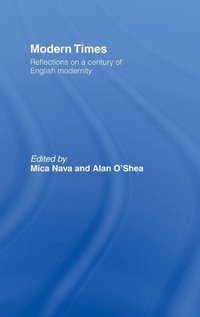
Modern Times
Reflections on a Century of English Modernity
Published on 28. December 1995
Book
Hardback
280 pages
978-0-415-06932-8 (ISBN)
Description
Confronting the contemporary poststructuralist debate from the perspective of cultural of cultural historiography, this book presents an historical study of race and ethnicity. Specifically, it provides an account, both theoretical and applied, of the combination of sexual, racial and ethnic underpinning and shaping the experiences of English men and women in various colonies in the nineteenth century. Although accessible for the student, the book will be received seriously by both theorists and historians.
More details
Language
English
Place of publication
London
United Kingdom
Publishing group
Taylor & Francis Ltd
Target group
College/higher education
Professional and scholarly
Postgraduate
Dimensions
Height: 240 mm
Width: 161 mm
Thickness: 20 mm
Weight
590 gr
ISBN-13
978-0-415-06932-8 (9780415069328)
Copyright in bibliographic data and cover images is held by Nielsen Book Services Limited or by the publishers or by their respective licensors: all rights reserved.
Schweitzer Classification
Other editions
Additional editions
E-Book
04/2013
1st Edition
Routledge
€69.99
Available for download
E-Book
04/2013
1st Edition
Routledge
€69.99
Available for download
Book
12/1995
Routledge
€69.00
Shipment within 15-20 days
Persons
Mica Nava, Alan O¿Shea
Content
1. English subjects of Modernity - Alan O'Shea 2. Modernity's disavowal: women, the city and the department store - Mica Nava 3. Sensation of the abyss: the urban poor and Modernity - John Marriott 4. Night battles: hooligan and citizen - Bill Schwarz 5. Sodomy to Salome: Camp revisions of Modernism, Modernity and Masquerade - Peter Horne 6. The mysteries and secrets of women's bodies: sexual knowledge in the first half of the twentieth century - Sally Alexander 7. Black Metropolis, White England - Bill Schwarz 8. Re-placing British music - Andrew Blake 9. What a day for a daydream: cinema, Modernity and the popular imagination in the late twentieth century - Alan O'Shea