

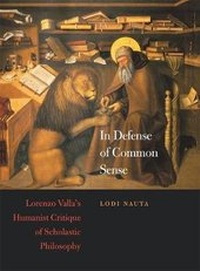
In Defense of Common Sense
Lorenzo Valla's Humanist Critique of Scholastic Philosophy
Will be published approx. on 31. March 2009
Book
Hardback
416 pages
978-0-674-03269-9 (ISBN)
Description
One of the leading humanists of Quattrocento Italy, Lorenzo Valla (ca. 1406-1457) has been praised as a brilliant debunker of medieval scholastic philosophy. In this book Lodi Nauta seeks a more balanced assessment, presenting us with the first comprehensive analysis of the humanist's attempt at radical reform of Aristotelian scholasticism.
This study examines Valla's attack on major tenets of Aristotelian metaphysics, showing how Valla employed common sense and linguistic usage as his guides. It then explicates Valla's critique of Aristotelian psychology and natural philosophy and discusses his moral and religious views, including Valla's notorious identification of Christian beatitude with Epicurean pleasure and his daring views on the Trinity. Finally, it takes up Valla's humanist dialectic, which seeks to transform logic into a practical tool measured by persuasiveness and effectiveness.
Nauta firmly places Valla's arguments and ideas within the contexts of ancient and medieval philosophical traditions as well as renewed interest in ancient rhetoric in the Renaissance. He also demonstrates the relevance of Valla's conviction that the philosophical problems of the scholastics are rooted in a misunderstanding of language. Combining philosophical exegesis and historical scholarship, this book offers a new approach to a major Renaissance thinker.
This study examines Valla's attack on major tenets of Aristotelian metaphysics, showing how Valla employed common sense and linguistic usage as his guides. It then explicates Valla's critique of Aristotelian psychology and natural philosophy and discusses his moral and religious views, including Valla's notorious identification of Christian beatitude with Epicurean pleasure and his daring views on the Trinity. Finally, it takes up Valla's humanist dialectic, which seeks to transform logic into a practical tool measured by persuasiveness and effectiveness.
Nauta firmly places Valla's arguments and ideas within the contexts of ancient and medieval philosophical traditions as well as renewed interest in ancient rhetoric in the Renaissance. He also demonstrates the relevance of Valla's conviction that the philosophical problems of the scholastics are rooted in a misunderstanding of language. Combining philosophical exegesis and historical scholarship, this book offers a new approach to a major Renaissance thinker.
Reviews / Votes
This is by far the best book in any language on Valla as a philosopher. It will immediately take its place on graduate reading lists and in courses on Renaissance humanism and philosophy, and bring Valla into the narrative of Western philosophical history as no book has previously succeeded in doing. -- James Hankins * Harvard University * Tremendously impressive. This is a welcome development in scholarship on Valla. Nauta has written a book that will be consulted for a long time to come. -- Christopher Celenza * Johns Hopkins University *More details
Series
Language
English
Place of publication
Cambridge, Mass
United States
Target group
Adult education
Illustrations
2 tables
Dimensions
Height: 235 mm
Width: 156 mm
Thickness: 32 mm
Weight
748 gr
ISBN-13
978-0-674-03269-9 (9780674032699)
Copyright in bibliographic data and cover images is held by Nielsen Book Services Limited or by the publishers or by their respective licensors: all rights reserved.
Schweitzer Classification
Person
Lodi Nauta is Professor of the History of Philosophy, University of Groningen, the Netherlands.
Content
Preface Introduction PART ONE: The Attack on Aristotelian-Scholastic Metaphysics 1 The Analysis of Things: Substance, Quality, and the Tree of Porphyry 2 Thing and Word: A Critique of Transcendental Terms 3 From a Grammatical Point of View: The Reduction of the Categories PART TWO: Soul, Nature, Morality, and God 4 Soul and Nature: A Critique of Aristotelian Psychology and Natural Philosophy 5 The Virtues and the Road to Heavenly Pleasure 6 Speaking about the Ineffable: The Trinity PART THREE: Toward a Humanist Dialectic 7 Dialectic I: Propositions, the Square of Contraries, Proof and Argument 8 Dialectic II: Forms of Argumentation Conclusion: Valla and "Ordinary Language Philosophy" List of Abbreviations Notes Bibliography