

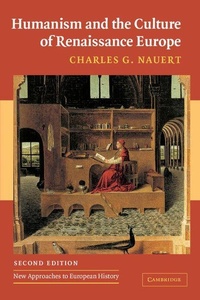
Humanism and the Culture of Renaissance Europe
2nd Edition
Published on 4. May 2006
Book
Paperback/Softback
266 pages
978-0-521-54781-9 (ISBN)
Description
In this updated edition of his classic account, Charles Nauert charts the rise of humanism as the distinctive culture of the social, political and intellectual elites in Renaissance Europe. He traces humanism's emergence in the unique social and cultural conditions of fourteenth-century Italy and its gradual diffusion throughout the rest of Europe. He shows how, despite its elitist origins, humanism became a major force in the popular culture and fine arts of the fifteenth and sixteenth centuries, and the powerful impact it had on both the Protestant and Catholic Reformations. He uses art and biographical sketches of key figures to illuminate the narrative and concludes with an account of the limitations of humanism at the end of the Renaissance. The revised edition includes a section dealing with the place of women in humanistic culture and an updated bibliography. It will be essential reading for all students of Renaissance Europe.
Reviews / Votes
'... lucidly and elegantly written book ... a fine example of that time-honored approach to the subject, intellectual and cultural history ... [This book] is surely destined to establish itself quickly as the best introduction to the subject of Renaissance humanism. In particular, it will be essential reading for graduate students preparing for their comprehensive examinations and for instructors faced with the task of explaining humanism to their students.' James M. Estes, Sixteenth Century Journal 'One would have thought it impossible to write such a book, but Charles Nauert has done it ... this book presents every important aspect of humanist culture, from Petrarch to Montaigne. All this is accomplished with deft authority and with disarming judiciousness ... His book supersedes any previous attempt at such a synthesis, and each chapter, with its own bibliography, is a key to the several sub-fields included here ... the writing is so clear that absolutely any reader, without any special preparation, can use this book as a first step toward mastering the field.' George Hupper, The Historian 'A student reading Nauert will get a comprehensive, intelligent, and eminently sensible discussion of the topic. [Nauert] effectively conveys the sweep of humanism over three centuries. He is notably excellent in discussing the sixteenth century ... in every chapter of the book he convincingly brings out why and how the classical tradition played such an important role in Renaissance humanism.' John Monfasani, International Journal of the Classical TraditionMore details
Series
Edition
Updated edition
Language
English
Place of publication
Cambridge
United Kingdom
Target group
College/higher education
Professional and scholarly
Edition type
Revised edition
Product notice
Paperback (trade)
Illustrations
12 Halftones, unspecified
Dimensions
Height: 229 mm
Width: 152 mm
Thickness: 14 mm
Weight
390 gr
ISBN-13
978-0-521-54781-9 (9780521547819)
Copyright in bibliographic data and cover images is held by Nielsen Book Services Limited or by the publishers or by their respective licensors: all rights reserved.
Schweitzer Classification
Other editions
Additional editions
Charles G. Nauert
Humanism and the Culture of Renaissance Europe
E-Book
05/2006
2nd Edition
Cambridge University Press
€32.49
Available for download
Previous edition
Charles G. Nauert, Jr
Humanism and the Culture of Renaissance Europe
Book
09/1995
Cambridge University Press
€19.80
Article exhausted; check for reprint
Person
Charles G. Nauert is Professor Emeritus of History at the University of Missouri, Columbia. His major publications include several essays on pre-Reformation academic and religious controversies and The Age of Renaissance and Reformation (1977).
Content
Introduction; 1. The birth of humanist culture; 2. Humanism and Italian society; 3. Crossing the Alps; 4. Triumph and disaster; 5. Humanism and High-Renaissance culture; 6. Humanism in the late Renaissance; 7. The end of an age; Bibliography.