

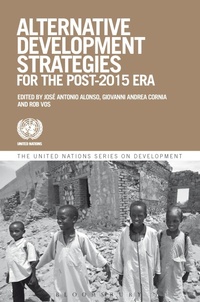
Alternative Development Strategies in the Post-2015 Era
Published on 2. January 2014
Book
Hardback
408 pages
978-1-4725-3240-4 (ISBN)
Description
This book is available as open access through the Bloomsbury Open Access programme and is available on bloomsburycollections.com.
The global economic crisis of 2008-2009 exposed systemic failings at the core of economic policy making worldwide. The crisis came on top of several other crises, including skyrocketing and highly volatile world food and energy prices and climate change. This book argues that new policy approaches are needed to address such devastating global development challenges and to avoid the potentially catastrophic consequences to livelihoods worldwide that would result from present approaches.
The contributors to the book are independent development experts, brought together by the UN to identify a development strategy capable of promoting a broad-based economic recovery and at the same time guaranteeing social equity and environmental sustainability both within countries and internationally. This new development approach seeks to promote the reforms needed to improve global governance, providing a more equitable distribution of global public goods. The contributors offer a critical evaluation of past development experiences and report on their creative search for new and well-thought out answers for the future. They suggest that economic progress, fairer societies and environmental sustainability can be compatible objectives, but only when pursued simultaneously by all.
The global economic crisis of 2008-2009 exposed systemic failings at the core of economic policy making worldwide. The crisis came on top of several other crises, including skyrocketing and highly volatile world food and energy prices and climate change. This book argues that new policy approaches are needed to address such devastating global development challenges and to avoid the potentially catastrophic consequences to livelihoods worldwide that would result from present approaches.
The contributors to the book are independent development experts, brought together by the UN to identify a development strategy capable of promoting a broad-based economic recovery and at the same time guaranteeing social equity and environmental sustainability both within countries and internationally. This new development approach seeks to promote the reforms needed to improve global governance, providing a more equitable distribution of global public goods. The contributors offer a critical evaluation of past development experiences and report on their creative search for new and well-thought out answers for the future. They suggest that economic progress, fairer societies and environmental sustainability can be compatible objectives, but only when pursued simultaneously by all.
More details
Series
Language
English
Place of publication
London
United Kingdom
Publishing group
Bloomsbury Publishing PLC
Target group
College/higher education
Professional and scholarly
Dimensions
Height: 240 mm
Width: 161 mm
Thickness: 29 mm
Weight
840 gr
ISBN-13
978-1-4725-3240-4 (9781472532404)
DOI
CBID183139
Copyright in bibliographic data and cover images is held by Nielsen Book Services Limited or by the publishers or by their respective licensors: all rights reserved.
Schweitzer Classification
Other editions
Additional editions
United Nations
Alternative Development Strategies in the Post-2015 Era
E-Book
01/2014
1st Edition
Bloomsbury Academic
€88.99
Available for download
Person
Jose Antonio Alonso is Professor of Applied Economics at the Complutense University, Spain. Previously, he was Director of Economic Cooperation at the Instituto de Cooperacion Iberoamericana (ICI), Vice-Chancellor at the International University Menendez Pelayo, Director of the Complutense Institute for Development Studies (ICEI) and Director of the Journal Principios. Estudios de Economia Politica. He has been a member of the Committee for Development Policy since 2007.
Giovanni Andrea Cornia is Professor of Economics at Florence University, Italy. Prior to this position, he was the Director of the World Institute for Development Economics Research of the United Nations University (UNU-WIDER) and chief economist of United Nations Children's Fund (UNICEF). He has further occupied various research positions in other agencies of the United Nations as well as in the private sector. He has been a member of the Committee for Development Policy since 2010.
Rob Vos is Coordinator of the Strategic Programme on Rural Poverty Reduction and Director of the Gender, Equity and Rural Employment Division at the Food and Agriculture Organization (FAO) of the United Nations. He is also a Professor of Finance and Development at the International Institute of Social Studies of Erasmus University in The Hague, the Netherlands. At the time of writing of this volume he was Director of the Development Policy and Analysis Division of the Department of Economic and Social Affairs of the United Nations. In that capacity, he was also responsible for the secretariat of the Committee for Development Policy.
Giovanni Andrea Cornia is Professor of Economics at Florence University, Italy. Prior to this position, he was the Director of the World Institute for Development Economics Research of the United Nations University (UNU-WIDER) and chief economist of United Nations Children's Fund (UNICEF). He has further occupied various research positions in other agencies of the United Nations as well as in the private sector. He has been a member of the Committee for Development Policy since 2010.
Rob Vos is Coordinator of the Strategic Programme on Rural Poverty Reduction and Director of the Gender, Equity and Rural Employment Division at the Food and Agriculture Organization (FAO) of the United Nations. He is also a Professor of Finance and Development at the International Institute of Social Studies of Erasmus University in The Hague, the Netherlands. At the time of writing of this volume he was Director of the Development Policy and Analysis Division of the Department of Economic and Social Affairs of the United Nations. In that capacity, he was also responsible for the secretariat of the Committee for Development Policy.
Content
Overview
Jose Antonio Alonso, Giovanni Andrea Cornia and Rob Vos
1. Globalization at a Cross Roads: Key Challenges for the Twenty-First Century
Rob Vos
2. Should Global Goal Setting Continue, and How, in the Post-2015 Era?
Sakiko Fukuda-Parr
3. Do We Need New Development Models? The Impact of Neo-Liberal Policies
Frances Stewart
4. Learning from the Past: Which of the Past/Current Development Strategies are Best Suited to Deal With the 'Quadruple Crisis' ?
Giovanni Andrea Cornia and Milica Uvalic
5. Towards Climate Compatible and Resilient Development
J.B. (Hans) Opschoor
6. Aiming for Food and Nutrition Security in a Changed Global Context: Strategies for Ending Hunger
Joachim von Braun
7. The International Development Strategy Beyond 2015: Taking Demographic Dynamics into Account
Ana Louiza Cortez
8. Common Elements of National Development Strategies Consistent with the Post-2015 Achievements of MDGs
Giovanni Andrea Cornia and Rob Vos
9. Building a Stable and Equitable Global Monetary System
Bilge Erten and Jose Antonio Ocampo
10. From Aid to Global Development Policy
Jose Antonio Alonso
11. International Migration in the Development Agenda
Jose Antonio Alonso
12. Enabling International Environment
Norman Girvan and Ana Luiza Cortez
Jose Antonio Alonso, Giovanni Andrea Cornia and Rob Vos
1. Globalization at a Cross Roads: Key Challenges for the Twenty-First Century
Rob Vos
2. Should Global Goal Setting Continue, and How, in the Post-2015 Era?
Sakiko Fukuda-Parr
3. Do We Need New Development Models? The Impact of Neo-Liberal Policies
Frances Stewart
4. Learning from the Past: Which of the Past/Current Development Strategies are Best Suited to Deal With the 'Quadruple Crisis' ?
Giovanni Andrea Cornia and Milica Uvalic
5. Towards Climate Compatible and Resilient Development
J.B. (Hans) Opschoor
6. Aiming for Food and Nutrition Security in a Changed Global Context: Strategies for Ending Hunger
Joachim von Braun
7. The International Development Strategy Beyond 2015: Taking Demographic Dynamics into Account
Ana Louiza Cortez
8. Common Elements of National Development Strategies Consistent with the Post-2015 Achievements of MDGs
Giovanni Andrea Cornia and Rob Vos
9. Building a Stable and Equitable Global Monetary System
Bilge Erten and Jose Antonio Ocampo
10. From Aid to Global Development Policy
Jose Antonio Alonso
11. International Migration in the Development Agenda
Jose Antonio Alonso
12. Enabling International Environment
Norman Girvan and Ana Luiza Cortez