

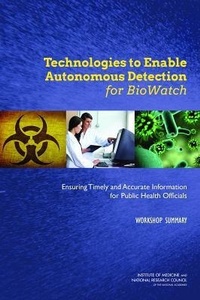
Technologies to Enable Autonomous Detection for BioWatch
Ensuring Timely and Accurate Information for Public Health Officials: Workshop Summary
Published on 31. December 2013
Book
Paperback/Softback
260 pages
978-0-309-29251-1 (ISBN)
Description
The BioWatch program, funded and overseen by the Department of Homeland Security (DHS), has three main elements--sampling, analysis, and response--each coordinated by different agencies. The Environmental Protection Agency maintains the sampling component, the sensors that collect airborne particles. The Centers for Disease Control and Prevention coordinates analysis and laboratory testing of the samples, though testing is actually carried out in state and local public health laboratories. Local jurisdictions are responsible for the public health response to positive findings. The Federal Bureau of Investigation is designated as the lead agency for the law enforcement response if a bioterrorism event is detected. In 2003 DHS deployed the first generation of BioWatch air samplers. The current version of this technology, referred to as Generation 2.0, requires daily manual collection and testing of air filters from each monitor. DHS has also considered newer automated technologies (Generation 2.5 and Generation 3.0) which have the potential to produce results more quickly, at a lower cost, and for a greater number of threat agents.
Technologies to Enable Autonomous Detection for BioWatch is the summary of a workshop hosted jointly by the Institute of Medicine and the National Research Council in June 2013 to explore alternative cost-effective systems that would meet the requirements for a BioWatch Generation 3.0 autonomous detection system, or autonomous detector, for aerosolized agents . The workshop discussions and presentations focused on examination of the use of four classes of technologies--nucleic acid signatures, protein signatures, genomic sequencing, and mass spectrometry--that could reach Technology Readiness Level (TRL) 6-plus in which the technology has been validated and is ready to be tested in a relevant environment over three different tiers of temporal timeframes: those technologies that could be TRL 6-plus ready as part of an integrated system by 2016, those that are likely to be ready in the period 2016 to 2020, and those are not likely to be ready until after 2020.
Technologies to Enable Autonomous Detection for BioWatch discusses the history of the BioWatch program, the role of public health officials and laboratorians in the interpretation of BioWatch data and the information that is needed from a system for effective decision making, and the current state of the art of four families of technology for the BioWatch program. This report explores how the technologies discussed might be strategically combined or deployed to optimize their contributions to an effective environmental detection capability.
Technologies to Enable Autonomous Detection for BioWatch is the summary of a workshop hosted jointly by the Institute of Medicine and the National Research Council in June 2013 to explore alternative cost-effective systems that would meet the requirements for a BioWatch Generation 3.0 autonomous detection system, or autonomous detector, for aerosolized agents . The workshop discussions and presentations focused on examination of the use of four classes of technologies--nucleic acid signatures, protein signatures, genomic sequencing, and mass spectrometry--that could reach Technology Readiness Level (TRL) 6-plus in which the technology has been validated and is ready to be tested in a relevant environment over three different tiers of temporal timeframes: those technologies that could be TRL 6-plus ready as part of an integrated system by 2016, those that are likely to be ready in the period 2016 to 2020, and those are not likely to be ready until after 2020.
Technologies to Enable Autonomous Detection for BioWatch discusses the history of the BioWatch program, the role of public health officials and laboratorians in the interpretation of BioWatch data and the information that is needed from a system for effective decision making, and the current state of the art of four families of technology for the BioWatch program. This report explores how the technologies discussed might be strategically combined or deployed to optimize their contributions to an effective environmental detection capability.
More details
Language
English
Place of publication
Washington
United States
Target group
Professional and scholarly
Product notice
Paperback (trade)
Unsewn / adhesive bound
Dimensions
Height: 229 mm
Width: 155 mm
Thickness: 15 mm
Weight
431 gr
ISBN-13
978-0-309-29251-1 (9780309292511)
Copyright in bibliographic data and cover images is held by Nielsen Book Services Limited or by the publishers or by their respective licensors: all rights reserved.
Schweitzer Classification
Other editions
Additional editions
National Research Council | Institute of Medicine | Board on Life Sciences
Technologies to Enable Autonomous Detection for BioWatch
Ensuring Timely and Accurate Information for Public Health Officials: Workshop Summary
E-Book
12/2013
1st Edition
National Academies Press
€7.99
Available for download
Persons
Content
1 Front Matter; 2 1 Introduction; 3 2 Overview of the BioWatch Program; 4 3 Public Health's Perspective on the Role of BioWatch in the Decision-Making Process; 5 4 Potential Technologies for the BioWatch Program; 6 5 Final Thoughts; 7 Appendix A: References; 8 Appendix B: Biographical Sketches of Workshop Participants; 9 Appendix C: Workshop Agenda; 10 Appendix D: Registered Attendees; 11 Appendix E: Technology Readiness Levels in the Department of Defense; 12 Appendix F: White Paper 1: The BioWatch Program: What Information Is Needed to Inform Decision Making?; 13 Appendix G: White Paper 2: Nucleic-Acid Signatures at Three Levels of Readiness for BioWatch; 14 Appendix H: White Paper 3: State of the Art for Autonomous Detection Systems Using Immunoassays and Protein Signatures; 15 Appendix I: White Paper 4: State of the Art for Autonomous Detection Systems Using Genomic Sequencing; 16 Appendix J: White Paper 5: State of the Art for Autonomous Detection Systems Using Mass Spectrometry