

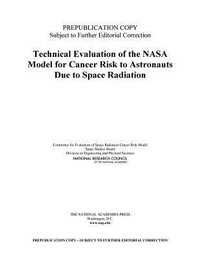
Technical Evaluation of the NASA Model for Cancer Risk to Astronauts Due to Space Radiation
Published on 19. March 2012
Book
Paperback/Softback
86 pages
978-0-309-25305-5 (ISBN)
Description
NASA's current missions to the International Space Station (ISS) and potential future exploration missions involving extended stays by astronauts on the lunar surface, as well as the possibility of near- Earth object (NEO) or Mars missions, present challenges in protecting astronauts from radiation risks. These risks arise from a number of sources, including solar particle events (SPEs), galactic cosmic rays (GCRs), secondary radiation from surface impacts, and even the nuclear isotope power sources transported with the astronauts. The serious early and late radiation health effects potentially posed by these exposures are equally varied, ranging from early signs of radiation sickness to cancer induction. Other possible effects include central nervous system damage, cataracts, cardiovascular damage, heritable effects, impaired wound healing, and infertility. Recent research, much of which has been sponsored by NASA, has focused on understanding and quantifying the radiation health risks posed by space radiation environments.
Although many aspects of the space radiation environments are now relatively well characterized, important uncertainties still exist regarding biological effects and thus regarding the level and types of risks faced by astronauts. This report presents an evaluation of NASA's proposed space radiation cancer risk assessment model, which is described in the 2011 NASA report, Space Radiation Cancer Risk Projections and Uncertainties--2010. The evaluation in Technical Evaluation of the NASA Model for Cancer Risk to Astronauts Due to Space Radiation considers the model components, input data (for the radiation types, estimated doses, and epidemiology), and the associated uncertainties. This report also identifies gaps in NASA's current research strategy for reducing the uncertainties in cancer induction risks.
Although many aspects of the space radiation environments are now relatively well characterized, important uncertainties still exist regarding biological effects and thus regarding the level and types of risks faced by astronauts. This report presents an evaluation of NASA's proposed space radiation cancer risk assessment model, which is described in the 2011 NASA report, Space Radiation Cancer Risk Projections and Uncertainties--2010. The evaluation in Technical Evaluation of the NASA Model for Cancer Risk to Astronauts Due to Space Radiation considers the model components, input data (for the radiation types, estimated doses, and epidemiology), and the associated uncertainties. This report also identifies gaps in NASA's current research strategy for reducing the uncertainties in cancer induction risks.
More details
Language
English
Place of publication
Washington
United States
Target group
College/higher education
Professional and scholarly
Product notice
Paperback (trade)
Unsewn / adhesive bound
Dimensions
Height: 280 mm
Width: 216 mm
ISBN-13
978-0-309-25305-5 (9780309253055)
Copyright in bibliographic data and cover images is held by Nielsen Book Services Limited or by the publishers or by their respective licensors: all rights reserved.
Schweitzer Classification
Other editions
Additional editions
National Research Council | Division on Engineering and Physical Sciences | Space Studies Board
Technical Evaluation of the NASA Model for Cancer Risk to Astronauts Due to Space Radiation
E-Book
03/2012
1st Edition
National Academies Press
€7.99
Available for download
Content
1 Front Matter; 2 Summary; 3 1 Introduction; 4 2 Review of NASA Model; 5 Appendixes; 6 Appendix A: Statement of Task; 7 Appendix B: Committee and Staff Biographical Information; 8 Appendix C: Glossary and Acronyms