

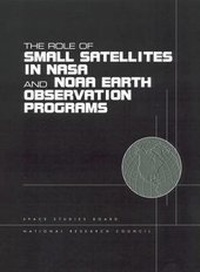
The Role of Small Satellites in NASA and NOAA Earth Observation Programs
Published on 12. April 2000
Book
Paperback/Softback
104 pages
978-0-309-06982-3 (ISBN)
Description
Remote observations of Earth from space serve an extraordinarily broad range of purposes, resulting in extraordinary demands on those at the National Aeronautics and Space Administration (NASA), the National Oceanic and Atmospheric Administration (NOAA), and elsewhere who must decide how to execute them. In research, Earth observations promise large volumes of data to a variety of disciplines with differing needs for measurement type, simultaneity, continuity, and long-term instrument stability. Operational needs, such as weather forecasting, add a distinct set of requirements for continual and highly reliable monitoring of global conditions. The Role of Small Satelites in NASA and NOAA Earth Observation Porgrams confronts these diverse requirements and assesses how they might be met by small satellites. In the past, the preferred architecture for most NASA and NOAA missions was a single large spacecraft platform containing a sophisticated suite of instruments. But the recognition in other areas of space research that cost-effectiveness, flexibility, and robustness may be enhanced by using small spacecraft has raised questions about this philosophy of Earth observation.
For example, NASA has already abandoned its original plan for a follow-on series of major platforms in its Earth Observing System. This study finds that small spacecraft can play an important role in Earth observation programs, providing to this field some of the expected benefits that are normally associated with such programs, such as rapid development and lower individual mission cost. It also identifies some of the programmatic and technical challenges associated with a mission composed of small spacecraft, as well as reasons why more traditional, larger platforms might still be preferred. The reasonable conclusion is that a systems-level examination is required to determine the optimum architecture for a given scientific and/or operational objective. The implied new challenge is for NASA and NOAA to find intra- and interagency planning mechanisms that can achieve the most appropriate and cost-effective balance among their various requirements.
For example, NASA has already abandoned its original plan for a follow-on series of major platforms in its Earth Observing System. This study finds that small spacecraft can play an important role in Earth observation programs, providing to this field some of the expected benefits that are normally associated with such programs, such as rapid development and lower individual mission cost. It also identifies some of the programmatic and technical challenges associated with a mission composed of small spacecraft, as well as reasons why more traditional, larger platforms might still be preferred. The reasonable conclusion is that a systems-level examination is required to determine the optimum architecture for a given scientific and/or operational objective. The implied new challenge is for NASA and NOAA to find intra- and interagency planning mechanisms that can achieve the most appropriate and cost-effective balance among their various requirements.
More details
Language
English
Place of publication
Washington
United States
Target group
Professional and scholarly
Dimensions
Height: 279 mm
Width: 216 mm
ISBN-13
978-0-309-06982-3 (9780309069823)
Copyright in bibliographic data and cover images is held by Nielsen Book Services Limited or by the publishers or by their respective licensors: all rights reserved.
Schweitzer Classification
Other editions
Additional editions
National Research Council | Commission on Physical Sciences | Mathematics
Role of Small Satellites in NASA and NOAA Earth Observation Programs
E-Book
04/2000
1st Edition
National Academies Press
€52.99
Available for download
Persons
Committee on Earth Studies, Space Studies Board, National Research Council
Content
1 Front Matter; 2 Executive Summary; 3 1 Introduction; 4 2 Core Observational Needs; 5 3 Payload Sensor Characteristics; 6 4 Small Satellite Buses; 7 5 Small Launch Vehicles; 8 6 Small Satellites and Mission Architectures; 9 7 Opportunities and Challenges in Managing Small Satellite Systems; 10 8 Findings and Recommendations; 11 Appendix A: Statement of Task; 12 Appendix B: Effects of Technology on Sensor Size and Design; 13 Appendix C: U.S. Launch Vehicles for Small Satellites; 14 Appendix D: Case Studies; 15 Appendix E: Acronyms and Abbreviations