

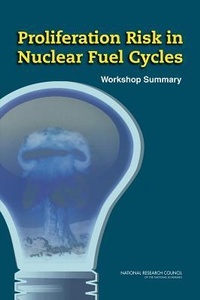
Proliferation Risk in Nuclear Fuel Cycles
Workshop Summary
Will be published approx. on 6. January 2012
Book
Paperback/Softback
110 pages
978-0-309-22049-1 (ISBN)
Description
The worldwide expansion of nuclear energy has been accompanied by concerns about nuclear weapons proliferation. If sited in states that do not possess nuclear weapons technology, some civilian nuclear technologies could provide a route for states or other organizations to acquire nuclear weapons. Metrics for assessing the resistance of a nuclear technology to diversion for non-peaceful uses-proliferation resistance-have been developed, but at present there is no clear consensus on whether and how these metrics are useful to policy decision makers. In 2011, the U.S. Department of Energy asked the National Academies to convene a public workshop addressing the capability of current and potential methodologies for assessing host state proliferation risk and resistance to meet the needs of decision makers. Proliferation Risk in Nuclear Fuel Cycles is a summary of presentations and discussions that transpired at the workshop-held on August 1-2, 2011-prepared by a designated rapporteur following the workshop. It does not provide findings and recommendations or represent a consensus reached by the symposium participants or the workshop planning committee.
However, several themes emerged through the workshop: nonproliferation and new technologies, separate policy and technical cultures, value of proliferation resistance analysis, usefulness of social science approaches. The workshop was organized as part of a larger project undertaken by the NRC, the next phase of which (following the workshop) will be a consensus study on improving the assessment of proliferation risks associated with nuclear fuel cycles. This study will culminate in a report prepared by a committee of experts with expertise in risk assessment and communication, proliferation metrics and research, nuclear fuel cycle facility design and engineering, international nuclear nonproliferation and national security policy, and nuclear weapons design. This report is planned for completion in the spring of 2013.
However, several themes emerged through the workshop: nonproliferation and new technologies, separate policy and technical cultures, value of proliferation resistance analysis, usefulness of social science approaches. The workshop was organized as part of a larger project undertaken by the NRC, the next phase of which (following the workshop) will be a consensus study on improving the assessment of proliferation risks associated with nuclear fuel cycles. This study will culminate in a report prepared by a committee of experts with expertise in risk assessment and communication, proliferation metrics and research, nuclear fuel cycle facility design and engineering, international nuclear nonproliferation and national security policy, and nuclear weapons design. This report is planned for completion in the spring of 2013.
More details
Language
English
Place of publication
Washington
United States
Target group
Professional and scholarly
Product notice
Paperback (trade)
Unsewn / adhesive bound
Dimensions
Height: 229 mm
Width: 152 mm
ISBN-13
978-0-309-22049-1 (9780309220491)
Copyright in bibliographic data and cover images is held by Nielsen Book Services Limited or by the publishers or by their respective licensors: all rights reserved.
Schweitzer Classification
Other editions
Additional editions
National Research Council | Division on Earth and Life Studies | Nuclear and Radiation Studies Board
Proliferation Risk in Nuclear Fuel Cycles
Workshop Summary
E-Book
01/2012
1st Edition
National Academies Press
€7.99
Available for download
Persons
Content
1 Front Matter; 2 Overview; 3 1 Background; 4 2 Policy Makers' Perspectives on Key Nonproliferation Issues Associated with the Nuclear Fuel Cycle; 5 3 Technical Assessment of Proliferation Resistance; 6 4 Summary Discussions; 7 References and Bibliography; 8 Appendix A: Project Statement of Task; 9 Appendix B: Workshop Statement of Task; 10 Appendix C: Committee and Staff Biographical Sketches; 11 Appendix D: Workshop Agenda; 12 Appendix E: Workshop Participant List; 13 Appendix F: Workshop Speakers Biographical Sketches