

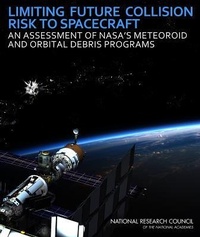
Limiting Future Collision Risk to Spacecraft
An Assessment of NASA's Meteoroid and Orbital Debris Programs
Published on 16. November 2011
Book
Paperback/Softback
178 pages
978-0-309-21974-7 (ISBN)
Description
Derelict satellites, equipment and other debris orbiting Earth (aka space junk) have been accumulating for many decades and could damage or even possibly destroy satellites and human spacecraft if they collide. During the past 50 years, various National Aeronautics and Space Administration (NASA) communities have contributed significantly to maturing meteoroid and orbital debris (MMOD) programs to their current state. Satellites have been redesigned to protect critical components from MMOD damage by moving critical components from exterior surfaces to deep inside a satellite's structure. Orbits are monitored and altered to minimize the risk of collision with tracked orbital debris. MMOD shielding added to the International Space Station (ISS) protects critical components and astronauts from potentially catastrophic damage that might result from smaller, untracked debris and meteoroid impacts.
Limiting Future Collision Risk to Spacecraft: An Assessment of NASA's Meteoroid and Orbital Debris Program examines NASA's efforts to understand the meteoroid and orbital debris environment, identifies what NASA is and is not doing to mitigate the risks posed by this threat, and makes recommendations as to how they can improve their programs. While the report identified many positive aspects of NASA's MMOD programs and efforts including responsible use of resources, it recommends that the agency develop a formal strategic plan that provides the basis for prioritizing the allocation of funds and effort over various MMOD program needs. Other necessary steps include improvements in long-term modeling, better measurements, more regular updates of the debris environmental models, and other actions to better characterize the long-term evolution of the debris environment.
Limiting Future Collision Risk to Spacecraft: An Assessment of NASA's Meteoroid and Orbital Debris Program examines NASA's efforts to understand the meteoroid and orbital debris environment, identifies what NASA is and is not doing to mitigate the risks posed by this threat, and makes recommendations as to how they can improve their programs. While the report identified many positive aspects of NASA's MMOD programs and efforts including responsible use of resources, it recommends that the agency develop a formal strategic plan that provides the basis for prioritizing the allocation of funds and effort over various MMOD program needs. Other necessary steps include improvements in long-term modeling, better measurements, more regular updates of the debris environmental models, and other actions to better characterize the long-term evolution of the debris environment.
More details
Language
English
Place of publication
Washington
United States
Target group
Professional and scholarly
Product notice
Paperback (trade)
Unsewn / adhesive bound
Dimensions
Height: 279 mm
Width: 216 mm
ISBN-13
978-0-309-21974-7 (9780309219747)
Copyright in bibliographic data and cover images is held by Nielsen Book Services Limited or by the publishers or by their respective licensors: all rights reserved.
Schweitzer Classification
Other editions
Additional editions
National Research Council | Division on Engineering and Physical Sciences | Aeronautics and Space Engi
Limiting Future Collision Risk to Spacecraft
An Assessment of NASA's Meteoroid and Orbital Debris Programs
E-Book
11/2011
1st Edition
National Academies Press
€83.99
Available for download
Content
1 Front Matter; 2 Summary; 3 1 Introduction and Historical Background; 4 2 Orbital Debris Environment: Detection and Monitoring; 5 3 Orbital Debris Modeling and Simulation; 6 4 The Meteoroid Environment and Its Effects on Spacecraft; 7 5 Risk Assessment and Uncertainty; 8 6 Spacecraft Protection in the MMOD Environment; 9 7 Mitigation of Orbital Debris; 10 8 Hazards Posed by Reentry of Orbital Debris; 11 9 Conjunction Assessment Risk Analysis and Launch Collision Avoidance; 12 10 Spacecraft Anomalies; 13 11 Issues External to NASA; 14 12 Management and Organizational Issues; 15 13 Preparing for the Future; 16 14 Compiled List of Findings and Recommendations; 17 Appendixes; 18 Appendix A: Letter of Request; 19 Appendix B: Statement of Task; 20 Appendix C: Committee and Staff Biographical Information; 21 Appendix D: Acronyms; 22 Appendix E: Glossary; 23 Appendix F: Reprinted Workshop Report