

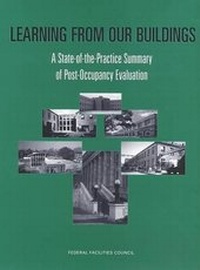
Learning from Our Buildings
A State-of-the-Practice Summary of Post-Occupancy Evaluation
Published on 29. January 2002
Book
Paperback/Softback
137 pages
978-0-309-07611-1 (ISBN)
Description
In 1986, the FFC requested that the NRC appoint a committee to examine the field and propose ways by which the POE process could be improved to better serve public and private sector organizations. The resulting report, Post-Occupancy Evaluation Practices in the Building Process: Opportunities for Improvement, proposed a broader view of POEs-from being simply the end phase of a building project to being an integral part of the entire building process. The authoring committee recommended a series of actions related to policy, procedures, and innovative technologies and techniques to achieve that broader view. In 2000, the FFC funded a second study to look at the state of the practice of POEs and lessons-learned programs among federal agencies and in private, public, and academic organizations both here and abroad. The sponsor agencies specifically wanted to determine whether and how information gathered during POE processes could be used to help inform decisions made in the programming, budgeting, design, construction, and operation phases of facility acquisition in a useful and timely way.
To complete this study, the FFC commissioned a set of papers by recognized experts in this field, conducted a survey of selected federal agencies with POE programs, and held a forum at the National Academy of Sciences on March 13, 2001, to address these issues. This report is the result of those efforts.
To complete this study, the FFC commissioned a set of papers by recognized experts in this field, conducted a survey of selected federal agencies with POE programs, and held a forum at the National Academy of Sciences on March 13, 2001, to address these issues. This report is the result of those efforts.
More details
Language
English
Place of publication
Washington
United States
Target group
Professional and scholarly
Dimensions
Height: 279 mm
Width: 216 mm
ISBN-13
978-0-309-07611-1 (9780309076111)
Copyright in bibliographic data and cover images is held by Nielsen Book Services Limited or by the publishers or by their respective licensors: all rights reserved.
Schweitzer Classification
Other editions
Additional editions
National Research Council | Board on Infrastructure and the Constructed Environment | Federal Faciliti
Learning from Our Buildings
A State-of-the-Practice Summary of Post-Occupancy Evaluation
E-Book
01/2002
1st Edition
National Academies Press
€84.99
Available for download
Content
Front Matter
1 Overview: A Summary of Findings
2 The Evolution of Post-Occupancy Evaluation: Toward Building Performance and Universal Design Evaluation
3 Post-Occupancy Evaluation: A Multifaceted Tool for Building Improvement
4 Post-Occupancy Evaluation Processes in Six Federal Agencies
5 Post-Occupancy Evaluations and Organizational Learning
6 The Role of Technology for Building Performance Assessments
Appendix A Functionality and Serviceability Standards: Tools for Stating Functional Requirements and for Evaluating Facilities
Appendix B A Balanced Scorecard Approach to Post-Occupancy Evaluation: Using the Tools of Business to Evaluate Facilities
Appendix C Supplemental Information to Chapter 3
Appendix D Supplemental Information to Chapter 4
Appendix E Supplemental Information to Chapter 6
Appendix F Chapter 5 from Post-Occupancy Evaluation Practices in the Building Process: Opportunities for Improvement, National Academy Press, 1987
Bibliography
1 Overview: A Summary of Findings
2 The Evolution of Post-Occupancy Evaluation: Toward Building Performance and Universal Design Evaluation
3 Post-Occupancy Evaluation: A Multifaceted Tool for Building Improvement
4 Post-Occupancy Evaluation Processes in Six Federal Agencies
5 Post-Occupancy Evaluations and Organizational Learning
6 The Role of Technology for Building Performance Assessments
Appendix A Functionality and Serviceability Standards: Tools for Stating Functional Requirements and for Evaluating Facilities
Appendix B A Balanced Scorecard Approach to Post-Occupancy Evaluation: Using the Tools of Business to Evaluate Facilities
Appendix C Supplemental Information to Chapter 3
Appendix D Supplemental Information to Chapter 4
Appendix E Supplemental Information to Chapter 6
Appendix F Chapter 5 from Post-Occupancy Evaluation Practices in the Building Process: Opportunities for Improvement, National Academy Press, 1987
Bibliography