

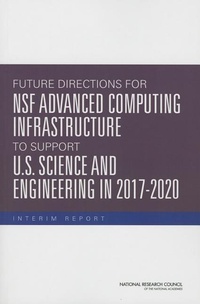
Future Directions for NSF Advanced Computing Infrastructure to Support U.S. Science and Engineering in 2017-2020
Interim Report
Published on 10. November 2014
Book
Paperback/Softback
48 pages
978-0-309-31379-7 (ISBN)
Description
Advanced computing capabilities are used to tackle a rapidly growing range of challenging science and engineering problems, many of which are compute- and data-intensive as well. Demand for advanced computing has been growing for all types and capabilities of systems, from large numbers of single commodity nodes to jobs requiring thousands of cores; for systems with fast interconnects; for systems with excellent data handling and management; and for an increasingly diverse set of applications that includes data analytics as well as modeling and simulation. Since the advent of its supercomputing centers, the National Science Foundation (NSF) has provided its researchers with state-of-the-art computing systems. The growth of new models of computing, including cloud computing and publically available by privately held data repositories, opens up new possibilities for NSF.
In order to better understand the expanding and diverse requirements of the science and engineering community and the importance of a new broader range of advanced computing infrastructure, the NSF requested that the National Research Council carry out a study examining anticipated priorities and associated tradeoffs for advanced computing. This interim report identifies key issues and discusses potential options. Future Directions for NSF Advanced Computing Infrastructure to Support U.S. Science and Engineering in 2017-2020 examines priorities and associated tradeoffs for advanced computing in support of NSF-sponsored science and engineering research. This report is an initial compilation of issues to be considered as future NSF strategy, budgets, and programs for advanced computing are developed. Included in the report are questions on which the authoring committee invites comment. We invite your feedback on this report, and more generally, your comments on the future of advanced computing at NSF.
In order to better understand the expanding and diverse requirements of the science and engineering community and the importance of a new broader range of advanced computing infrastructure, the NSF requested that the National Research Council carry out a study examining anticipated priorities and associated tradeoffs for advanced computing. This interim report identifies key issues and discusses potential options. Future Directions for NSF Advanced Computing Infrastructure to Support U.S. Science and Engineering in 2017-2020 examines priorities and associated tradeoffs for advanced computing in support of NSF-sponsored science and engineering research. This report is an initial compilation of issues to be considered as future NSF strategy, budgets, and programs for advanced computing are developed. Included in the report are questions on which the authoring committee invites comment. We invite your feedback on this report, and more generally, your comments on the future of advanced computing at NSF.
More details
Language
English
Place of publication
Washington
United States
Target group
Professional and scholarly
Product notice
Paperback (trade)
Unsewn / adhesive bound
Dimensions
Height: 224 mm
Width: 150 mm
Thickness: 5 mm
Weight
77 gr
ISBN-13
978-0-309-31379-7 (9780309313797)
Copyright in bibliographic data and cover images is held by Nielsen Book Services Limited or by the publishers or by their respective licensors: all rights reserved.
Schweitzer Classification
Other editions
Additional editions
National Research Council | Division on Engineering and Physical Sciences | Computer Science and Telec
Future Directions for NSF Advanced Computing Infrastructure to Support U.S. Science and Engineering in 2017-2020
Interim Report
E-Book
11/2014
1st Edition
National Academies Press
€7.99
Available for download
Content
1 Front Matter; 2 Summary; 3 1 The Role of Advanced Computing in Science and Engineering; 4 2 Challenges; 5 3 Possible NSF Responses; 6 Appendixes; 7 Appendix A: Biographies of Committee Members; 8 Appendix B: Questions on Directions and Needs for Advanced Cyberinfrastructure