

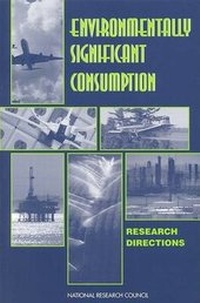
Environmentally Significant Consumption
Research Directions
Published on 9. June 1997
Book
Paperback/Softback
152 pages
978-0-309-05598-7 (ISBN)
Description
There has been much polemic about affluence, consumption, and the global environment. For some observers, "consumption" is at the root of global environmental threats: wealthy individuals and societies use far too much of the earth's resource base and should scale back their appetites to preserve the environment for future generations and allow a decent life for the rest of the world. Other observers see affluence as the way to escape environmental threats: economic development increases public pressure for environmental protection and makes capital available for environmentally benign technologies. The arguments are fed by conflicting beliefs, values, hopes, and fears--but surprisingly little scientific analysis. This book demonstrates that the relationship of consumption to the environment needs careful analysis by environmental and social scientists and conveys some of the excitement of treating the issue scientifically. It poses the key empirical questions: Which kinds of consumption are environmentally significant? Which actors are responsible for that consumption? What forces cause or explain environmentally significant consumption? How can it be changed?
The book presents studies that open up important issues for empirical study: Are there any signs of saturation in the demand for travel in wealthy countries? What is the relationship between environmental consumption and human well-being? To what extent do people in developing countries emulate American consumption styles? The book also suggests broad strategies that scientists and research sponsors can use to better inform future debates about the environment, development, and consumption.
The book presents studies that open up important issues for empirical study: Are there any signs of saturation in the demand for travel in wealthy countries? What is the relationship between environmental consumption and human well-being? To what extent do people in developing countries emulate American consumption styles? The book also suggests broad strategies that scientists and research sponsors can use to better inform future debates about the environment, development, and consumption.
More details
Language
English
Place of publication
Washington
United States
Target group
College/higher education
Professional and scholarly
Dimensions
Height: 229 mm
Width: 152 mm
ISBN-13
978-0-309-05598-7 (9780309055987)
Copyright in bibliographic data and cover images is held by Nielsen Book Services Limited or by the publishers or by their respective licensors: all rights reserved.
Schweitzer Classification
Other editions
Additional editions
National Research Council | Division of Behavioral and Social Sciences and Education | Board on Enviro
Environmentally Significant Consumption
Research Directions
E-Book
06/1997
1st Edition
National Academies Press
€83.99
Available for download
Content
FRONT MATTER
1 CONSUMPTION AS A PROBLEM FOR ENVIRONMENTAL SCIENCE
2 TOWARD A WORKING DEFINITION OF CONSUMPTION FOR ENVIRONMENTAL RESEARCH AND POLICY
3 TRACKING THE FLOWS OF ENERGY AND MATERIALS
4 EXAMINING THE DRIVING FORCES
5 STRATEGIES FOR SETTING RESEARCH PRIORITIES
ABOUT THE CONTRIBUTORS
1 CONSUMPTION AS A PROBLEM FOR ENVIRONMENTAL SCIENCE
2 TOWARD A WORKING DEFINITION OF CONSUMPTION FOR ENVIRONMENTAL RESEARCH AND POLICY
3 TRACKING THE FLOWS OF ENERGY AND MATERIALS
4 EXAMINING THE DRIVING FORCES
5 STRATEGIES FOR SETTING RESEARCH PRIORITIES
ABOUT THE CONTRIBUTORS