

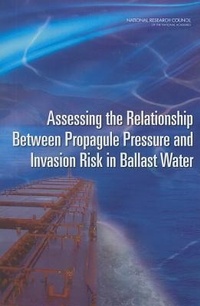
Assessing the Relationship Between Propagule Pressure and Invasion Risk in Ballast Water
Published on 27. July 2011
Book
Paperback/Softback
156 pages
978-0-309-21562-6 (ISBN)
Description
The human-mediated introduction of species to regions of the world they could never reach by natural means has had great impacts on the environment, the economy, and society. In the ocean, these invasions have long been mediated by the uptake and subsequent release of ballast water in ocean-going vessels. Increasing world trade and a concomitantly growing global shipping fleet composed of larger and faster vessels, combined with a series of prominent ballast-mediated invasions over the past two decades, have prompted active national and international interest in ballast water management. Assessing the Relationship Between Propagule Pressure and Invasion Risk in Ballast Water informs the regulation of ballast water by helping the Environnmental Protection Agency (EPA) and the U.S. Coast Guard (USCG) better understand the relationship between the concentration of living organisms in ballast water discharges and the probability of nonindigenous organisms successfully establishing populations in U.S. waters.
The report evaluates the risk-release relationship in the context of differing environmental and ecological conditions,including estuarine and freshwater systems as well as the waters of the three-mile territorial sea. It recommends how various approaches can be used by regulatory agencies to best inform risk management decisions on the allowable concentrations of living organisms in discharged ballast water in order to safeguard against the establishment of new aquatic nonindigenous species, and to protect and preserve existing indigenous populations of fish, shellfish, and wildlife and other beneficial uses of the nation's waters. Assessing the Relationship Between Propagule Pressure and Invasion Risk in Ballast Water provides valuable information that can be used by federal agencies, such as the EPA, policy makers, environmental scientists, and researchers.
The report evaluates the risk-release relationship in the context of differing environmental and ecological conditions,including estuarine and freshwater systems as well as the waters of the three-mile territorial sea. It recommends how various approaches can be used by regulatory agencies to best inform risk management decisions on the allowable concentrations of living organisms in discharged ballast water in order to safeguard against the establishment of new aquatic nonindigenous species, and to protect and preserve existing indigenous populations of fish, shellfish, and wildlife and other beneficial uses of the nation's waters. Assessing the Relationship Between Propagule Pressure and Invasion Risk in Ballast Water provides valuable information that can be used by federal agencies, such as the EPA, policy makers, environmental scientists, and researchers.
More details
Language
English
Place of publication
Washington
United States
Target group
Professional and scholarly
Product notice
Paperback (trade)
Unsewn / adhesive bound
Dimensions
Height: 228 mm
Width: 151 mm
Thickness: 15 mm
Weight
265 gr
ISBN-13
978-0-309-21562-6 (9780309215626)
Copyright in bibliographic data and cover images is held by Nielsen Book Services Limited or by the publishers or by their respective licensors: all rights reserved.
Schweitzer Classification
Other editions
Additional editions
National Research Council | Division on Earth and Life Studies | Water Science and Technology Board
Assessing the Relationship Between Propagule Pressure and Invasion Risk in Ballast Water
E-Book
07/2011
1st Edition
National Academies Press
€68.99
Available for download
Content
1 Front Matter; 2 Summary; 3 1 Setting the Invasive Species Management Stage; 4 2 Policy Context for Regulating Live Organisms in Ballast Discharge; 5 3 Sources of Variation Influencing the Probability of Invasion and Establishment; 6 4 Relationship between Propagule Pressureand Establishment Risk; 7 5 Other Approaches to Setting a Ballast Water Discharge Standard; 8 6 The Path Forward; 9 Glossary; 10 Appendix A Committee Biographical Information