

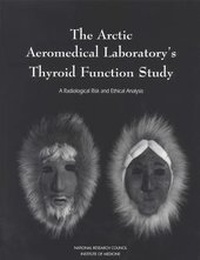
The Arctic Aeromedical Laboratory's Thyroid Function Study
A Radiological Risk and Ethical Analysis
Published on 26. January 1996
Book
Paperback/Softback
116 pages
978-0-309-05428-7 (ISBN)
Description
During the 1950s, with the Cold War looming, military planners sought to know more about how to keep fighting forces fit and capable in the harsh Alaskan environment. In 1956 and 1957, the U.S. Air Force's former Arctic Aeromedical Laboratory conducted a study of the role of the thyroid in human acclimatization to cold. To measure thyroid function under various conditions, the researchers administered a radioactive medical trace, Iodine-131, to Alaska Natives and white military personnel; based on the study results, the researchers determined that the thyroid did not play a significant role in human acclimatization to cold. When this study of thyroid function was revisited at a 1993 conference on the Cold War legacy in the Arctic, serious questions were raised about the appropriateness of the activity--whether it posed risks to the people involved and whether the research had been conducted within the bounds of accepted guidelines for research using human participants. In particular, there was concern over the relatively large proportion of Alaska Natives used as subjects and whether they understood the nature of the study.
This book evaluates the research in detail, looking at both the possible health effects of Iodine-131 administration in humans and the ethics of human subjects research. This book presents conclusions and recommendations and is a significant addition to the nation's current reevaluation of human radiation experiments conducted during the Cold War.
This book evaluates the research in detail, looking at both the possible health effects of Iodine-131 administration in humans and the ethics of human subjects research. This book presents conclusions and recommendations and is a significant addition to the nation's current reevaluation of human radiation experiments conducted during the Cold War.
More details
Language
English
Place of publication
Washington
United States
Target group
Professional and scholarly
Dimensions
Height: 279 mm
Width: 216 mm
ISBN-13
978-0-309-05428-7 (9780309054287)
Copyright in bibliographic data and cover images is held by Nielsen Book Services Limited or by the publishers or by their respective licensors: all rights reserved.
Schweitzer Classification
Other editions
Additional editions
National Research Council | Institute of Medicine | Division on Earth and Life Studies
Arctic Aeromedical Laboratory's Thyroid Function Study
A Radiological Risk and Ethical Analysis
E-Book
01/1996
1st Edition
National Academies Press
€63.99
Available for download
Persons
Committee on Evaluation of 1950s Air Force Human Health Testing in Alaska Using Radioactive Iodine-131, Commission on Geosciences, Environment, and Resources, Commission on Life Sciences, National Research Council
Content
1 Front Matter; 2 Executive Summary; 3 1 Introduction; 4 2 Health Effect of I131 Administration in Humans; 5 3 The Ethics of Human Subjects Research; 6 4 Conclusions and Recommendations; 7 5 References; 8 A. Thyroid Function in Health and Disease; 9 B. Summary of the Public Session; 10 C. Thyroid Radaition Dose Estimates for I131; 11 D. Secretary of Defense Letter; 12 E. Informed Consent Elements of Disclosure; 13 F. Principles for the Conduct of Research in the Arctic; 14 G. Biographical Sketches of Committee Members; 15 H. Glossary