

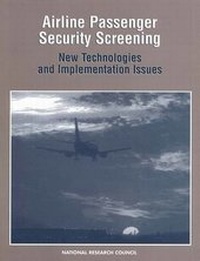
Airline Passenger Security Screening
New Technologies and Implementation Issues
Will be published approx. on 19. June 1996
Book
Paperback/Softback
88 pages
978-0-309-05439-3 (ISBN)
Description
This book addresses new technologies being considered by the Federal Aviation Administration (FAA) for screening airport passengers for concealed weapons and explosives. The FAA is supporting the development of promising new technologies that can reveal the presence not only of metal-based weapons as with current screening technologies, but also detect plastic explosives and other non-metallic threat materials and objects, and is concerned that these new technologies may not be appropriate for use in airports for other than technical reasons. This book presents discussion of the health, legal, and public acceptance issues that are likely to be raised regarding implementation of improvements in the current electromagnetic screening technologies, implementation of screening systems that detect traces of explosive materials on passengers, and implementation of systems that generate images of passengers beneath their clothes for analysis by human screeners.
More details
Language
English
Place of publication
Washington
United States
Target group
College/higher education
Professional and scholarly
Dimensions
Height: 279 mm
Width: 216 mm
ISBN-13
978-0-309-05439-3 (9780309054393)
Copyright in bibliographic data and cover images is held by Nielsen Book Services Limited or by the publishers or by their respective licensors: all rights reserved.
Schweitzer Classification
Other editions
Additional editions
National Research Council | Division on Engineering and Physical Sciences | National Materials Advisor
Airline Passenger Security Screening
New Technologies and Implementation Issues
E-Book
06/1996
1st Edition
National Academies Press
€57.99
Available for download
Content
FRONT MATTER
EXECUTIVE SUMMARY
1 INTRODUCTION
2 METHODOLOGY
3 PASSENGER SCREENING TECHNOLOGIES
4 OPERATIONAL AND COST ISSUES
5 OPERATOR ERGONOMICS, SELECTION, TRAINING, AND MOTIVATION
6 HEALTH EFFECTS
7 LEGAL ISSUES
8 PUBLIC ACCEPTANCE
9 CONCLUSIONS AND RECOMMENDATIONS
REFERENCES
APPENDICES
EXECUTIVE SUMMARY
1 INTRODUCTION
2 METHODOLOGY
3 PASSENGER SCREENING TECHNOLOGIES
4 OPERATIONAL AND COST ISSUES
5 OPERATOR ERGONOMICS, SELECTION, TRAINING, AND MOTIVATION
6 HEALTH EFFECTS
7 LEGAL ISSUES
8 PUBLIC ACCEPTANCE
9 CONCLUSIONS AND RECOMMENDATIONS
REFERENCES
APPENDICES