

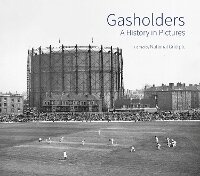
Gasholders
A History in Pictures
Will be published approx. on 15. October 2024
Book
Hardback
240 pages
978-1-83553-849-4 (ISBN)
Description
Winner of the Association for Industrial Archaeology's Publication Award 2025
Gasholders became one of the most instantly recognisable and iconic features on the landscape since they first appeared in the early 19th century. Their simple but precise engineering, durability and flexibility allowed then to operate over a span of 200 years. They witnessed times of great social change, from the early years of the industrial revolution, through countless wars, the reign of nine monarchs, strikes, suffrage, switch to natural gas and through the turn of the millennium. Using a mixture of archive and contemporary photographs, engineering drawings, prints, paintings, adverts and diagrams, the book captures the importance of these industrial structures on the English Townscape. From their very earliest beginnings the book captures their place on the gasworks and in wider society. Evolving from simple designs on a small scale through to becoming massive features dominating skylines and becoming local landmarks.
Each chapter take a different perspective, covering the different types, the varying landscapes they inhabited, their place in society, the engineers who designed them and the people who built them. It finishes with a glimpse of how they will be reimagined for future generations.
Gasholders became one of the most instantly recognisable and iconic features on the landscape since they first appeared in the early 19th century. Their simple but precise engineering, durability and flexibility allowed then to operate over a span of 200 years. They witnessed times of great social change, from the early years of the industrial revolution, through countless wars, the reign of nine monarchs, strikes, suffrage, switch to natural gas and through the turn of the millennium. Using a mixture of archive and contemporary photographs, engineering drawings, prints, paintings, adverts and diagrams, the book captures the importance of these industrial structures on the English Townscape. From their very earliest beginnings the book captures their place on the gasworks and in wider society. Evolving from simple designs on a small scale through to becoming massive features dominating skylines and becoming local landmarks.
Each chapter take a different perspective, covering the different types, the varying landscapes they inhabited, their place in society, the engineers who designed them and the people who built them. It finishes with a glimpse of how they will be reimagined for future generations.
Reviews / Votes
'Das vorliegende Buch gibt hier fuer England einen sehenswerten UEberblick und verstaerkt hoffentlich die Tendenz zur Erhaltung weiterer Exemplare.' 'This book provides a fascinating overview of England and will hopefully reinforce the trend towards preserving further examples.' Axel Foehl, Industriekultur Translated from German 'This book is an utter joy, packed with amazing pictures and drawings from a wide range of historical sources, most of which I had not seen before, as well as some stunning modern photographs of sites with surviving remains. I applaud National Grid, Historic England and the authors for their ambition in producing such a mighty tome - it deserves a place on the shelves (provided they are large enough) of anyone interested in the impact of industry on society.' Ian West, Industrial Archaeology Review 'Gasholders: A History in Pictures is addressed to all of us; the text is easy to understand [...] and the fantastic pictures - photographs, advertisements etc. - must fascinate equally industrial heritage specialists/enthusiasts and those whose only contact with gasholders has been living in the same area with them.' Katriina Etholen, The International Journal for the History of Engineering & Technology 'At folio size, with full-page photographs, the book gives a vivid picture of these extraordinary structures, that were largely taken for granted during the years of their operation.'Peter de Figueiredo, Context 'Gasholders: A History in Pictures excels as a visually compelling chronicle of one of England's most evocative industrial forms. It unites architectural, technological, and social histories through stunning imagery and authoritative editing. For enthusiasts of industrial heritage, architectural history, or urban landscapes, it's a visual feast and thoughtful primer. It's a beautifully crafted and informative volume - an essential tribute to a rapidly fading yet enduring icon of England's industrial past.'
Jose Manuel Lopes Cordeiro, Arqueologia Industrial
More details
Series
Language
English
Place of publication
United Kingdom
Publishing group
Liverpool University Press
Illustrations
252 Illustrations
ISBN-13
978-1-83553-849-4 (9781835538494)
Copyright in bibliographic data and cover images is held by Nielsen Book Services Limited or by the publishers or by their respective licensors: all rights reserved.
Schweitzer Classification
Persons
National Grid is an energy company operating in the UK and the US. Our business plays a vital role in connecting millions of people to the energy they use while continually seeking ways to make the energy system cleaner. We enable the innovation that is transforming the energy system. Prof. Russell Thomas (Chapters 1-11) is a Technical Director at WSP and Chair of Institution of Gas Engineers and Managers History Panel. He has worked on former gasworks and gasholder sites through his career, investigating, remediating and documenting their history. In recent years he authored Historic England's research report on the Manufactured Gas Industry and numerous other publications focused on different aspects of the industry, from forensic science to the conversion programme from town gas to natural gas. Dr. Timur Tatlioglu (Chapter 12) is a Partner in Montagu Evans' Historic Environment and Townscape team. He has particular expertise in advising clients on major and complex projects involving listed buildings, sensitive landscapes, conservation areas and tall buildings. He has provide heritage advice throughout National Grid's Gasholder Programme.