

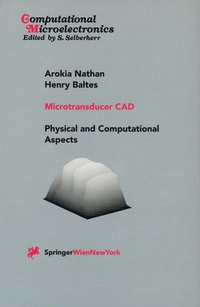
Microtransducer CAD
Physical and Computational Aspects
Published on 3. October 2013
Book
Paperback/Softback
XVIII, 427 pages
978-3-7091-7321-3 (ISBN)
Description
Computer-aided-design (CAD) of semiconductor microtransducers is relatively new in contrast to their counterparts in the integrated circuit world. Integrated silicon microtransducers are realized using microfabrication techniques similar to those for standard integrated circuits (ICs). Unlike IC devices, however, microtransducers must interact with their environment, so their numerical simulation is considerably more complex. While the design of ICs aims at suppressing "parasitic" effects, microtransducers thrive on optimizing the one or the other such effect. The challenging quest for physical models and simulation tools enabling microtransducer CAD is the topic of this book. The book is intended as a text for graduate students in Electrical Engineering and Physics and as a reference for CAD engineers in the microsystems industry.
More details
Series
Edition
Softcover reprint of the original 1st ed. 1999
Language
English
Place of publication
Vienna
Austria
Publishing group
Springer Wien
Target group
Professional and scholarly
Research
Illustrations
44 s/w Abbildungen
XVIII, 427 p. 44 illus.
Dimensions
Height: 235 mm
Width: 155 mm
Thickness: 25 mm
Weight
686 gr
ISBN-13
978-3-7091-7321-3 (9783709173213)
DOI
10.1007/978-3-7091-6428-0
Schweitzer Classification
Other editions
Additional editions
Book
05/1999
Springer
€85.55
Article exhausted; check different version
Content
1. Introduction.- 1.1 Modeling and Simulation of Microtransducers.- 1.2 Illustrative Example.- 1.3 Progress in Microtransducer Modeling.- 1.4 References.- 2 Basic Electronic Transport.- 2.1 Poisson's Equation.- 2.2 Continuity Equations.- 2.3 Carrier Transport in Crystalline Materials and Isothermal Behavior.- 2.4 Electrical Conductivity and Isothermal Behavior in Polycrystalline Materials.- 2.5 Electrical Conductivity and Isothermal Behavior in Metals.- 2.6 Boundary and Interface Conditions.- 2.7 The External Fields - What Do They Influence?.- 2.8 References.- 3 Radiation Effects on Carrier Transport.- 3.1 Reflection and Transmission of Optical Signals.- 3.2 Modeling Optical Absorption in Intrinsic Semiconductors.- 3.3 Absorption in Heavily-Doped Semiconductors.- 3.4 Optical Generation Rate and Quantum Efficiency.- 3.5 Low Energy Interactions with Insulators and Metals.- 3.6 High Energy Interactions and Monte Carlo Simulations.- 3.7 Model Equations for Radiant Sensor Simulation.- 3.8 Illustrative Simulation Example - Color Sensor.- 3.9 References.- 4 Magnetic Field Effects on Carrier Transport.- 4.1 Galvanomagnetic Transport Equation.- 4.2 Galvanomagnetic Transport Coefficients.- 4.3 Equations and Boundary Conditions for Magnetic Sensor Simulation.- 4.4 Illustrative Simulation Example - Micromachined Magnetic Vector Probe.- 4.5 References.- 5 Thermal Non-Uniformity Effects on Carrier Transport.- 5.1 Non-Isothermal Effects.- 5.2 Electrothermal Transport Model.- 5.3 Electrical and Thermal Transport Coefficients.- 5.4 Electro-Thermo-Magnetic Interactions.- 5.5 Heat Transfer in Thermal Microstructures.- 5.6 Summary of Equations and Computational Procedure.- 5.7 Illustrative Simulation Example - Micro Pirani Gauge.- 5.8 References.- 6 Mechanical Effects on CarrierTransport.- 6.1 Piezoresistive Effect.- 6.2 Strain and Electron Transport.- 6.3 Strain and Hole Transport.- 6.4 Piezojunction Effect.- 6.5 Effects of Stress Gradients.- 6.6 Galvano-Piezo-Magnetic Effects.- 6.7 The Piezo Drift-Diffusion Transport Model.- 6.8 Illustrative Simulation Example - Stress Effects on Hall Sensors.- 6.9 References.- 7 Mechanical and Fluidic Signals.- 7.1 Definitions.- 7.2 Model Equations for Mechanical Analysis.- 7.3 Model Equations for Analysis of Fluid Transport.- 7.4 Illustrative Simulation Example - Analysis of Flow Channels.- 7.5 References.- 8 Micro-Actuation.- 8.1 Transduction Principles.- 8.2 State-of-the-Art and Preview.- 8.3 Electrostatic Actuation.- 8.4 Thermal Actuation.- 8.5 Magnetic Actuation.- 8.6 Piezoelectric Actuation.- 8.7 Electroacoustic Transducers.- 8.8 Computational Procedure and Coupling.- 8.9 Illustrative Example - CMOS Micromirror.- 8.10 References.- 9 Microsystem Simulation.- 9.1 Electrical Analogues for Mixed-Signals and Historical Developments.- 9.2 Circuit Modeling and Implementation Considerations.- 9.3 Lumped Analysis: Illustrative Example - Electrostatic Micromirror.- 9.4 Distributed Analysis: Illustrative Example - Flow Microsensor.- 9.5 References.