

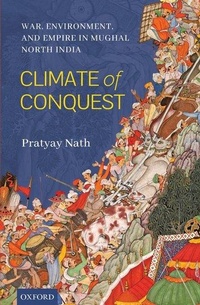
Climate of Conquest
War, Environment, and Empire in Mughal North India
Published on 10. September 2019
Book
Hardback
368 pages
978-0-19-949555-9 (ISBN)
Description
What can war tell us about empire? Climate of Conquest is built around this question. Here the author eschews the conventional way of writing about warfare primarily in terms of battles and technologies. Instead, he unravels the deep connections that Mughal war-making shared with the broader dynamics of society, culture, and politics. In the process, he offers a new analysis of the Mughal empire from the vantage point of war.
Climate of Conquest closely studies the dynamics of the military campaigns that helped the Mughals conquer North India and project their power beyond it. The author argues that these campaigns unfolded in constant negotiation with the diverse natural environment of South Asia. The empire sought to discipline the environment and harness its resources to satisfy its own military needs. At the same time, environmental factors like climate, terrain, and ecology profoundly influenced Mughal military tactics, strategy, and deployment of technology. The book also explores the world of non-elite labour that spearheaded Mughal military logistics, the process of formation of imperial frontiers, and the empire's legitimisation of war and conquest. What emerges is a fresh interpretation of Mughal empire-building as a highly adaptive, flexible, and accommodative process.
Climate of Conquest closely studies the dynamics of the military campaigns that helped the Mughals conquer North India and project their power beyond it. The author argues that these campaigns unfolded in constant negotiation with the diverse natural environment of South Asia. The empire sought to discipline the environment and harness its resources to satisfy its own military needs. At the same time, environmental factors like climate, terrain, and ecology profoundly influenced Mughal military tactics, strategy, and deployment of technology. The book also explores the world of non-elite labour that spearheaded Mughal military logistics, the process of formation of imperial frontiers, and the empire's legitimisation of war and conquest. What emerges is a fresh interpretation of Mughal empire-building as a highly adaptive, flexible, and accommodative process.
More details
Language
English
Place of publication
New Delhi
India
Target group
College/higher education
Product notice
sewn/stitched
Cloth over boards
Dimensions
Height: 221 mm
Width: 142 mm
Thickness: 33 mm
Weight
476 gr
ISBN-13
978-0-19-949555-9 (9780199495559)
Copyright in bibliographic data and cover images is held by Nielsen Book Services Limited or by the publishers or by their respective licensors: all rights reserved.
Schweitzer Classification
Other editions
Additional editions
E-Book
06/2019
1st Edition
OUP
€50.15
Available for download
Person
Pratyay Nath is Assistant Professor and Head, Department of History, Ashoka University. He is a historian of war and empire. Climate of Conquest is his first book.
Content
CONTENTS Acknowledgements
Introduction
PART I. FIGHTING WARS: CAMPAIGNS, ENVIRONMENT, EMPIRE
Chapter 1. Environment and the Heterogeneous Conquest of North India
Chapter 2. Moving East, Moving West: War, Environment, and Imperial Expansion PART II. PRODUCING WARS: LOGISTICS, FRONTIER, IDEOLOGY
Chapter 3. Military Labour, Animals, and the Material Production of War
Chapter 4. Routes, Forts, Environment, and the Making of Imperial Frontiers
Chapter 5. Ideology, Empire, and the Cultural Climate of War
Conclusion
Bibliography
Introduction
PART I. FIGHTING WARS: CAMPAIGNS, ENVIRONMENT, EMPIRE
Chapter 1. Environment and the Heterogeneous Conquest of North India
Chapter 2. Moving East, Moving West: War, Environment, and Imperial Expansion PART II. PRODUCING WARS: LOGISTICS, FRONTIER, IDEOLOGY
Chapter 3. Military Labour, Animals, and the Material Production of War
Chapter 4. Routes, Forts, Environment, and the Making of Imperial Frontiers
Chapter 5. Ideology, Empire, and the Cultural Climate of War
Conclusion
Bibliography