

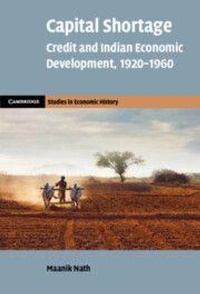
Capital Shortage
Credit and Indian Economic Development, 1920-1960
Published on 10. August 2023
Book
Hardback
248 pages
978-1-009-35907-8 (ISBN)
Description
The great majority of the population in colonial and postcolonial India lived in the countryside and were poor. Many were unable to find gainful work outside agriculture and remained dependent on a livelihood that provided only subsistence, and a precarious one. Seeking the roots of persistent poverty, Maanik Nath finds that the pervasive high cost and shortage of capital affected the peasant's ability to invest in land. The productivity of land, as a result, remained small and changed little. Bridging economic theory and historical evidence, Capital Shortage shows that climate, law, policy design, and interactions between these factors, perpetuated a stubborn cycle of low investment and widespread deprivation over several decades. These findings can be tested against credit and development in preceding and succeeding periods as well as positioned in comparative global context.
More details
Series
Language
English
Place of publication
Cambridge
United Kingdom
Target group
College/higher education
Product notice
sewn/stitched
Cloth over boards
Illustrations
Worked examples or Exercises
Dimensions
Height: 232 mm
Width: 159 mm
Thickness: 20 mm
Weight
516 gr
ISBN-13
978-1-009-35907-8 (9781009359078)
Copyright in bibliographic data and cover images is held by Nielsen Book Services Limited or by the publishers or by their respective licensors: all rights reserved.
Schweitzer Classification
Other editions
Additional editions
Book
05/2025
Cambridge University Press
€37.50
Shipment within 15-20 days
E-Book
09/2023
Cambridge University Press
€105.99
Available for download
Person
Maanik Nath is Assistant Professor in Economic and Social History at Utrecht University.
Content
1. Introduction; 2. Agriculture, commerce and governance in the Longue Duree; 3. Climate and credit; 4. Courts and credit; 5. Regulating moneylenders; 6. Regulating cooperatives; 7. Credit after 1960; 8. Conclusion; Epilogue: risk and regulation across colonial India.