

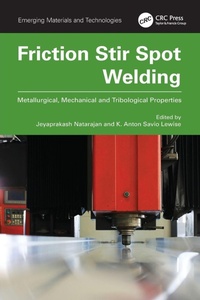
Friction Stir Spot Welding
Metallurgical, Mechanical and Tribological Properties
1st Edition
Will be published approx. on 20. July 2026
Book
Paperback/Softback
330 pages
978-1-032-55802-8 (ISBN)
Description
Friction Stir Spot Welding offers an introduction to friction stir spot welding (FSSW) between both similar and dissimilar metals and materials. It explains the impact of the interlayer in FSSW of different metals with regard to mechanical, metallurgical, wear, thermo-mechanical, and chemical characteristics.
Emphasizing the impact of interlayer on FSSW of different metals, this book discusses the influence of the interlayer in the process as a new technique. Using aerospace and automotive structures as examples, the book explains how their components successfully employ materials like dissimilar aluminium alloys, yielding increased electrical, thermal, and mechanical characteristics. It also considers the reinforcement, effect of tool geometry, wettability, and corrosion behavior of joints.
This book is intended for mechanical, materials, and manufacturing professionals, researchers, and engineers working in the field of FSSW.
Emphasizing the impact of interlayer on FSSW of different metals, this book discusses the influence of the interlayer in the process as a new technique. Using aerospace and automotive structures as examples, the book explains how their components successfully employ materials like dissimilar aluminium alloys, yielding increased electrical, thermal, and mechanical characteristics. It also considers the reinforcement, effect of tool geometry, wettability, and corrosion behavior of joints.
This book is intended for mechanical, materials, and manufacturing professionals, researchers, and engineers working in the field of FSSW.
More details
Series
Language
English
Place of publication
London
United Kingdom
Publishing group
Taylor & Francis Ltd
Target group
College/higher education
Professional and scholarly
Postgraduate and Professional Reference
Illustrations
30 s/w Photographien bzw. Rasterbilder, 118 s/w Zeichnungen, 43 s/w Tabellen, 148 s/w Abbildungen
43 Tables, black and white; 118 Line drawings, black and white; 30 Halftones, black and white; 148 Illustrations, black and white
Dimensions
Height: 234 mm
Width: 156 mm
ISBN-13
978-1-032-55802-8 (9781032558028)
Copyright in bibliographic data and cover images is held by Nielsen Book Services Limited or by the publishers or by their respective licensors: all rights reserved.
Schweitzer Classification
Other editions
Additional editions
Jeyaprakash Natarajan | K. Anton Savio Lewise
Friction Stir Spot Welding
Metallurgical, Mechanical and Tribological Properties
Book
07/2024
1st Edition
CRC Press
€176.70
Shipment within 10-20 days
Jeyaprakash Natarajan | K. Anton Savio Lewise
Friction Stir Spot Welding
Metallurgical, Mechanical and Tribological Properties
E-Book
07/2024
1st Edition
CRC Press
€139.99
Available for download
Jeyaprakash Natarajan | K. Anton Savio Lewise
Friction Stir Spot Welding
Metallurgical, Mechanical and Tribological Properties
E-Book
07/2024
1st Edition
CRC Press
€139.99
Available for download
Persons
Jeyaprakash Natarajan is an Associate Professor in School of Mechanical and Electrical Engineering, China University of Mining and Technology, Xuzhou City, China. He received his PhD in Production Engineering in 2018 from National Institute of Technology, Tiruchirappalli, India. Dr. Natarajan has published more than 75 peer-reviewed research articles, book chapters and two books titled Laser Surface Treatments for Tribological Application and Advances in Additive Manufacturing Processes in 2021. He teaches various postgraduate courses in automotive, mechanical, manufacturing and laser ultrasound, and conducts academic research and consultancy. He is serving as a reviewer for many reputed international journals. Also, he has completed four research projects in the field of additive manufacturing, surface engineering, tribology, laser cladding and corrosion etc.
Dr. K. Anton Savio Lewise is an Assistant Professor in Department of Aerospace Engineering, Karunya Institute of Technology and Sciences, Coimbatore, India. He received his PhD in Aeronautical Engineering in 2022 from Noorul Islam Centre for Higher Education, Kumaracoil, Tamilnadu, India. He has published more than 20 peer-reviewed research articles, book chapters, patents and conference proceedings. He teaches various undergraduate and postgraduate courses in aeronautical, aerospace, mechanical, manufacturing and conducts academic research and consultancy. Dr. Lewise is serving as a reviewer for many reputed international journals.
Dr. K. Anton Savio Lewise is an Assistant Professor in Department of Aerospace Engineering, Karunya Institute of Technology and Sciences, Coimbatore, India. He received his PhD in Aeronautical Engineering in 2022 from Noorul Islam Centre for Higher Education, Kumaracoil, Tamilnadu, India. He has published more than 20 peer-reviewed research articles, book chapters, patents and conference proceedings. He teaches various undergraduate and postgraduate courses in aeronautical, aerospace, mechanical, manufacturing and conducts academic research and consultancy. Dr. Lewise is serving as a reviewer for many reputed international journals.
Content
1. Introduction. 2. Interlayers in FSSW process - An overview. 3. Process Parameter Optimization during the Friction Stir Spot Welding Process. 4. Types of Tool Geometry. 5. Interlayer Morphology of friction stir spot welding. 6. Mechanical properties evolution in FSSW. 7. Metallurgical Transition. 8. Thermomechanical analysis. 9. Wear characterization of friction stir spot welded joint material. 10. Mechanical Properties and Temperature Distribution of Friction stir spot welding Process. 11. Residual stress in FSSW process. 12. Corrosion in Friction Stir Welded joints. 13. Nanoparticle reinforcements in Friction Stir Spot Welding (n-FSSW). 14. Challenges and Application of Friction Stir Spot Welding of dissimilar Al joints. 15. Advances in Friction Stir Spot Welding. 16. Nano particles reinforcements via friction stir processing (FSP). 17. Effect of tool geometry on friction stir spot welded joints. 18. Wettability and Corrosion Resistance on Hydrophobic Steel Surfaces.