

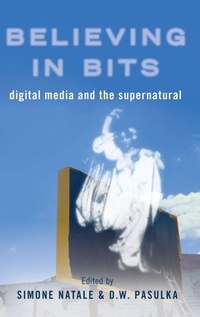
Believing in Bits
Digital Media and the Supernatural
Published on 9. October 2019
Book
Hardback
266 pages
978-0-19-094998-3 (ISBN)
Description
Believing in Bits advances the idea that religious beliefs and practices have become inextricably linked to the functioning of digital media. How did we come to associate things such as mindreading and spirit communications with the functioning of digital technologies? How does the internets capacity to facilitate the proliferation of beliefs blur the boundaries between what is considered fiction and fact? Addressing these and similar questions, the volume challenges and redefines established understandings of digital media and culture by employing the notions of belief, religion, and the supernatural.
Reviews / Votes
It unquestionably achieves the goal to awakening the reader to a relevant and engaging academic discussion about how belief and practice take shape in the encounter digital media. * Melissa E. Maples, Religious Studies Review * Believing in Bits: Digital Media and the Supernatural recognises the co-constitutive nature of belief and technology and provides compelling and smart cross-disciplinary moments demonstrating such entanglements. * Alexia Derbas, Journal of Religion, Media and Digital Culture * Believing in Bits ... unquestionably achieves the goal to awakening the reader to a relevant and engaging academic discussion about how belief and practice take shape in the encounter digital media. * Melissa E. Maples, Uppsala University, Religious Studies Reviews * Human beings and their technological creations, including and especially their modern digital technologies, reflect, express, and intensify their fundamental strangeness. Scholars have long known that the history of religions is intimately related to the history of technology, from the ancient practices of agriculture, writing, the domestication of the horse, and the forging of iron, to the more recent invention of the printing press and the telegraph and telephone. This book takes that key insight into the present and near future, to the cell phone in your pocket, the computer game on your screen, and the VR system strapped around your skull. This book takes that key insight into the human-techno cyborg that is you. * Jeffrey J. Kripal, author of Secret Body: Erotic and Esoteric Currents in the History of Religions * Believing in Bits is a guide to why media technologies are magical: they create beliefs, manipulate thoughts, make us see things. After reading this wonderful collection of essays, you realize why the most natural thing about media is that they are supernatural. This book is full of media archaeological joys and insightful contemporary readings. * Jussi Parikka, Professor of Technological Culture & Aesthetics, University of Southampton *More details
Language
English
Place of publication
New York
United States
Target group
Professional and scholarly
Dimensions
Height: 240 mm
Width: 161 mm
Thickness: 19 mm
Weight
567 gr
ISBN-13
978-0-19-094998-3 (9780190949983)
Copyright in bibliographic data and cover images is held by Nielsen Book Services Limited or by the publishers or by their respective licensors: all rights reserved.
Schweitzer Classification
Other editions
Additional editions
Book
10/2019
Oxford University Press Inc
€56.00
Shipment within 15-20 days
E-Book
09/2019
OUP eBook
€23.99
Available for download
E-Book
09/2019
OUP eBook
€23.99
Available for download
Persons
Simone Natale is a Lecturer in Communication and Media Studies at Loughborough University, UK.
Diana Walsh Pasulka is a Professor of Religious Studies at the University of North Carolina, Wilmington and chair of the Department of Philosophy and Religion.
Diana Walsh Pasulka is a Professor of Religious Studies at the University of North Carolina, Wilmington and chair of the Department of Philosophy and Religion.
Content
Introduction
1: Amazon Can Read Your Mind: A Media Archaeology of the Algorithmic Imaginary
2: Information Theory of the Soul: Spiritualism, Technology, and Science Fiction
3: The Return of the Sonic Ghosts: Phonographic Revenants and Digital Reanimations, from Paleospectography to Hauntology
4: I play, therefore I believe: Religio and faith in digital games
5: Ritual Magic and User Generated Deities on Instagram
6: Instant Karma and Internet Karma: Karmic Memes and Morality on Social Media
7: Disciples of the New Digital Religions: Or, How to Make Your 'Fake' Religion Real
8: Where Soul Meets Technology: Catholic Visionaries and the Stanford Research Institute as Precedents for Human-Machine Interfaces and Social Telepathy Apps
9:Plurality through Imagination: The Emergence of Online Tulpa Communities in the Making of New Identities
10:UFOs, ufologists and digital media in Brazil
11:Augmented Reality, Virtual Reality, and Religion: Past, Present, and Future
12:Algorithm Magic: Gilbert Simondon and Techno-animism
Afterword: Religious and digital imaginaries in parallel lines
1: Amazon Can Read Your Mind: A Media Archaeology of the Algorithmic Imaginary
2: Information Theory of the Soul: Spiritualism, Technology, and Science Fiction
3: The Return of the Sonic Ghosts: Phonographic Revenants and Digital Reanimations, from Paleospectography to Hauntology
4: I play, therefore I believe: Religio and faith in digital games
5: Ritual Magic and User Generated Deities on Instagram
6: Instant Karma and Internet Karma: Karmic Memes and Morality on Social Media
7: Disciples of the New Digital Religions: Or, How to Make Your 'Fake' Religion Real
8: Where Soul Meets Technology: Catholic Visionaries and the Stanford Research Institute as Precedents for Human-Machine Interfaces and Social Telepathy Apps
9:Plurality through Imagination: The Emergence of Online Tulpa Communities in the Making of New Identities
10:UFOs, ufologists and digital media in Brazil
11:Augmented Reality, Virtual Reality, and Religion: Past, Present, and Future
12:Algorithm Magic: Gilbert Simondon and Techno-animism
Afterword: Religious and digital imaginaries in parallel lines