

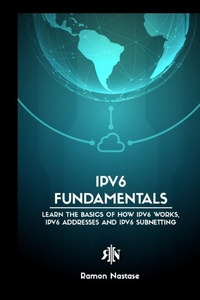
IPv6 Protocol for Beginners
Your Quick Guide for Learning the Fundamentals of the IPv6 Protocol
Published on 29. January 2026
Book
Paperback/Softback
30 pages
979-8-210-19808-2 (ISBN)
Description
Start learning the ins and outs of the IPv6 Protocol with this book!
If you are interested in IPv6 addresses and IPv6 Subnetting, then this book is for you. It will teach you the fundamentals. The ever growing number of Internet connected devices lead to the consumption of all IPv4 addresses. For that a new and better protocol was needed and the result is the IPv6 Protocol.
The IPv6 protocol has its own advantages over the IPv4 Protocol, as it is faster and more secure. But you need to know how to configure a network with this type of address if you want to enjoy all these benefits.
You will be able to enjoy all the major benefits of IPv6 if you read this book cover to cover. And you shouldn't worry about not understanding what is being written here.
The book is made so every beginner gets a grasp of what the author is talking about. By reading it, you will:
- Understand the basic concept of how IPv6 works
- Find out how Subnetting for IPv6 works
- Be able to make the transition between IPv4 and IPv6
- Configure and use IPv6 on devices
Not to mention that you have an extra chapter that will show you how to configure a network with IPv6 on Routers and Windows devices.
Grab a copy of this book today and start configuring a network with IPv6 addresses in no time. You will fully understand what the author has to say and how things work when you have an address of this type! ¿
More details
Language
English
Place of publication
San Francisco
United States
Product notice
Paperback (trade)
Unsewn / adhesive bound
Dimensions
Height: 229 mm
Width: 152 mm
Thickness: 2 mm
Weight
61 gr
ISBN-13
979-8-210-19808-2 (9798210198082)
Copyright in bibliographic data and cover images is held by Nielsen Book Services Limited or by the publishers or by their respective licensors: all rights reserved.
Schweitzer Classification