

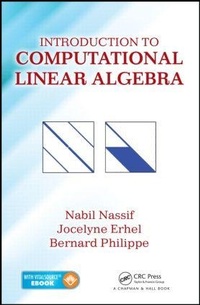
Introduction to Computational Linear Algebra
1st Edition
Published on 26. June 2015
Book
Hardback
262 pages
978-1-4822-5869-1 (ISBN)
Description
Teach Your Students Both the Mathematics of Numerical Methods and the Art of Computer Programming
Introduction to Computational Linear Algebra presents classroom-tested material on computational linear algebra and its application to numerical solutions of partial and ordinary differential equations. The book is designed for senior undergraduate students in mathematics and engineering as well as first-year graduate students in engineering and computational science.
The text first introduces BLAS operations of types 1, 2, and 3 adapted to a scientific computer environment, specifically MATLAB (R). It next covers the basic mathematical tools needed in numerical linear algebra and discusses classical material on Gauss decompositions as well as LU and Cholesky's factorizations of matrices. The text then shows how to solve linear least squares problems, provides a detailed numerical treatment of the algebraic eigenvalue problem, and discusses (indirect) iterative methods to solve a system of linear equations. The final chapter illustrates how to solve discretized sparse systems of linear equations. Each chapter ends with exercises and computer projects.
Introduction to Computational Linear Algebra presents classroom-tested material on computational linear algebra and its application to numerical solutions of partial and ordinary differential equations. The book is designed for senior undergraduate students in mathematics and engineering as well as first-year graduate students in engineering and computational science.
The text first introduces BLAS operations of types 1, 2, and 3 adapted to a scientific computer environment, specifically MATLAB (R). It next covers the basic mathematical tools needed in numerical linear algebra and discusses classical material on Gauss decompositions as well as LU and Cholesky's factorizations of matrices. The text then shows how to solve linear least squares problems, provides a detailed numerical treatment of the algebraic eigenvalue problem, and discusses (indirect) iterative methods to solve a system of linear equations. The final chapter illustrates how to solve discretized sparse systems of linear equations. Each chapter ends with exercises and computer projects.
More details
Language
English
Place of publication
Oxford
United States
Publishing group
Taylor & Francis Inc
Target group
College/higher education
Advanced Undergraduate and Graduate Students in Mathematics, Applied Mathematics, Engineering, and Computational Sciences.
Product notice
sewn/stitched
Cloth over boards
Illustrations
9 s/w Abbildungen, 16 s/w Tabellen
16 Tables, black and white; 9 Illustrations, black and white
Dimensions
Height: 243 mm
Width: 161 mm
Thickness: 20 mm
Weight
533 gr
ISBN-13
978-1-4822-5869-1 (9781482258691)
Copyright in bibliographic data and cover images is held by Nielsen Book Services Limited or by the publishers or by their respective licensors: all rights reserved.
Schweitzer Classification
Other editions
Additional editions
Nabil Nassif | Jocelyne Erhel | Bernard Philippe
Introduction to Computational Linear Algebra
E-Book
06/2015
1st Edition
Chapman & Hall/CRC
€125.99
Available for download
Nabil Nassif | Jocelyne Erhel | Bernard Philippe
Introduction to Computational Linear Algebra
E-Book
06/2015
1st Edition
Chapman and Hall
€125.99
Available for download
Persons
Nabil Nassif is affiliated with the Department of Mathematics at the American University of Beirut, where he teaches and conducts research in mathematical modeling, numerical analysis, and scientific computing. He earned a PhD in applied mathematics from Harvard University under the supervision of Professor Garrett Birkhoff.
Jocelyne Erhel is a senior research scientist and scientific leader of the Sage team at INRIA in Rennes, France. She earned a PhD from the University of Paris. Her research interests include sparse linear algebra and high performance scientific computing applied to geophysics, mainly groundwater models.
Bernard Philippe was a senior research scientist at INRIA in Rennes, France, until 2015 when he retired. He earned a PhD from the University of Rennes. His research interests include matrix computing with a special emphasis on large-sized eigenvalue problems.
Jocelyne Erhel is a senior research scientist and scientific leader of the Sage team at INRIA in Rennes, France. She earned a PhD from the University of Paris. Her research interests include sparse linear algebra and high performance scientific computing applied to geophysics, mainly groundwater models.
Bernard Philippe was a senior research scientist at INRIA in Rennes, France, until 2015 when he retired. He earned a PhD from the University of Rennes. His research interests include matrix computing with a special emphasis on large-sized eigenvalue problems.
Content
Basic Linear Algebra Subprograms: BLAS. Basic Concepts for Matrix Computations. Gauss Elimination and LU Decompositions of Matrices. Orthogonal Factorizations and Linear Least Squares Problems. Algorithms for the Eigenvalue Problem. Iterative Methods for Systems of Linear Equations. Sparse Systems to Solve Poisson Differential Equations. Bibliography. Index.