

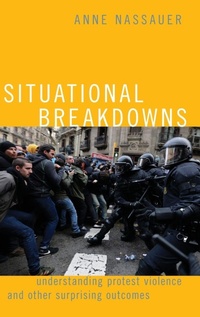
Situational Breakdowns
Understanding Protest Violence and other Surprising Outcomes
Published on 5. September 2019
Book
Hardback
288 pages
978-0-19-092206-1 (ISBN)
Description
In our everyday lives, we rely on routines that make tasks and interactions easier and provide a sense of order--routines of greeting each other, getting to work, organizing the things we do on the job, at the gym, or during family dinners. Yet, we have all experienced situations where routines fail and people behave contrary to expectations.
In Situational Breakdowns, Anne Nassauer demonstrates that when routines break down, surprising outcomes often emerge. Focusing on detailed accounts of peaceful and violent protests from the 1960s until 2010, violent uprisings such as Ferguson 2014, and armed store robberies caught on CCTV, Nassauer argues that by systematically looking at the way situations unfold, clear patterns can be identified for how and why routine interactions break down. Employing over 1,000 visual recordings, documentary sources, interviews with participants, and participant observation with police, she shows which factors can draw us into violent situations and discusses how and why we make uncommon individual and collective decisions. Drawing on insights from sociology, psychology, primatology, international relations, and neuroscience, Nassauer compares situational dynamics with human motivations to demonstrate that our interactions, interpretations, and emotions greatly influence the outcome of situations.
A novel interpretation of surprising social outcomes, Situational Breakdowns reveals that, despite the course of events overriding motivations, people can avoid being caught up in violence, if they know what to look for.
In Situational Breakdowns, Anne Nassauer demonstrates that when routines break down, surprising outcomes often emerge. Focusing on detailed accounts of peaceful and violent protests from the 1960s until 2010, violent uprisings such as Ferguson 2014, and armed store robberies caught on CCTV, Nassauer argues that by systematically looking at the way situations unfold, clear patterns can be identified for how and why routine interactions break down. Employing over 1,000 visual recordings, documentary sources, interviews with participants, and participant observation with police, she shows which factors can draw us into violent situations and discusses how and why we make uncommon individual and collective decisions. Drawing on insights from sociology, psychology, primatology, international relations, and neuroscience, Nassauer compares situational dynamics with human motivations to demonstrate that our interactions, interpretations, and emotions greatly influence the outcome of situations.
A novel interpretation of surprising social outcomes, Situational Breakdowns reveals that, despite the course of events overriding motivations, people can avoid being caught up in violence, if they know what to look for.
Reviews / Votes
a nuanced and creative scholarly work that adds markedly to existing knowledge onmultiple fronts. It can be alternatively read as a counterintuitive study on social movements, policing, and protests, as a microlevel inquiry of violence, or as a situational analysis of social outcomes. Hence, it should certainly attract readers from different disciplines. * Kivanc Atak, American Journal of Sociology *More details
Series
Language
English
Place of publication
New York
United States
Target group
Professional and scholarly
Illustrations
6 Line drawings; 1 Halftone
Dimensions
Height: 240 mm
Width: 161 mm
Thickness: 20 mm
Weight
593 gr
ISBN-13
978-0-19-092206-1 (9780190922061)
Copyright in bibliographic data and cover images is held by Nielsen Book Services Limited or by the publishers or by their respective licensors: all rights reserved.
Schweitzer Classification
Other editions
Additional editions
E-Book
06/2019
1st Edition
OUP eBook
€20.99
Available for download
E-Book
06/2019
1st Edition
OUP eBook
€20.99
Available for download
Person
Anne Nassauer is Assistant Professor of Sociology at the John F. Kennedy Institute for North American Studies at Freie Universitaet Berlin. Her research focuses on violence and deviant action, collective behavior, and the use of video data for scientific inquiry. Her work lies at the intersection of sociology, social psychology, and criminology, with the ultimate goal of better understanding human action and interaction.
Content
Preface
Introduction: Situational Collapses and Eruptions
1. Protest Groups and Physical Violence
2. The (Lack of) Power of the Violent Few
3. The Police's Fault?
4. Losing Control
5. Expecting the Worst
6. Uncertainty
7. In the Tunnel of Violence
8. How to Keep Protests Peaceful
9. Situational Breakdowns beyond Protest Violence
Conclusion
References
Appendices
A. Studying Situational Dynamics in the 21st Century
B. Methodological Notes on Studying Protest Violence
C. Methodological Notes on Studying Uprisings
D. Methodological Notes on Studying Robberies
Introduction: Situational Collapses and Eruptions
1. Protest Groups and Physical Violence
2. The (Lack of) Power of the Violent Few
3. The Police's Fault?
4. Losing Control
5. Expecting the Worst
6. Uncertainty
7. In the Tunnel of Violence
8. How to Keep Protests Peaceful
9. Situational Breakdowns beyond Protest Violence
Conclusion
References
Appendices
A. Studying Situational Dynamics in the 21st Century
B. Methodological Notes on Studying Protest Violence
C. Methodological Notes on Studying Uprisings
D. Methodological Notes on Studying Robberies