


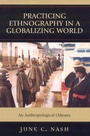
Practicing Ethnography in a Globalizing World
An Anthropological Odyssey
Published on 28. December 2006
Book
Hardback
304 pages
978-0-7591-0880-6 (ISBN)
Description
In this book distinguished anthropologist June Nash demonstrates how ethnography can illuminate a wide array of global problems. She describes encounters with an urban U.S. community undergoing de-industrialization, with Mandalay rice cultivators accommodating to post-World War II independence through animistic pratices, with Mayans mobilizing for autonomy, and with Andean peasants and miners confronting the International Monetary Fund. Havin worked in a great variety of cultural settings around the world, Nash challenges us to expand our anthropological horizons and to think about local problems in a global manner.
Reviews / Votes
For the past fifty years June Nash has been consistently five or ten years ahead of her time. The topics on which she has made ground breaking interventions-feminist theory, local-global relations, ethnography of powerful institutions, consciousness and resistance, social movements, indigenous empowerment, militarization and empire, ethics and politics of research- document anthropology's major preoccupations since the 1950s. This volume offers a comprehensive record of Nash's achievements confirms her place as one of the most influential and accomplished anthropologists of our times. We are well advised to read closely, to appreciate how she has shaped our field, and to glean some clues about what is coming next. -- Charles R. Hale, University of California, Santa Barbara Practicing Anthropology in a Globalized Worldoffers students of anthropology and globalization a unique tour of the intellectual and political development of one of the most inspiring contemporary cultural anthropologists while also providing a world tour of social and cultural movements that have staked out interconnected terrains of resistance to U.S. Empire-building, global capital, and political and cultural forces of homogenization. Through in-depth essays that bring to life the contradictory politics of cultural and political economy in a transnational world, June Nash provides her readers with an insightful comparative collection that adds depth and breadth to the ethnography of globalization through time. -- Lynn Stephen, University of Oregon [an] important volume... Summing Up: Recommended. * Choice Reviews * This new collection of writings by June Nash is eagerly anticipated. Practicing Ethnography in a Globalizing World encompasses the full sweep of Nash's research on three continents during more than fifty years of her distinguished career as an anthropologist. These essays will be read and re-read by researchers, students, and activists who will find engaged scholarship at its best. Looking back on her long-term work on indigenous cultural identities, women in social movements, and global political economy, June Nash reflects on what we can learn from the past and how we can work toward a more just future through ethnographic practice. A tour de force. -- Florence E. Babb, Author of After Revolution: Mapping Gender and Cultural Politics in Neoliberal Nicaragua and Vada Allen Yeomans Professor of Wo This new collection of writings by June Nash is eagerly anticipated. Practicing Ethnography in a Globalizing World encompasses the full sweep of Nash's research on three continents during more than fifty years of her distinguished career as an anthropologist. These essays will be read and re-read by researchers, students, and activists who will find engaged scholarship at its best. Looking back on her long-term work on indigenous cultural identities, women in social movements, and global political economy, June Nash reflects on what we can learn from the past and how we can work toward a more just future through ethnographic practice. A tour de force. -- Florence E. Babb, Author of <I>After Revolution: Mapping Gender <I> and <I>Cultural Politics in Neoliberal Nicaragua<I> and Vada Allen Yeomans ProMore details
Language
English
Place of publication
California
United States
Dimensions
Height: 240 mm
Width: 161 mm
Thickness: 21 mm
Weight
625 gr
ISBN-13
978-0-7591-0880-6 (9780759108806)
Copyright in bibliographic data and cover images is held by Nielsen Book Services Limited or by the publishers or by their respective licensors: all rights reserved.
Schweitzer Classification
Other editions
Additional editions

E-Book
12/2006
1st Edition
AltaMira Press
€42.49
Available for download
E-Book
12/2006
1st Edition
AltaMira Press
€42.49
Available for download
Person
June C. Nash is Distinguished Professor Emerita at the City University of New York, Graduate Center and City College. She is the author of In the Eyes of the Ancestors: Belief and Behavior in a Mayan Community; We Eat the Mines and the Mines Eat Us: Dependency and Exploitation in Bolivian Mining Communities; and a family autobiography with Juan Rojas, I Spent My Life in the Mines. As a result of her engagement with feminist and working class movements, she has also co-edited with Helen Safa Sex and Class in Latin America, and Women and Change in Latin America; with M. Patricia Fernandez Kelly, Women, Men, and the International Division of Labor; and authored From Tank Town to High Tech: The Clash of Community and Industrial Cycles.
Content
4 Part I: Paradigms and Postures
5 When Isms Become Wasms: Paradigms Lost and Regained
6 The Notion of the Limited Good and the Specter of the Unlimited Good
7 Women in Between: Globalization and the New Enlightenment
8 Part II: Reflections in the Ethnographic Mirror
9 Multiple Perspectives on Burmese Buddhism and Nat Worship
10 Part III: Engagement in Social Movements Today
11 Social Movements in Global Circuits
12 Part IV: The Hobbesian World of Terror and Violence
13 The Export of Militarization: Counterinsurgency Warfare in the Periphery
14 At Home with the Military-Industrial Complex
15 The Limits of Naivete in Anthropological Fieldwork: The 1954 U.S. Instigated Coup in Guatemala
15 Interpreting Social Movements: Bolivian Resistance to Economic Conditions Imposed by the IMF
5 When Isms Become Wasms: Paradigms Lost and Regained
6 The Notion of the Limited Good and the Specter of the Unlimited Good
7 Women in Between: Globalization and the New Enlightenment
8 Part II: Reflections in the Ethnographic Mirror
9 Multiple Perspectives on Burmese Buddhism and Nat Worship
10 Part III: Engagement in Social Movements Today
11 Social Movements in Global Circuits
12 Part IV: The Hobbesian World of Terror and Violence
13 The Export of Militarization: Counterinsurgency Warfare in the Periphery
14 At Home with the Military-Industrial Complex
15 The Limits of Naivete in Anthropological Fieldwork: The 1954 U.S. Instigated Coup in Guatemala
15 Interpreting Social Movements: Bolivian Resistance to Economic Conditions Imposed by the IMF