

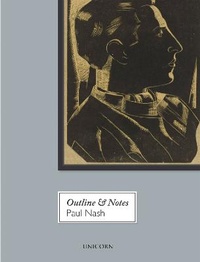
Outline & Notes
An Autobiography
Book
Paperback/Softback
400 pages
978-1-910787-60-1 (ISBN)
Description
Trained at the Slade School of Art, and following the romantic traditions of first Rossetti
and then Blake, Paul Nash is regarded as one of the twentieth century's most successful
artists. His decimated landscapes of World War I are perhaps the most memorable
painted by any official war artist.
Following the war, Nash continued to paint landscapes finding inspiration in ancient
burial mounds and iron age forts. It has been said of Nash that `no artist has interpreted
the beauty and rhythm of the English countryside as perfectly as he'. His paintings
gradually became more abstract and he became a leading exponent of the Surrealism
movement. Everyday objects placed into the scenes lent them new meaning and
symbolism. He was also a prolific book illustrator, textile designer, theatre designer
and photographer. World War II saw him undertake Official War Artist duties for a
second time and his anthropomorphic depictions of aircraft and his symbolically rich
landscapes are some of the best known artworks from the period.
He was also a wonderful writer. This autobiography - sadly filed way at the outbreak
of World War II and unfinished - paints a vivid picture of the early part of Nash's
life. Enticingly, his biographical notes, also reproduced in this edition, offer a skeletal
framework for the rest of the book.
and then Blake, Paul Nash is regarded as one of the twentieth century's most successful
artists. His decimated landscapes of World War I are perhaps the most memorable
painted by any official war artist.
Following the war, Nash continued to paint landscapes finding inspiration in ancient
burial mounds and iron age forts. It has been said of Nash that `no artist has interpreted
the beauty and rhythm of the English countryside as perfectly as he'. His paintings
gradually became more abstract and he became a leading exponent of the Surrealism
movement. Everyday objects placed into the scenes lent them new meaning and
symbolism. He was also a prolific book illustrator, textile designer, theatre designer
and photographer. World War II saw him undertake Official War Artist duties for a
second time and his anthropomorphic depictions of aircraft and his symbolically rich
landscapes are some of the best known artworks from the period.
He was also a wonderful writer. This autobiography - sadly filed way at the outbreak
of World War II and unfinished - paints a vivid picture of the early part of Nash's
life. Enticingly, his biographical notes, also reproduced in this edition, offer a skeletal
framework for the rest of the book.
More details
Series
Edition
New edition
Language
English
Place of publication
London
United Kingdom
Publishing group
Unicorn Publishing Group
Edition type
New edition
Illustrations
8 Illustrations
Dimensions
Height: 193 mm
Width: 140 mm
ISBN-13
978-1-910787-60-1 (9781910787601)
Copyright in bibliographic data and cover images is held by Nielsen Book Services Limited or by the publishers or by their respective licensors: all rights reserved.
Schweitzer Classification
Person
Paul Nash (1889 - 1946) was a British landscape painter who specialised in oils and
watercolours. He was also a book illustrator, photographer, writer and designer. He
was a leading proponent of the Surrealist movement, and he was one of only a select
few who was made Official War Artist during both World wars.
watercolours. He was also a book illustrator, photographer, writer and designer. He
was a leading proponent of the Surrealist movement, and he was one of only a select
few who was made Official War Artist during both World wars.