

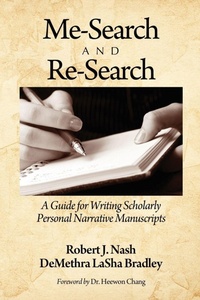
Me-Search and Re-Search
A Guide for Writing Scholarly Personal Narrative Manuscripts
Will be published approx. on 9. March 2011
Book
Paperback/Softback
222 pages
978-1-61735-393-2 (ISBN)
Description
What we intend to do in this book is to explain, and exemplify, in a nuts-and-bolts way, what we are calling Scholarly Personal Narrative (SPN) writing.
This is a genre created over 15 years ago by Robert, one of the co-authors of this book. The other co-author, DeMethra, has actually written a thesis and dissertation using this genre, so she brings an author's direct SPN experience to the table. Both of us co-teach a course that we call "Scholarly Personal Narrative Writing for Pre-Professionals and Professionals."
In the chapters that follow, we will present a step-by-step approach for composing an SPN manuscript. The book will be comprised of four general parts, consisting of several short, practical chapters, written in non-technical language. We will write each of the chapters as a way of responding to the most common questions that our students have raised about SPN writing through the years. We will attempt to write as we teach, with no frills and with clarity, empathy, and understanding. We will also provide several SPN writing examples, as well as authorial toolbox tips, throughout the book. In addition, we will conclude with a bibliography of the most relevant personal narrative writing guides we have been able to muster.
Our desire is to minimize the number of in-text citations and references in order to maximize the space for us to present a useful, nuts-and-bolts guide to writing, as well as a realistic, down-to-earth rationale for scholarly personal narrative writing in the academy. After reading the book, and practicing the writing exercises, undergraduate and graduate students will be able to author research papers, theses, and dissertations using the Scholarly Personal Narrative research genre. Hundreds of students have done this already throughout the country.
This is a genre created over 15 years ago by Robert, one of the co-authors of this book. The other co-author, DeMethra, has actually written a thesis and dissertation using this genre, so she brings an author's direct SPN experience to the table. Both of us co-teach a course that we call "Scholarly Personal Narrative Writing for Pre-Professionals and Professionals."
In the chapters that follow, we will present a step-by-step approach for composing an SPN manuscript. The book will be comprised of four general parts, consisting of several short, practical chapters, written in non-technical language. We will write each of the chapters as a way of responding to the most common questions that our students have raised about SPN writing through the years. We will attempt to write as we teach, with no frills and with clarity, empathy, and understanding. We will also provide several SPN writing examples, as well as authorial toolbox tips, throughout the book. In addition, we will conclude with a bibliography of the most relevant personal narrative writing guides we have been able to muster.
Our desire is to minimize the number of in-text citations and references in order to maximize the space for us to present a useful, nuts-and-bolts guide to writing, as well as a realistic, down-to-earth rationale for scholarly personal narrative writing in the academy. After reading the book, and practicing the writing exercises, undergraduate and graduate students will be able to author research papers, theses, and dissertations using the Scholarly Personal Narrative research genre. Hundreds of students have done this already throughout the country.
More details
Language
English
Place of publication
Charlotte
United States
Publishing group
Emerald Publishing Inc
Target group
Professional and scholarly
Dimensions
Height: 234 mm
Width: 156 mm
Thickness: 13 mm
Weight
345 gr
ISBN-13
978-1-61735-393-2 (9781617353932)
Copyright in bibliographic data and cover images is held by Nielsen Book Services Limited or by the publishers or by their respective licensors: all rights reserved.
Schweitzer Classification
Other editions
Additional editions
Robert Nash | Demethra Lasha Bradley
Me-Search and Re-Search
A Guide for Writing Scholarly Personal Narrative Manuscripts
E-Book
03/2011
1st Edition
Information Age Publishing
from
€62.33
Available for download
Content
Part I. Setting The Stage For Writing An SPN.
Chapter 1. What Our Book Is About.
Chapter 2. Why Can't I Write More Personally, More Honestly?
Chapter 3. Autoethnographies, Memoirs, Personal Narrative Essays, Autobiographies.
Chapter 4. Okay Then! What Exactly Is Scholarly Personal Narrative Writing?
Part II. The Four Components Of SPN: Pre-Search, Me-Search, Re-Search, We-Search.
Chapter 5. How Do You Get Started?
Chapter 6. DeMethra's Pre-Search Dissertation Process.
Chapter 7. Speaking to All the Me-Search Self-Doubters.
Chapter 8. Tell Your Story, Speak Your Truth.
Chapter 9. The SPN Way to Think About Research.
Chapter 10. The Relationship of Art to Truth in SPN Writing.
Chapter 11. The Centrality of Theme-Search in SPN Research.
Chapter 12. Moving from the Pre-, the Me-, and the Re-, to the We.
Chapter 13. DeMethra's Use of We-Search and Universalizability in Her Dissertation.
Part III. The Nuts And Bolts SPN Toolbox.
Chapter 14. The Nuts and Bolts SPN Toolbox.
Part IV. Additional Resources For SPN Writers.
Chapter 15. Our SPN Course Syllabus.
Chapter 16. Putting It All Together.
Chapter 17. How to Deal with PSPND Syndrome.
Chapter 18. Creating an SPN Code of Ethics.
Chapter 19. How to Create Faculty Support for SPN Writing.
References.
Chapter 1. What Our Book Is About.
Chapter 2. Why Can't I Write More Personally, More Honestly?
Chapter 3. Autoethnographies, Memoirs, Personal Narrative Essays, Autobiographies.
Chapter 4. Okay Then! What Exactly Is Scholarly Personal Narrative Writing?
Part II. The Four Components Of SPN: Pre-Search, Me-Search, Re-Search, We-Search.
Chapter 5. How Do You Get Started?
Chapter 6. DeMethra's Pre-Search Dissertation Process.
Chapter 7. Speaking to All the Me-Search Self-Doubters.
Chapter 8. Tell Your Story, Speak Your Truth.
Chapter 9. The SPN Way to Think About Research.
Chapter 10. The Relationship of Art to Truth in SPN Writing.
Chapter 11. The Centrality of Theme-Search in SPN Research.
Chapter 12. Moving from the Pre-, the Me-, and the Re-, to the We.
Chapter 13. DeMethra's Use of We-Search and Universalizability in Her Dissertation.
Part III. The Nuts And Bolts SPN Toolbox.
Chapter 14. The Nuts and Bolts SPN Toolbox.
Part IV. Additional Resources For SPN Writers.
Chapter 15. Our SPN Course Syllabus.
Chapter 16. Putting It All Together.
Chapter 17. How to Deal with PSPND Syndrome.
Chapter 18. Creating an SPN Code of Ethics.
Chapter 19. How to Create Faculty Support for SPN Writing.
References.