

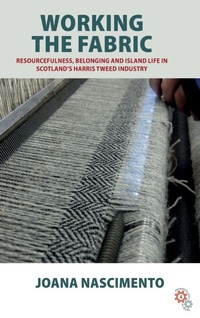
Working the Fabric
Resourcefulness, Belonging and Island Life in Scotland's Harris Tweed Industry
Published on 14. April 2023
Book
Hardback
230 pages
978-1-80073-882-9 (ISBN)
Description
Trademark-protected since 1910, the famous woollen cloth known as Harris Tweed can only be produced in the Outer Hebrides of Scotland - yet it is exported to over 50 countries around the world. Examining contemporary experiences of work and life, this book is the first in-depth anthropological study of the renowned textile industry, complementing and updating existing historical and ethnographic research. Drawing on one year of ethnographic fieldwork research in the Outer Hebrides, it offers an intimate account of industry workers' lived experiences and contributes to anthropological debates on work and labour, cultural production, inclusive belonging and place-making in global capitalism.
Reviews / Votes
"Nascimento provides a lively and ethnographically rich account of how this iconic fashion product is made and what it means for those who produce it." * Exertions"This book is a beautifully-crafted ethnography of the multiple and complex meanings of weaving among those involved in the Harris Tweed industry. The book takes the central concept of 'work' but expands it through both ethnography and theory." * Magnus Course, University of Edinburgh
"This is an excellent book ... It is a smart and refreshing contribution to the anthropology of work and labour, showing the importance of place and place-making in the production of a global commodity. I wish more academic books were written in the same jargon-free and engaging style." * Rebecca Prentice, University of Sussex
More details
Series
Language
English
Place of publication
Oxford
United Kingdom
Target group
Professional and scholarly
Product notice
Library binding
Illustrations
25 Illustrations
Dimensions
Height: 235 mm
Width: 157 mm
Thickness: 17 mm
Weight
490 gr
ISBN-13
978-1-80073-882-9 (9781800738829)
DOI
10.3167/9781800738829
Copyright in bibliographic data and cover images is held by Nielsen Book Services Limited or by the publishers or by their respective licensors: all rights reserved.
Schweitzer Classification
Other editions
Additional editions
Joana Nascimento
Working the Fabric
Resourcefulness, Belonging and Island Life in Scotland's Harris Tweed Industry
E-Book
06/2026
1st Edition
Berghahn Books
€19.49
Available for download
Joana Nascimento
Working the Fabric
Resourcefulness, Belonging and Island Life in Scotland's Harris Tweed Industry
E-Book
04/2023
1st Edition
Berghahn Books
€19.49
Available for download
Person
Joana Nascimento is a social anthropologist based at the University of Cambridge, where she works as a postdoctoral teaching and research associate. Her research explores the social, cultural and political-economic complexities of contemporary work and livelihood strategies.
Content
List of Figures
Acknowledgments
Note on Pseudonyms
List of Abbreviations
Introduction: Working the Fabric
Chapter 1. Where Harris Tweed is Made: 'Remoteness', Resourcefulness and Island Life
Chapter 2. Following the Tweed Van: Road Stories, Productive Encounters, and Local Experiences of a Global Industry
Chapter 3. In the Loom Shed: Time, Work and Value in Harris Tweed Weaving
Chapter 4. Weaving Lives and Livelihoods: Uncertainty, Anticipation and Personal Narratives
Chapter 5. Manufacturing Repertoires: Production, 'Heritage' and Place-Making
Conclusion: 'Finishing' as a New Beginning
References
Index
Acknowledgments
Note on Pseudonyms
List of Abbreviations
Introduction: Working the Fabric
Chapter 1. Where Harris Tweed is Made: 'Remoteness', Resourcefulness and Island Life
Chapter 2. Following the Tweed Van: Road Stories, Productive Encounters, and Local Experiences of a Global Industry
Chapter 3. In the Loom Shed: Time, Work and Value in Harris Tweed Weaving
Chapter 4. Weaving Lives and Livelihoods: Uncertainty, Anticipation and Personal Narratives
Chapter 5. Manufacturing Repertoires: Production, 'Heritage' and Place-Making
Conclusion: 'Finishing' as a New Beginning
References
Index