

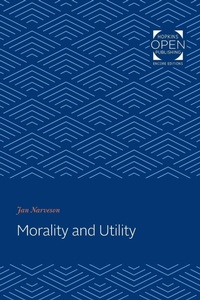
Morality and Utility
Published on 26. January 2020
Book
Paperback/Softback
315 pages
978-1-4214-3091-1 (ISBN)
Description
Originally published in 1967. In the past half-century, Utilitarianism has fallen out of favor among professional philosophers, except in such "amended" forms as "Ideal" and "Rule" Utilitarianism. Professor Narveson contends that amendments and qualifications are unnecessary and misguided, and that a careful interpretation and application of the original theory, as advocated by Bentham, the Mills, and Sidgwick, obviates any need for modification. Drawing on the analytical work of such influential recent thinkers as Stevenson, Toulmin, Hare, Nowell-Smith, and Baier, the author attempts to draw a more careful and detailed picture than has previously been offered of the logical status and workings of the Principle of Utility. He then turns to the traditional objections to the theory as developed by such respected thinkers as Ross, Frankena, Hart, and Rawls and attempts to show how Utilitarianism can account for our undoubted obligations in the areas of punishment, promising, distributive justice, and the other principal moral convictions of mankind. He contends that the Principle of Utility implies whatever is recognized to be clearly true in these convictions and that it leaves room to doubt whatever is doubtful in them.
Narveson concludes with a rationally forceful proof of the Principle of Utility. In the course of this argument, which draws on the most widely accepted recent findings in analytical ethics, Narveson discovers an essential identity between the ethical outlooks of Kant and of Mill, which are traditionally held to be antithetical. Both thinkers, he shows, center on the principle that the interests of others are to be regarded as equal in value to one's own. A new view of Mill's celebrated "proof of utilitarianism" is developed in the course of the discussion.
Narveson concludes with a rationally forceful proof of the Principle of Utility. In the course of this argument, which draws on the most widely accepted recent findings in analytical ethics, Narveson discovers an essential identity between the ethical outlooks of Kant and of Mill, which are traditionally held to be antithetical. Both thinkers, he shows, center on the principle that the interests of others are to be regarded as equal in value to one's own. A new view of Mill's celebrated "proof of utilitarianism" is developed in the course of the discussion.
More details
Language
English
Place of publication
Baltimore, MD
United States
Target group
Professional and scholarly
College/higher education
Product notice
Paperback (trade)
Dimensions
Height: 229 mm
Width: 152 mm
Thickness: 19 mm
Weight
518 gr
ISBN-13
978-1-4214-3091-1 (9781421430911)
DOI
10.1353/book.67855
Copyright in bibliographic data and cover images is held by Nielsen Book Services Limited or by the publishers or by their respective licensors: all rights reserved.
Schweitzer Classification
Other editions
Additional editions
Jan Narveson
Morality and Utility
E-Book
01/2020
Johns Hopkins University Press
€34.49
Available for download

Jan Narveson
Morality and Utility
Book
08/1967
Johns Hopkins University Press
€33.02
Article not available for order
Person
Jan Narveson is a professor of philosophy emeritus at the University of Waterloo, Ontario.
Content
Preface
I. Introduction: Utilitarianism and Philosophical Ethics
II. The Locigal Status of Moral Principles
III. Utility
IV. Formalism
V. Tasks and Methods
VI. The Utilitarian Theory of "Strict" Obligation
VII. Distributive Justice
VIII. Rounding Out the System
IX. Foundations
Index
I. Introduction: Utilitarianism and Philosophical Ethics
II. The Locigal Status of Moral Principles
III. Utility
IV. Formalism
V. Tasks and Methods
VI. The Utilitarian Theory of "Strict" Obligation
VII. Distributive Justice
VIII. Rounding Out the System
IX. Foundations
Index